
An Essential Guide to One-Time Password Tokens
A one-time password token generates a fresh code for every login, but not all OTPs are equal. Here's how HOTP and TOTP work under the hood, how hardware and software tokens compare, and why passkeys are the next step.

Why Every Security Team Needs to Understand the One-Time Password Token
A one-time password token is a hardware device or software application that generates a short, temporary numeric code — valid for a single login session or a fixed time window — used as a second factor alongside a password to verify identity.
Quick answer: What is an OTP token?
| Concept | Detail |
|---|---|
| What it generates | A 6-digit code that expires after one use or within 30–60 seconds |
| How it works | Combines a shared secret (seed) with a moving factor (time or counter) using HMAC cryptography |
| Main types | Hardware key fobs, display cards, and software authenticator apps |
| Primary standards | HOTP (RFC 4226) and TOTP (RFC 6238) |
| Why it matters | Prevents replay attacks — stolen codes are useless after expiry |
Compromised credentials are a factor in the vast majority of data breaches. Static passwords fail not because users pick bad ones — they fail because any reusable secret can be stolen, phished, or replayed. OTP tokens were designed to close that gap.
And for most of the 2000s and 2010s, they did the job reasonably well.
But the threat landscape has moved faster than the technology. Automated phishing toolkits can now intercept and relay a valid OTP code to the real site in real time — before it expires. Telegram-based interception bots targeting SMS codes have claimed efficacy rates around 80%. The 0ktapus campaign compromised over 100 companies by automating exactly this attack against employees' phones.
OTP tokens are not broken — but they are showing their age.
This guide covers how OTP tokens work at the cryptographic level, where they still provide genuine value, where they fail, and what a realistic migration path to phishing-resistant authentication looks like for teams operating under real budget and operational constraints.
What is a One-Time Password Token and How Does It Work?
To understand how a one-time password token works, it helps to look at what happens behind the scenes when a user enrolls a device and logs in. Unlike traditional static passwords, an OTP relies on a dynamic, cryptographically secure calculation that happens simultaneously on both the client device (the token) and the authentication server.
At the heart of this process is the shared secret, also known as the cryptographic seed. During the enrollment phase, this seed is generated by the server and securely provisioned onto the user's token. For software authenticator apps, this is typically done by scanning a QR code that contains the seed. For hardware tokens, the seed is pre-programmed into the physical microchip at the factory and imported into the enterprise's authentication server via a secure file.
Once the seed is in place, both the token and the server use a specific moving factor to generate matching codes. The moving factor acts as a variable that changes constantly, ensuring that the resulting passcode is unique every time. When a user attempts to log in, the token runs the seed and the current moving factor through a cryptographic hashing function to produce a short string of numbers, usually six digits long. You can read more about this on our page about the one-time password generator.
When the user enters this code, the authentication server runs the exact same calculation. If the server’s calculated code matches the code submitted by the user, the server grants access. This dynamic process provides a robust defense against replay attacks; because the code is valid only once and expires quickly, an attacker who intercepts a used code cannot use it to gain access later. This process establishes clear proof of possession, verifying that the user has physical or logical control over the registered token device at the exact moment of authentication. For a deeper dive into this concept, check out how one-time password token explained how otp tokens strengthen enterprise authentication details these mechanics.
Cryptographic Standards: HOTP vs. TOTP
The standardized algorithms that govern how these tokens calculate passwords were developed by the Initiative for Open Authentication (OATH). These open standards ensure that tokens from different hardware manufacturers can interoperate seamlessly with various enterprise identity providers. Understanding these algorithms is a key part of mastering the concepts covered in our authentication protocols complete guide.
Both standards rely on Hashed Message Authentication Code (HMAC) algorithms, which typically utilize cryptographic hash functions like SHA-1, SHA-256, or SHA-512 to securely bind the shared secret with the moving factor.
Event-Based One-Time Password Token Mechanics (HOTP)
The event-based standard, defined in RFC 4226: HOTP: An HMAC-Based One-Time Password Algorithm | RFC Editor , uses an incrementing counter as its moving factor.
Every time a user presses the physical button on an HOTP hardware token, or requests a new code in an HOTP app, the local counter increments by one. The algorithm hashes the shared secret and the counter value, then performs a process called dynamic truncation. Dynamic truncation extracts a 31-bit binary value from the 160-bit HMAC-SHA-1 output and converts it into a human-readable 6-to-8-digit number.
Because the counter only increments when a code is generated, HOTP tokens can easily fall out of sync with the server. For example, if a user accidentally presses the button on their physical key fob three times while it is in their pocket, the token's counter will be three steps ahead of the server's counter.
To handle this counter desynchronization, authentication servers implement a look-ahead window. This window allows the server to calculate and check a set number of future codes (for instance, the next 20 possible values) to see if one matches the user's input. Additionally, servers must enforce strict throttling parameters. Without brute-force throttling, an attacker could try thousands of sequential codes to guess the current value within the look-ahead window.
Time-Based One-Time Password Token Mechanics (TOTP)
To solve the synchronization issues inherent in HOTP, the industry developed the time-based standard, specified in RFC 6238 - TOTP: Time-Based One-Time Password Algorithm . This method has become the dominant standard for modern authenticator apps and is explored extensively in our guide on totp a core method for modern authentication.
Instead of an incrementing counter, TOTP uses the current Unix epoch time as its moving factor. The current Unix time (the number of seconds elapsed since January 1, 1970) is divided by a defined time step interval — almost always 30 or 60 seconds. The result of this division is an integer value that serves as the counter for the HMAC calculation.
Because TOTP relies on time, both the token and the server must agree on the current time. To account for minor differences in internal system clocks, authentication servers allow for clock drift. The server will typically validate codes from the current time step as well as one step immediately preceding and following it. This 30-to-60-second validity window naturally mitigates the risk of desynchronization without requiring a complex look-ahead window.
Hardware vs. Software OTP Tokens: A Comparative Analysis
When designing an enterprise multi-factor authentication policy, security teams must choose between physical hardware key fobs and software-based authenticator apps. To help you plan your deployment, you can consult our two-factor authentication setup guide 2026 or check out our rankings in the best 2 factor authenticator guide 2026.
The table below breaks down how these two form factors compare across critical operational, financial, and security vectors:
| Evaluation Vector | Hardware OTP Tokens | Software OTP Apps |
|---|---|---|
| Form Factors | Keychain fobs, credit-card-sized display cards, USB keys. | Mobile applications (e.g., Google Authenticator, Microsoft Authenticator). |
| Upfront Financial Cost | Moderate to High ($10 to $30+ per unit depending on bulk pricing). | Extremely Low (typically free or included with the identity provider license). |
| Deployment & Logistics | Complex; requires physical shipping, inventory management, and tracking. | Simple; users download the application directly from public app stores. |
| IT Helpdesk Overhead | High; requires manual replacement when batteries die or devices are lost. | Moderate; requires identity verification and QR code regeneration when users swap phones. |
| Battery & Device Lifecycle | Limited; internal lithium batteries typically last 3 to 5 years and cannot be replaced. | Dependent entirely on the lifecycle of the user's personal or corporate smartphone. |
| Offline Generation | Excellent; generates codes locally without needing cellular network or internet access. | Excellent; runs locally on the mobile OS without requiring active data connections. |
| Physical Attack Surface | Low; highly isolated, tamper-resistant microchips with no network connection. | Vulnerable to host mobile OS compromises, malware, and screen-scraping apps. |
| User Experience Friction | Moderate; users must carry a physical accessory and manually type in the code. | Low; users can copy/paste codes on-device or utilize push-notification approvals. |
Security Vulnerabilities and Real-World Threat Vectors
While OTP tokens are vastly superior to static passwords, they are not a silver bullet. As detailed on One-time passwords (OTP) - Security | MDN , the security of an OTP relies heavily on the confidentiality of the delivery channel and the context of the authentication session. For a broader look at how these vulnerabilities fit into the larger security picture, see our multi-factor authentication complete guide.
Real-Time Phishing & MitM Proxies
The most critical weakness of any OTP token is that it only verifies what was entered, not where it was entered. This structural limitation has made OTPs highly vulnerable to modern, automated Man-in-the-Middle (MitM) reverse-proxy phishing toolkits like Evilginx.
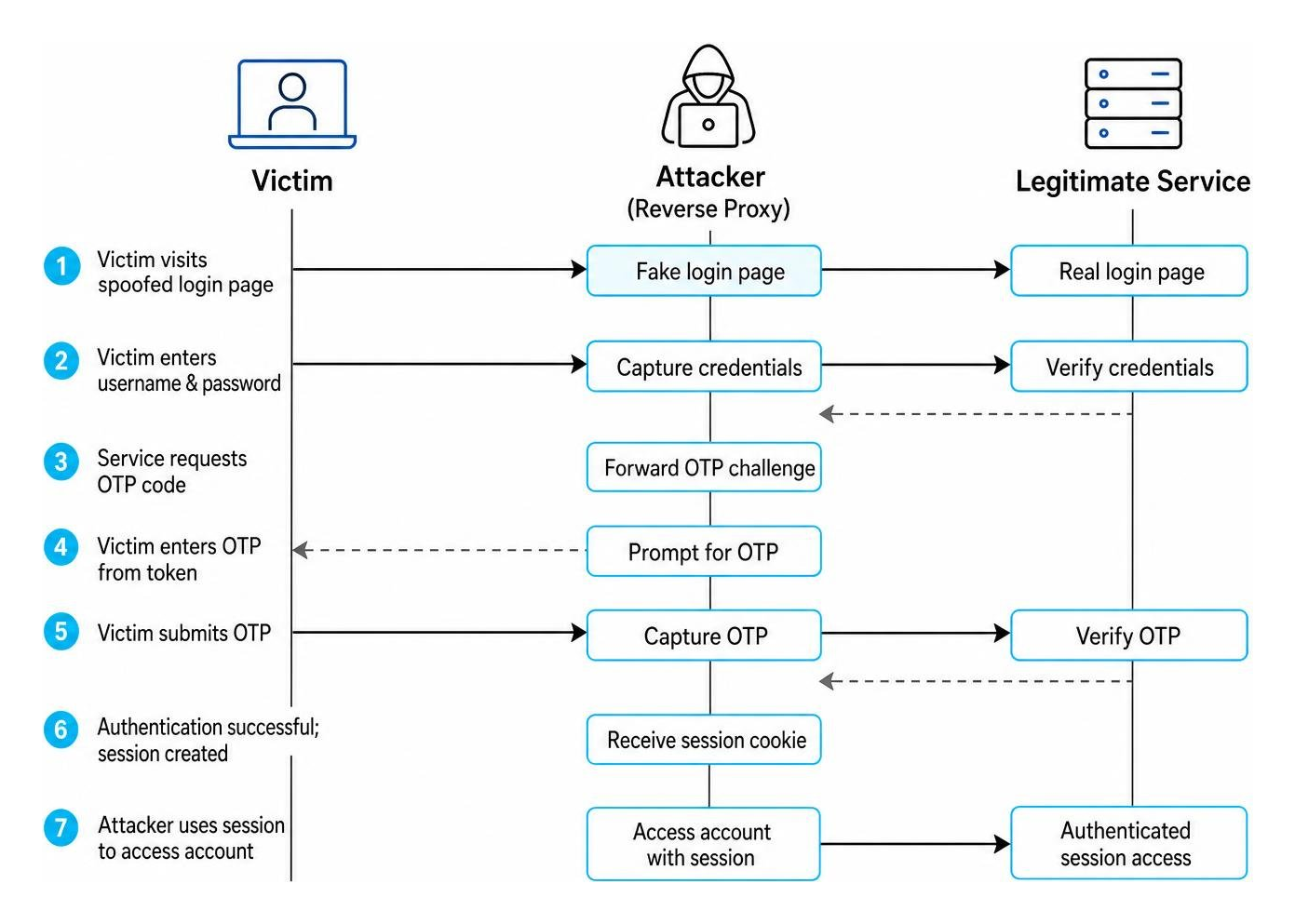
In a reverse-proxy attack, the threat actor sets up a convincing spoofed login page that sits between the victim and the legitimate service. When the victim enters their username and password, the proxy forwards those credentials to the real service in real time. The real service then requests an OTP code. The victim, believing they are on the legitimate site, generates a code from their token and enters it into the spoofed page. The proxy immediately relays that valid OTP code to the real service, completes the authentication process, and intercepts the resulting session cookie. Once the attacker has the session cookie, they can bypass the MFA layer entirely.
Social Engineering & Interception
Attackers have also turned to automated social engineering to bypass OTP protections. Telegram-based OTP interception bots (such as SMSRanger and SMS Buster) have democratized credential harvesting. These services allow low-skilled attackers to initiate automated spoofed phone calls that mimic a victim's bank or IT helpdesk. The bot convinces the victim that their account is under threat and prompts them to type the OTP code generated by their token into their phone's keypad. The bot then instantly relays this code back to the attacker's control panel.
In high-profile corporate environments, identity-focused threat groups like Scattered Spider (the actors behind the infamous 0ktapus campaigns) have successfully bypassed OTP barriers by targeting IT helpdesks directly. Using sophisticated vishing (voice phishing) tactics, they impersonate employees, claim their OTP hardware token is broken or lost, and convince helpdesk administrators to register a new device controlled by the attacker.
Network-Level Exploits
When organizations choose to deliver OTP codes via SMS text messages rather than dedicated hardware or software tokens, they expose themselves to severe telecommunications vulnerabilities. SIM swapping attacks allow bad actors to trick mobile carrier employees into porting a victim’s phone number to a SIM card owned by the attacker.
Additionally, sophisticated adversaries can exploit fundamental routing flaws in the SS7 (Signaling System No. 7) telecommunications protocol to redirect SMS traffic globally, intercepting out-of-band OTP codes without the victim ever realizing their security has been breached.
The Modern Authentication Landscape: OTP vs. FIDO2 and Passkeys
To combat the rise of real-time phishing and social engineering, the cybersecurity industry has shifted toward passwordless, phishing-resistant multi-factor authentication. To understand this transition, explore our resources on the best authentication methods of 2026 mfa biometrics passkeys more, the passwordless authentication benefits for businesses, and our analysis of the future of authentication embracing passkeys.
This evolution is fundamentally a transition from symmetric cryptography (where both the client and server share a vulnerable secret key) to asymmetric cryptography (where the client holds a private key and the server only holds a public key).
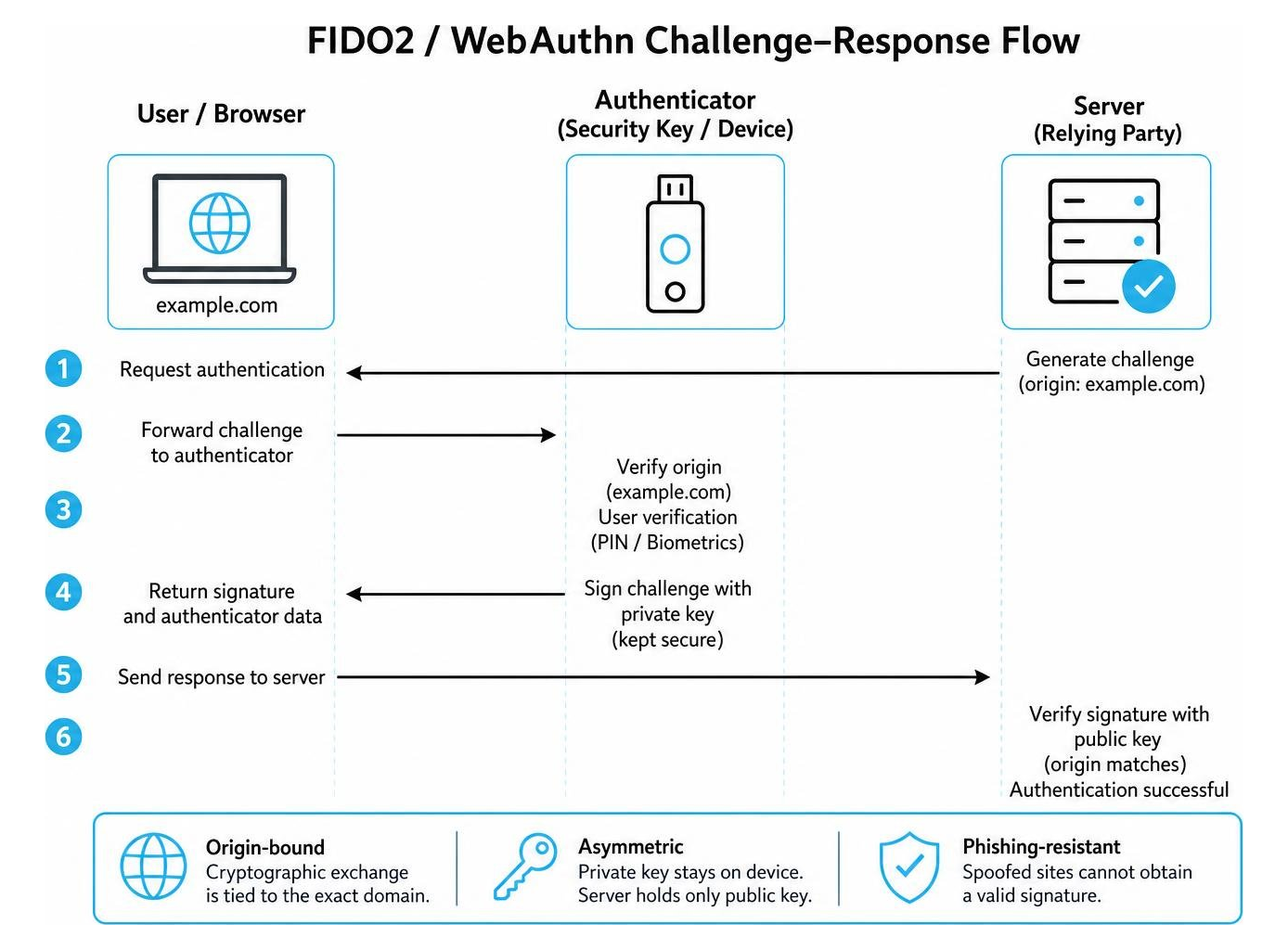
Under the FIDO2 and WebAuthn standards, the authentication process does not involve typing in a shared numeric code. Instead, the server sends a cryptographic challenge to the user's browser or security key. The device signs this challenge using its hardware-secured private key and returns the signature to the server.
Crucially, this process is origin-bound. The browser automatically scopes the cryptographic exchange to the exact domain name listed in the address bar. If a user is tricked into visiting a spoofed site, the security key will recognize that the domain does not match the registered credential and will refuse to sign the challenge. This domain-binding mechanism makes FIDO2-based authentication completely resistant to reverse-proxy phishing attacks.
Compliance, Frameworks, and Strategy
This shift is no longer just a technical recommendation; it is rapidly becoming a regulatory and operational mandate. Evolving Zero Trust architectures, updated NIST SP 800-63-3 guidelines, and strict underwriting requirements from cyber insurance providers are forcing organizations to move away from phishable MFA methods like SMS and standard OTP tokens. Federal mandates, such as the U.S. Office of Management and Budget (OMB) memorandum M-22-09, explicitly require government agencies to deploy phishing-resistant MFA.
For mid-to-large enterprises, a strategic migration path is essential. While migrating directly to software-based passkeys is viable for some workforces, many organizations operating in high-security, regulated, or shared-workstation environments (such as healthcare clinics, manufacturing floors, or retail operations) cannot rely on personal mobile devices.
In these scenarios, transitioning from legacy OTP hardware tokens to modern, phishing-resistant physical security keys — such as EveryKey's enterprise-grade hardware security keys — allows organizations to meet Zero Trust requirements without introducing user friction or logistical complexity.
Frequently Asked Questions about OTP Tokens
What is the difference between a one-time token (OTT) and a one-time password (OTP)?
While the terms sound nearly identical, they refer to different authentication architectures. A one-time token (OTT) is typically generated entirely on the server side and delivered to the user via an out-of-band channel, such as a "magic link" sent via email.
As outlined in the docs/modules/ROOT/pages/servlet/authentication/onetimetoken.adoc at 7.0.0 · spring-projects/spring-security framework documentation, an OTT requires no initial cryptographic setup or enrollment on the user's device. The server generates a unique token string, stores it temporarily (often with a default expiration of five minutes), and invalidates it immediately upon its first use.
In contrast, a one-time password token requires a pre-shared cryptographic seed to be enrolled on the user's device, allowing the client to generate codes locally without relying on external delivery networks or active internet connections.
How do you implement TOTP/HOTP programmatically in Python?
To implement server-side validation or token generation in Python, developers frequently rely on open-source libraries like PyOTP, as detailed in PyOTP v2.10.0 and the PyOTP - The Python One-Time Password Library — PyOTP 0.0.1 documentation .
To build a working implementation, a developer first generates a cryptographically secure, random 32-character base32 string to serve as the shared secret key. This secret key must be stored securely in an encrypted database on the server.
To provision this secret to a user's mobile authenticator app, the library can generate a standardized provisioning URI. This URI contains the secret key, the user's account identifier, and the enterprise issuer name. Rendering this URI as a QR code allows the user to scan it with apps like Google Authenticator or Microsoft Authenticator, which automatically configures the local TOTP generator.
When the user attempts to log in and submits a code, the server uses the library to verify the input. The library calculates the expected code for the current time window based on the stored secret and compares it to the user's input. To prevent replay attacks, the server's backend must record successful logins and reject any subsequent authentication attempts using the same code within its active time window.
Why does NIST discourage SMS-based OTP tokens?
The National Institute of Standards and Technology (NIST) explicitly discourages the use of out-of-band SMS-based authentication in its SP 800-63-3 guidelines due to systemic vulnerabilities in public telecommunications networks.
Unlike dedicated hardware key fobs or local authenticator apps, SMS delivery exposes the authentication code to intercept risks at multiple points. These include SIM-swapping attacks targeting carrier retail employees, SS7 network routing exploits that allow attackers to redirect messages globally, and phone number recycling, where a new subscriber inherits a previous user's old phone number and gains access to their legacy SMS authentication streams.
Conclusion
A one-time password token remains a highly practical and cost-effective security measure for organizations looking to move away from the dangerous vulnerability of static passwords. Whether deployed as physical keychain fobs or software authenticator apps, OTP tokens provide an essential layer of protection for everyday business systems.
However, as phishing toolkits and social engineering campaigns grow increasingly sophisticated, security teams must recognize the inherent limits of shared-secret authentication.
For comprehensive technical insights, security reviews, and strategic guidance, visit the one-time password token explained how otp tokens strengthen enterprise authentication knowledge hub on Unlocked. To learn how your organization can seamlessly transition to true phishing-resistant security, explore EveryKey's enterprise hardware authentication solutions today.