

One Time Token Authentication vs Passwords in the Age of Phishing

One Time Token Authentication Reduces Password Risk, Not Phishing Risk
One time token authentication replaces a reusable password with a short-lived credential that works once. To deploy it safely, generate tokens with a cryptographically secure random source, expire them within minutes, invalidate them atomically after use, hash stored values, and rate-limit verification attempts.
This reduces the damage from password reuse and credential stuffing. But a token delivered by SMS, email, or a phishing page can still be stolen and relayed in real time. Treat these tokens as bearer credentials: anyone who obtains a valid one may be able to sign in.
The latest identity-assurance guidance referenced in this article, NIST SP 800-63-4, published in July 2025, reinforces the need to match authentication strength to risk. For workforce and privileged access, organizations should move toward phishing-resistant passkeys or FIDO2 security keys instead of relying on one-time codes alone.
Easy one time token authentication word list:
OTT vs. OTP: Dissecting the Architectural Differences
While engineers often use the acronyms interchangeably, one-time tokens (OTT) and one-time passwords (OTP) rely on distinct cryptographic architectures, trust models, and lifecycle states. Understanding how OTP tokens strengthen enterprise authentication requires unpacking these technical boundaries.
| Architectural Dimension | One-Time Token (OTT) | One-Time Password (OTP / TOTP) |
|---|---|---|
| Generation Engine | Server-side CSPRNG on demand | Symmetric algorithm computed independently on client and server |
| Shared Secret Required | No pre-shared secret; ephemeral state generated at runtime | Yes; static symmetric seed stored on both server and client |
| Standard / RFC | Proprietary / Framework-specific (e.g., OAuth 2.0 grants, Spring OTT) | RFC 4226 (HOTP), RFC 6238 (TOTP) |
| Typical Transmission | Out-of-band delivery (Magic link via SMTP, SMS, Webhook) | Displayed on authenticator hardware/app; entered manually by user |
| Payload Structure | High-entropy string (UUIDv4, 128-bit+ cryptographically secure token) | Low-entropy numerical code (typically 6 to 8 decimal digits) |
| Primary Use Cases | Passwordless sign-in, cross-domain SSO handoffs, account resets | Secondary authentication factor (MFA / 2FA), step-up auth |
| Storage on Server | Ephemeral DB record or Redis key (hashed with SHA-256) | Encrypted symmetric secret key in user identity record |
Symmetric Shared Secrets vs Server-Generated Ephemera
Traditional one-time passwords rely on symmetric shared secrets established during enrollment. Under RFC 4226 (HOTP) and RFC 6238 (TOTP), both the authentication server and the client device hold an identical cryptographic seed. The client computes a code by running an HMAC-SHA-1, HMAC-SHA-256, or HMAC-SHA-512 operation against a moving factor—either an incrementing counter or the current UNIX time divided into 30-second steps.
As outlined in the MDN Web Docs on one-time password security, this model decouples code generation from active network transmission: the user’s authenticator app does not need an internet connection to produce a valid token. However, the architecture creates a high-value target on the server side. If an attacker breaches the identity provider database and extracts unencrypted symmetric seeds, they can calculate valid codes indefinitely.
Conversely, one-time tokens eliminate pre-shared secrets entirely. The server generates a unique, high-entropy string (such as an ephemeral UUIDv4) strictly on demand, persists it in an ephemeral storage tier with an aggressive time-to-live (TTL), and transmits it to the user.
Token Lifecycle and Scope Constraints
An OTT exists only for a discrete transactional lifecycle. Once consumed, the server immediately purges or flags the token record to prevent replay attacks.
Furthermore, OTTs can easily carry granular authorization constraints. A token generated for an email confirmation can be cryptographically scoped to a single API endpoint, a restricted OAuth delegation scope, or a isolated cross-domain redirection flow. Because the server retains full control over the generation and validation context, OTT payloads can enforce strict context binding that invalidates the token if the target resource, IP subnet, or user-agent profile deviates from the initial generation request.
How One Time Token Authentication Works: Generation, Delivery, and Verification
Deploying a reliable one-time token workflow requires orchestrating several distinct phases across server, transport, and client layers.
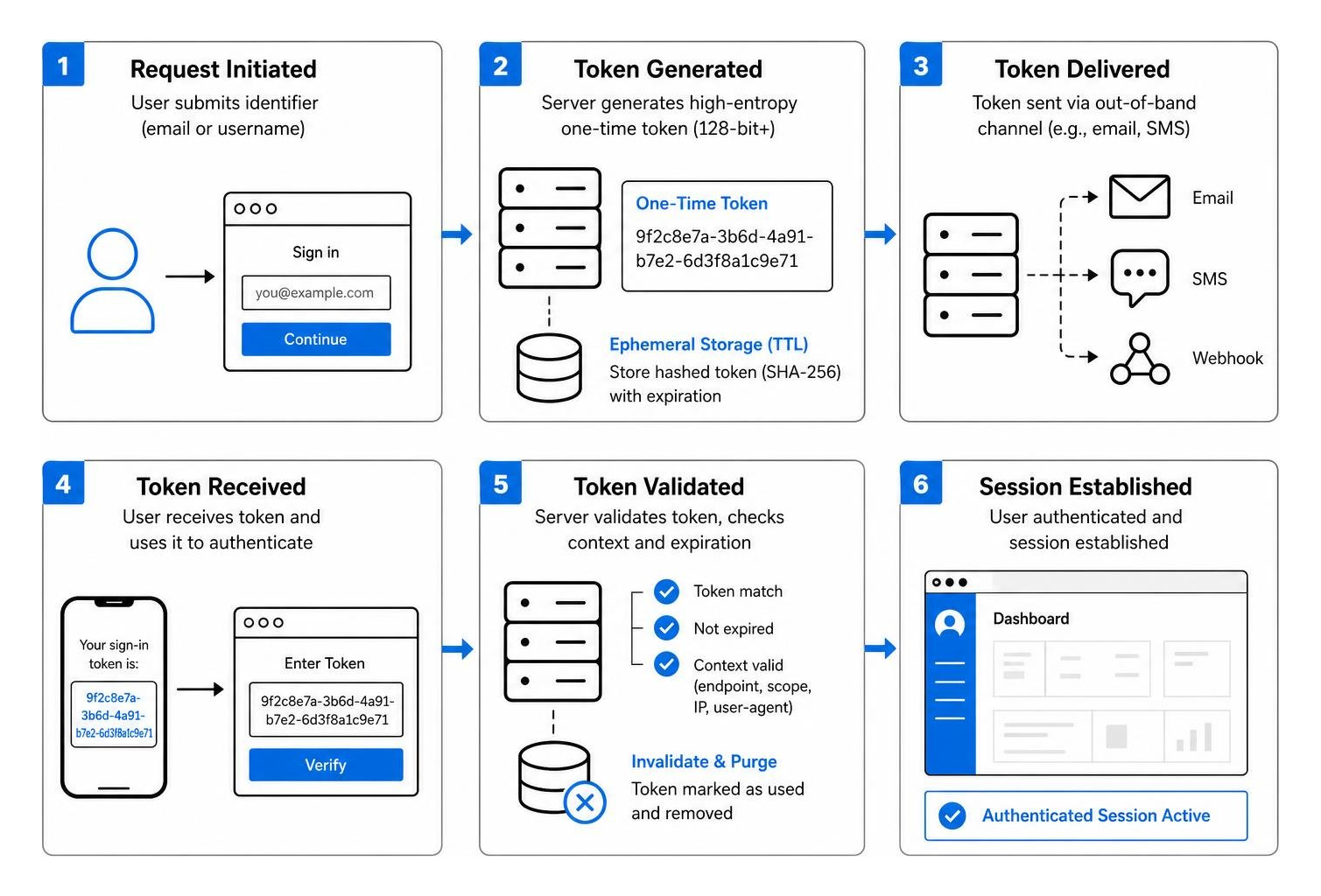
Token Generation and Payload Mechanics
When a user initiates an authentication flow by submitting their identifier (such as an email address or username), the authentication server initiates token generation:
- Entropy Generation: The backend invokes a cryptographically secure pseudo-random number generator (CSPRNG)—such as
crypto.randomBytes()in Node.js orjava.security.SecureRandomin Java—to produce at least 128 bits of entropy. - Payload Formatting: The token value is formatted, commonly as a secure base64-encoded string or a UUIDv4.
- Server-Side Persistence: The server hashes the raw token using SHA-256 and writes the hash to an ephemeral data store (e.g., Redis or a dedicated database table) alongside the user ID, creation timestamp, expiration timestamp (typically 180 to 300 seconds), and an unconsumed flag. Storing only the hash ensures that a read-only database compromise does not expose usable bearer tokens.
Delivery Vectors: Magic Links, SMS, and Out-of-Band Channels
Once generated, the raw token is delivered across an out-of-band communication channel:
- Email Magic Links: The raw token is embedded as a URL query parameter (
https://auth.example.com/login/verify?token=RAW_TOKEN). When sent via SMTP, the user completes authentication with a single click. - SMS Gateway Dispatch: The raw token, often truncated or formatted for human entry, is dispatched via a telecommunications gateway. However, understanding multi-factor authentication vulnerabilities is essential when assessing SMS transport, as telecommunications protocols introduce significant interception vectors.
- Mobile Deep Linking and WebOTP: Native mobile applications and modern browsers can leverage APIs such as the WebOTP API to automatically extract delivered tokens from inbound messages, reducing user friction while completing the round trip.
Verification, Consumption, and Session Binding
When the client presents the token to the verification endpoint, the server processes the request through an atomic transaction:
- Hash Lookup: The server computes the SHA-256 hash of the presented token and queries the store for an unexpired, unconsumed matching record.
- Atomic Invalidation: To prevent race conditions and concurrent replay attacks, the token must be marked as consumed within a single atomic operation (e.g., a Redis
GETDELor a SQLUPDATE ... WHERE token_hash = ? AND consumed = false RETURNING id). - Session Establishment: Upon successful consumption, the authentication system establishes a new authenticated session, issuing a secure, HTTP-only session cookie or minting an OAuth/OIDC JSON Web Token (JWT) pair. This transition adheres to modern password authentication protocols, protecting against session fixation attacks by regenerating session identifiers immediately upon verification.
The Identity Threat Landscape: Why One-Time Credentials Fail Against Modern Phishing
Despite eliminating static passwords, one-time credentials remain vulnerable to sophisticated modern threat actors. Because standard OTTs and OTPs act as simple bearer tokens, whoever presents the string to the verification endpoint receives the session.

Reverse-Proxy AiTM Attacks and Real-Time Interception
Adversary-in-the-Middle (AiTM) phishing frameworks like Evilginx and Evilproxy have industrialized the interception of one-time credentials. In an AiTM attack:
- The attacker lures the user to a proxy server hosting a spoofed domain that proxies legitimate enterprise login portals in real time.
- The user enters their credentials, triggering an OTT dispatch (or TOTP prompt).
- The user enters the one-time code into the proxy page.
- The reverse proxy forwards the token to the legitimate authentication server, intercepts the resulting session cookies or bearer tokens (MITRE ATT&CK T1539), and hands the user an active session while the adversary retains full administrative access.
This structural flaw shows how MFA gets phished when organizations rely on credentials lacking cryptographic channel binding. High-profile campaigns such as the 0ktapus operation—which generated nearly 10,000 compromised employee credentials over two months across more than 130 organizations using targeted SMS phishing lures—demonstrated the vulnerability of non-phishing-resistant factors. Similarly, during a coordinated phishing incident against Cloudflare, at least 76 employees received malicious SMS prompts within a single minute, proving how rapidly automated proxy infrastructure can harvest and consume ephemeral codes.
SS7 Protocol Exploitation and SIM Swapping in SMS Deliveries
Delivering one-time tokens via SMS introduces major structural vulnerabilities across telecommunications infrastructure:
- SS7 and Diameter Exploitation: Signaling System 7 (SS7), the core signaling protocol suite routing global telecommunications, lacks native authentication for message routing updates. Attackers with access to SS7 hubs can redirect SMS traffic to arbitrary intercept terminals.
- SIM-Swapping Fraud: Through social engineering or malicious carrier insiders, attackers port the victim's mobile subscriber identity to an adversary-controlled SIM card, intercepting all inbound SMS tokens.
- Air-Interface Interception: Legacy cellular stream ciphers (such as the A5/X algorithm family) remain vulnerable to real-time software-defined radio decryption.
For these reasons, NIST SP 800-63-4 explicitly restricts SMS and PSTN-based delivery for high-assurance authenticators.
Abuse of OAuth 2.0 Device Code Flows
Attackers also manipulate standard authorization protocols to achieve token-based account takeover. Under RFC 8628 (OAuth 2.0 Device Authorization Grant), input-constrained devices (such as smart TVs or CLI utilities) obtain access tokens by instructing a user to navigate to a verification URL on a secondary browser and submit an ephemeral user code.
Threat actors, including state-sponsored groups, exploit this workflow through device code phishing:
By tricking enterprise users into authenticating an adversary-initiated device code on a legitimate identity provider page, attackers bypass standard MFA protections and acquire long-lived tokens without capturing static user passwords.
Developer Implementation Guide: Building Robust OTT Workflows
When implementing one-time token authentication, software engineers must avoid standard anti-patterns such as unhashed token persistence, predictable randomness, and loose submission timelines.
Implementing One Time Token Authentication in Spring Security and Modern Frameworks
Modern application frameworks provide structured abstractions for managing one-time token lifecycles. For instance, developers can configure native token flows using the Spring Security One-Time Token Login documentation.
In a Spring Boot environment, you configure the security filter chain to enable OTT login, swap the default InMemoryOneTimeTokenService for a persistent JdbcOneTimeTokenService, and register a custom OneTimeTokenGenerationSuccessHandler to dispatch magic links via SMTP. Spring Security models inbound authentication requests via the OneTimeTokenAuthenticationToken class, handling credential extraction and validation internally.
Similarly, TypeScript applications leveraging the better-auth one-time token plugin can enforce server-side hashing and short-lived expirations out of the box. The framework supports setting storeToken: "hashed", automatically computing cryptographic digests before database persistence to maintain zero-knowledge storage.
Securing One Time Token Authentication Against Interception and Replay Attacks
To harden production OTT authentication endpoints, implement the following architectural controls:
- Cryptographic Storage Hashing: Never store raw tokens in plaintext databases. Hash incoming tokens with SHA-256 before writing to storage, and compare incoming candidate tokens by hashing them prior to running the database query.
- Constant-Time Comparisons: When verifying tokens or HMAC signatures in memory, use constant-time comparison functions (e.g.,
crypto.timingSafeEqual()in Node.js orMessageDigest.isEqual()in Java) to eliminate side-channel timing attacks. - Aggressive Expiration Windows: Bound token lifetimes strictly between 180 and 300 seconds. Extended windows increase exposure to adversary relay operations.
- Rate Limiting and Account Lockouts: Restrict generation and verification endpoints via IP- and user-based leaky-bucket rate limiting (e.g., maximum 3 attempts per minute) to thwart brute-force enumeration of short tokens.
- Strict Single-Use Guarantees: Execute token consumption within database transactions that guarantee atomic invalidation, ensuring parallel requests cannot exploit race conditions to achieve multi-session logins.
Beyond Ephemeral Tokens: The Shift to Phishing-Resistant FIDO2 and Passkeys
While one-time token authentication resolves many issues associated with static credential stuffing, it remains vulnerable to real-time relay. Securing modern enterprise identity perimeters requires transitioning to phishing-resistant architectures rooted in FIDO2 and WebAuthn standards. For a complete implementation roadmap, explore our two-factor authentication setup guide alongside our analysis of core TOTP authentication methods.
Cryptographic Origin Binding vs Bearer Tokens
The fundamental difference between one-time tokens and FIDO2/WebAuthn credentials lies in origin binding:
- Bearer Token Architecture (OTT / OTP): The token is an application-layer string decoupled from the transport channel. If an AiTM reverse proxy tricks a user into submitting the code on
login.evil-domain.com, the attacker can immediately reuse that string againstlogin.legitimate-domain.com. - Public-Key Cryptographic Challenge (FIDO2 / WebAuthn): Authentication uses asymmetric cryptography. During enrollment, the client authenticator creates a unique public/private keypair scoped specifically to the relying party’s domain origin (
rpId). During authentication, the browser cryptographically signs a server challenge along with client metadata (clientDataJSON), including the origin URL.
If an attacker proxies a WebAuthn request through login.evil-domain.com, the browser signs the challenge using the attacker's domain. When forwarded to login.legitimate-domain.com, the legitimate server detects the origin mismatch and drops the request. For a complete technical breakdown of enterprise identity controls, refer to our IT pro authentication cheat sheet.
Organizations looking to eliminate both credential fatigue and phishing vulnerabilities can evaluate physical security tokens, platform passkeys, and proximity-based hardware authenticators like EveryKey alongside software solutions to achieve seamless, phishing-resistant enterprise access.
Frequently Asked Questions About One Time Token Authentication
What is the primary security difference between an OTT and a TOTP?
An OTT (one-time token) is generated server-side on demand using a CSPRNG, has no pre-shared secret, and is delivered out-of-band (via email, SMS, or API) as an ephemeral bearer credential. A TOTP (time-based one-time password) relies on a symmetric secret key pre-shared between the server and the client device, using RFC 6238 to compute short numerical codes based on time intervals without requiring active network transmission.
How do attackers bypass one-time token authentication using OAuth device code flows?
Attackers initiate a legitimate RFC 8628 OAuth 2.0 device authorization flow against an identity provider (such as Microsoft Entra ID), obtain a valid user code, and phish the target into entering that code on the legitimate provider authentication portal. Once the victim completes sign-in and satisfies any MFA prompts, the identity provider issues authorization tokens directly to the attacker’s polling client.
Can one-time tokens be used as a primary authentication factor?
Yes. Passwordless architectures frequently employ OTTs—primarily as email magic links—as a primary authentication factor for consumer applications and customer identity access management (CIAM). However, because OTTs remain vulnerable to mailbox compromise and AiTM phishing interception, enterprise and privileged workforce environments should use phishing-resistant FIDO2 passkeys or hardware authenticators for primary access.
Conclusion
One-time token authentication marks a clear evolutionary step beyond static, reusable passwords, mitigating the widespread risks of credential stuffing and credential reuse across modern application ecosystems. However, security architects must treat one-time tokens for what they are: shared bearer secrets that remain vulnerable to adversary-in-the-middle reverse proxies, telecommunication exploits, and real-time social engineering.
Building a resilient identity posture requires a layered, defense-in-depth approach. Organizations must enforce strict cryptographic storage, minimal token TTLs, and atomic single-use invalidation while systematically migrating workforce and privileged access flows toward phishing-resistant, origin-bound FIDO2 credentials. To dive deeper into optimizing enterprise authentication strategies, review our enterprise OTP and one-time token security guidance and explore the technical frameworks available across Unlocked.