
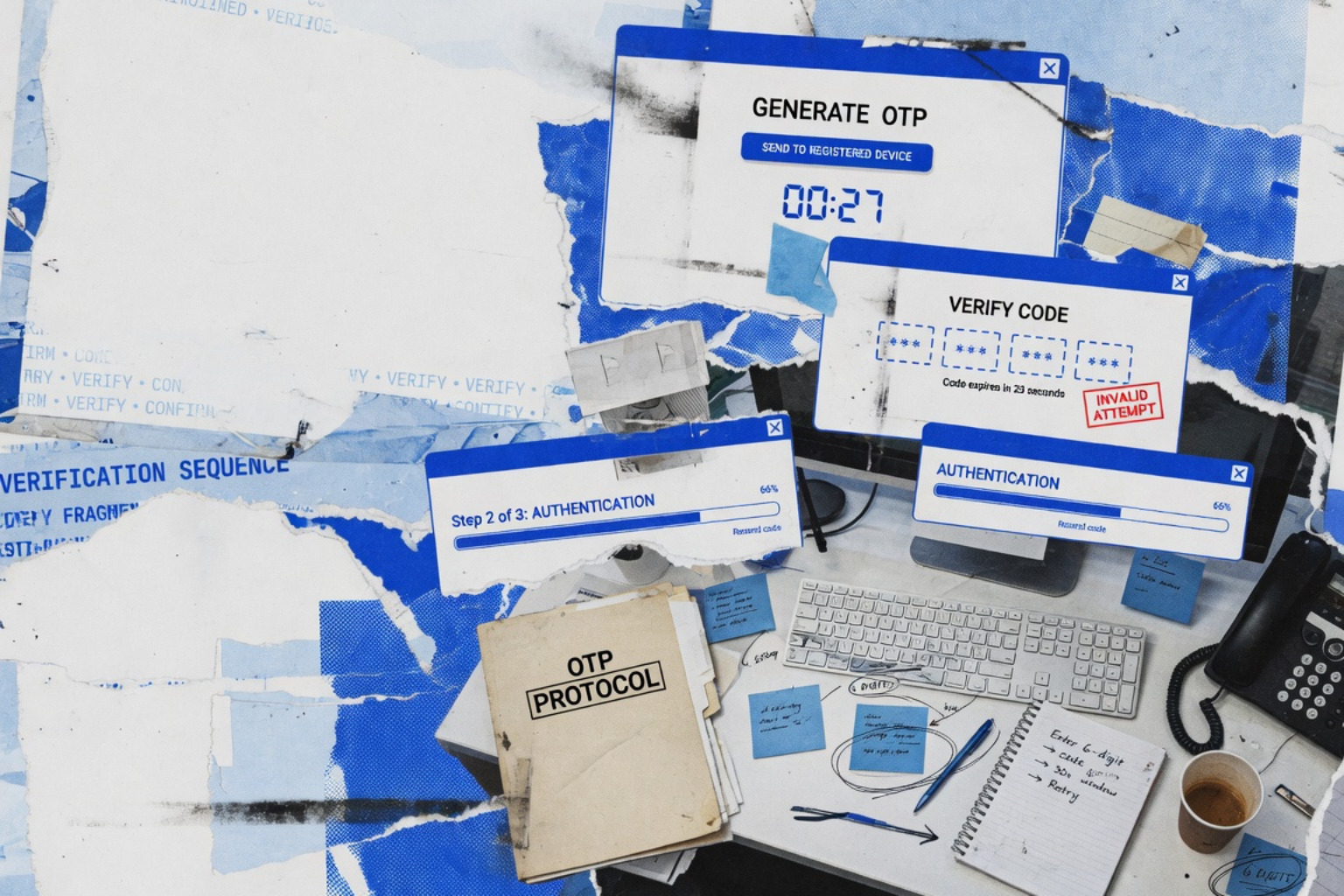
The Ultimate Guide to One-Time Password Generators
A one-time password generator turns a shared secret into single-use codes that expire in seconds. This guide covers how TOTP and HOTP work, where OTP breaks under phishing, and how to deploy it securely.

Why One-Time Password Generators Are Central to Modern Authentication
A one time password generator is a tool — hardware or software — that produces a short, single-use authentication code that expires within seconds or after one login attempt. Here's the quick version if that's all you need:
How a one-time password generator works:
- A shared secret key is established between your device and the server during setup
- The generator computes an HMAC (Hash-based Message Authentication Code) using that secret plus either the current time (TOTP) or an incrementing counter (HOTP)
- The result is truncated to a 6–8 digit code
- You enter the code to prove possession of the shared secret — without ever transmitting the secret itself
- The code expires after 30 seconds (TOTP) or one use (HOTP), making replay attacks useless
That one mechanism sits at the center of a much bigger problem.
81% of data breaches trace back to weak or reused passwords. The average person now manages over 100 accounts. Humans are genuinely bad at creating passwords that are both unique and random at the same time — we default to patterns, and attackers know it.
Static passwords, even complex ones, can be phished, leaked in breaches, or stuffed across accounts. A one-time code that expires in 30 seconds changes the attack surface entirely.
But OTP isn't invulnerable. Device code phishing attacks — where attackers trick users into authorizing rogue devices through legitimate OAuth flows — have increased 37 times in the past year alone. Platforms like Tycoon2FA have turned MFA bypass into a commercial service.
This guide covers the full picture: how OTP generators work at the cryptographic level, how they integrate into enterprise infrastructure, where they fail, and how to deploy them in a way that actually holds up against modern attack techniques. To understand the broader context of these tools, see our multi-factor authentication your complete guide to enhanced security.
Technical Architecture of a One Time Password Generator
At its core, a one time password generator is a mathematical engine. It doesn't "talk" to the server to get a code; instead, both the client (your phone or hardware token) and the server perform the same calculation independently. If the results match, access is granted.
This process relies on two primary standards maintained by the Internet Engineering Task Force (IETF): RFC 4226 for HOTP and RFC 6238 for TOTP. Both use a shared secret - a string of random bits usually encoded in Base32 for human readability - that serves as the seed for all future codes. For a deeper look at these protocols, explore how totp a core method for modern authentication functions in enterprise environments.
The Mechanics of a Time-Based One Time Password Generator
The most common form of OTP today is the Time-Based One-Time Password (TOTP). The "moving factor" in this algorithm is Unix time - the number of seconds elapsed since January 1, 1970 (the T0 epoch).
To generate a code, the system takes the current Unix time and divides it by a time step (usually 30 seconds). The result is the "T" parameter. The algorithm then calculates an HMAC-SHA1 hash using the shared secret (K) and this time value (T).
Modern browser-based tools perform these calculations using the Web Crypto API. This ensures that the shared secret stays in the browser's local memory and is never sent over the network. However, this method relies heavily on the local system clock. If a device's time drifts by more than 30-60 seconds from the server's clock, the generated codes will be rejected.
HOTP and Counter-Based Authentication
Before TOTP became the standard, we had HOTP (HMAC-based One-Time Password). Instead of using time, HOTP uses an incrementing counter. Every time you request a code, the counter on your device goes up by one.
The security challenge with HOTP is synchronization. if you click your hardware token ten times without logging in, your device counter will be ten steps ahead of the server. To solve this, servers use a "look-ahead window" (parameter 's'), checking the next several possible codes to see if they match the user's input. The algorithm extracts a 4-byte dynamic binary code from the HMAC-SHA1 hash through a process called dynamic truncation, which is then converted into the 6-digit number you see on your screen. You can learn more about these variations in our guide on the common mode of two step authentication methods security levels and best practices.
Integrating OTP Generation into Enterprise Infrastructure
For enterprises, managing thousands of OTP secrets requires more than just a mobile app. It requires a robust Identity and Access Management (IAM) strategy.
| Feature | Hardware Tokens (OATH) | Software Authenticators | Integrated Vaults |
|---|---|---|---|
| Security | Highest (Air-gapped) | High (Encrypted storage) | Moderate (Shared risk) |
| Cost | High ($20-$50 per unit) | Low/Free | Included in license |
| User Friction | Moderate (Physical device) | Low | Lowest (Autofill) |
| Compliance | NIST AAL3 compatible | NIST AAL2 compatible | Varies by vendor |
Many organizations now integrate OTP generation directly into password managers like 1Password, Bitwarden, or RoboForm. These tools use a "zero-knowledge" architecture, meaning the vault is encrypted with a master password that the vendor never sees. To assist in selecting the right tool, check out our best 2 factor authenticator guide 2026.
Client-Side Generation and Secret Storage
When using a software-based one time password generator, the security of the shared secret is paramount. In a browser environment, secrets are often stored in localStorage or IndexedDB. While convenient, these are vulnerable if the browser is compromised by malware or a malicious extension.
Enterprise-grade tools isolate these secrets within secure execution environments or content scripts to prevent other browser tabs from "peeking" at the authentication data. If a secret is leaked, an attacker can generate valid OTP codes indefinitely until the secret is rotated.
Password Strength and Entropy Requirements
Even with a one time password generator, the "first factor" (the password) still matters. A 12-character password made only of numbers can be cracked in roughly 25 seconds. However, increasing that to 12 characters with mixed cases, numbers, and symbols pushes the brute-force time to 34,000 years.
Security professionals now recommend using a password generator to create high-entropy strings or random word passphrases (e.g., "correct-horse-battery-staple"). These are harder for computers to guess but easier for humans to remember. Modern vaults use advanced hashing algorithms like Argon2id or bcrypt to protect these passwords against offline attacks.

Security Risks: Phishing and MFA Bypass Techniques
The greatest threat to OTP today isn't a math genius cracking the SHA1 hash; it's social engineering.
The rise of Phishing-as-a-Service (PhaaS) platforms like Tycoon2FA has made Adversary-in-the-Middle (AiTM) attacks accessible to low-skilled hackers. In these attacks, the victim lands on a fake login page that proxies their credentials and OTP code to the legitimate service in real-time. The attacker doesn't just get the password; they get a valid session token, bypassing the OTP entirely.
Defending Against One Time Password Generator Interception
Recent reports indicate a 37x increase in device code phishing. In this scenario, an attacker generates an OAuth 2.0 device authorization code and tricks a user into entering it at microsoft.com/devicelogin. Once the user completes the MFA prompt, the attacker’s rogue device is authorized to access the account.
To combat this, organizations are moving toward phishing-resistant MFA, such as FIDO2 and WebAuthn. These methods use public-key cryptography and bind authentication to the website's real domain, so a phisher cannot simply steal a reusable "code." Solutions like EveryKey can also fit into this broader shift toward stronger, more seamless authentication. For teams still relying on TOTP, Continuous Access Evaluation (CAE) is critical because it can revoke stolen session tokens when risk signals, like an unusual IP change, appear.
Real-World Breach Analysis: 2024-2025 Trends
In late 2024 and early 2025, we saw a surge in session hijacking targeting Microsoft 365 environments. Threat actors like Storm-2949 have been observed abusing Self-Service Password Reset (SSPR) features. By posing as IT support, they trick users into approving MFA prompts or providing OTP codes during a "security check."
This tactic was famously used in the MGM and Caesars breaches, where social engineering directed at IT helpdesks allowed attackers to reset MFA protections and gain administrative access. This highlights that a one time password generator is only as secure as the human and the processes surrounding it. For more on the history of these devices, see our article on one-time password token explained how otp tokens strengthen enterprise authentication.
Compliance, Data Sovereignty, and Implementation Best Practices
For enterprises operating globally, choosing a one time password generator involves legal considerations. GDPR Article 32 requires "appropriate technical and organizational measures" to ensure data security, which almost always necessitates some form of MFA.
Secure Secret Sharing and Lifecycle Management
When sharing credentials or OTP secrets during HR onboarding, standard email or Slack messages are unacceptable. Instead, use secure secret-sharing platforms to create self-destructing links. These ensure that sensitive data is deleted immediately after the recipient views it.
In DevOps environments, secrets should be injected into CI/CD pipelines via APIs using tools like AWS KMS or Azure Key Vault rather than being hardcoded. This maintains data sovereignty, ensuring that the keys used to encrypt your secrets stay within your chosen geographic region.
Choosing Between Open-Source and Enterprise OTP Frameworks
When evaluating tools, consider the following:
- SAML/OIDC Support: Does it integrate with your existing Identity Provider (IdP)?
- SDK Availability: Can you build OTP generation into your own mobile apps?
- Auditability: Can you track who accessed which secret and when?
- TCO: Factor in not just the license fee, but the cost of helpdesk tickets for "locked out" users and lost hardware tokens.
Frequently Asked Questions
Why do my TOTP codes fail even when entered correctly?
The most common culprit is clock skew. Because TOTP is time-based, your device and the server must agree on the time. Even a 30-second difference can result in a rejected code. Ensure your device is set to "Set Time Automatically" via NTP. Some servers allow a small window (±1 period) to account for slight drifts, but significant gaps will always fail.
Is a browser-based OTP generator safe for production use?
While browser-based generators are useful for testing and development, they carry risks in production. A browser-based generator is a "hot" storage method—the secret is accessible to the operating system and the browser. For high-security administrative roles, air-gapped hardware tokens or dedicated mobile authenticator apps are preferred.
How does TOTP differ from SMS-based 2FA?
SMS-based 2FA is susceptible to SIM swapping and SS7 protocol exploitation, where attackers redirect your text messages to their own devices. NIST 800-63B has deprecated SMS for high-security environments. TOTP is superior because it works offline and the secret never travels over the cellular network.
Conclusion
The landscape of identity and access management is shifting. While the one time password generator remains a cornerstone of defense, it is no longer a "set and forget" solution. Attackers have adapted with sophisticated proxy-based phishing and session theft.
To stay secure in 2026, organizations must combine strong cryptographic generators with identity-first security policies, such as Zero Trust and phishing-resistant hardware. Understanding the underlying mechanics of one-time password token explained how otp tokens strengthen enterprise authentication is the first step toward building a resilient security posture.