

Outsmarting Hackers: How MSPs Can Use Threat Intelligence Effectively

The Threat Landscape MSPs Can No Longer Afford to Ignore
Threat intelligence for MSPs has moved from a nice-to-have capability to a survival requirement — and the attack data from the first half of 2026 makes that case without ambiguity.
Here is what threat intelligence does for MSPs, at a glance:
- Proactive defense — Identify threats before they hit client networks, rather than reacting after the fact
- Faster detection — MSPs using threat intelligence report up to 87% faster threat detection
- Fewer false positives — Contextual intelligence filters alert noise, with reported reductions of up to 65%
- Stronger incident response — Knowing attacker TTPs means faster containment and clearer client communication
- Business growth — Dark web monitoring and threat briefing services can generate $2,500–$8,500 in monthly recurring revenue per client
The attack surface MSPs manage has never been more dangerous. In 2025, ransomware group DragonForce breached a managed service provider by exploiting a chain of unpatched vulnerabilities in the SimpleHelp RMM platform — then used that foothold to deploy encryptors across the MSP's downstream customers. A single unpatched tool. Multiple victims. That is the supply chain threat model MSPs now operate inside every day.
It is not just criminal gangs. State-sponsored APT groups aligned with Russian, Iranian, and North Korean interests have been documented specifically targeting regional MSPs — not because the MSPs themselves are the prize, but because of the privileged access they hold to dozens of SMB client environments. The disparity between an MSP's typical security posture and the value of its downstream access makes it an ideal stepping stone.
Meanwhile, the numbers are not softening. The global average cost of a data breach reached $4.88 million in 2024, up 10% year-over-year — the largest single-year jump since the pandemic. Global cybercrime is growing at 15% annually. Healthcare ransomware incidents surged 180% in a single month. The United States saw a 46% increase in cyberattacks in the first half of 2024 compared to the year before.
SMBs — the clients most MSPs serve — are not secondary targets anymore. Threat actors have consciously shifted focus toward smaller organizations precisely because they lack dedicated security teams. As one security researcher put it, they are effectively sitting ducks without the right protection in place.
The difference between MSPs that grow through this environment and those that get left behind comes down to one thing: whether they are operating on intelligence or just reacting to incidents.
Understanding Cyber Threat Intelligence in the Service Provider Landscape
Cyber threat intelligence (CTI) is the collection, processing, and analysis of data regarding active or emerging cyber threats. It is not just a raw feed of malicious IP addresses; it is the contextualized story of who is targeting your networks, how they operate, and what specific vulnerabilities they are looking to exploit.
For service providers, CTI is the bridge that turns a reactive IT shop into a proactive security guard. Instead of waiting for an Endpoint Detection and Response (EDR) agent to flag a running ransomware payload, threat intelligence allows you to block the delivery mechanism or patch the specific vulnerability before the attacker even attempts to gain access. For a deeper dive into the structural basics of CTI, read our guide on Understanding Threat Intelligence: A Practical Guide for Cyber Defense.
By tracking the behaviors and campaigns of specific threat groups, MSPs can anticipate high-impact attacks. Knowing the motivations and patterns of a specific Threat Actor: Understanding the Groups Behind Modern Cyber Attacks allows you to customize your defensive controls to match the exact techniques they are likely to use against your clients' industries.
Why Threat Intelligence for MSPs is a Strategic Necessity
When a data breach occurs under an MSP's watch, the damage is rarely contained to a single client. Security failures cascade, triggering client churn, legal liability, and brand devastation. With the average cost of a data breach hovering near $4.88 million, SMBs are increasingly unwilling to accept "best effort" security. In fact, industry reports show that over 50% of SMBs would actively fire their MSP if they suffered a major security breach.
The threat landscape is dominated by highly organized campaigns. The top targeted sector remains Manufacturing and Industrial Products, but no vertical is safe. To understand the mechanics of these modern extortion schemes, check out our curated coverage in the Ransomware (tag) archive.
Furthermore, social engineering remains the easiest way into any network. Attackers are leveraging a 3,000% increase in deepfake-assisted fraud and sophisticated credential harvesting campaigns to bypass traditional email filters. You can trace these emerging entry vectors in our Phishing (tag) analysis hub. Without threat intelligence, MSPs are defending blindly against an adversary that is innovating at machine speed.
The Four Pillars of Threat Intelligence: Strategic, Operational, Tactical, and Technical
To build an effective defense, MSPs must understand that threat intelligence is categorized into four distinct tiers, each serving a unique operational purpose:
| Intelligence Type | Target Audience | Focus Area | MSP Application |
|---|---|---|---|
| Strategic | Executives, CISOs, Client Owners | High-level global trends, geopolitical risks, and financial impacts. | Guiding security budgets, advising clients on industry-specific risks, and planning long-term security roadmaps. |
| Operational | SOC Managers, Incident Responders | Details of specific incoming or active threat campaigns and actor groups. | Anticipating localized attacks, tracking active ransomware groups, and adjusting active defensive postures. |
| Tactical | Security Engineers, Sysadmins | Adversary Tactics, Techniques, and Procedures (TTPs) mapped to frameworks like MITRE ATT&CK. | Configuring firewalls, setting detection rules for lateral movement, and designing access control architectures. |
| Technical | SIEM/SOAR Platforms, Automated Tools | Granular Indicators of Compromise (IOCs) such as malicious IPs, file hashes, and domains. | Driving automated blocklists, enriching security logs, and triggering immediate edge containment actions. |
Operationalizing Threat Intelligence for MSPs
Gathering threat intelligence is only half the battle; the real challenge is making it useful within your day-to-day operations. For MSPs managing dozens of distinct client environments, raw intelligence feeds can quickly turn into an overwhelming avalanche of alerts if they are not systematically operationalized.
To prevent this, service providers must establish structured ingestion pipelines that automatically filter out irrelevant noise and prioritize threats that directly map to their clients' technology stacks and geographical footprints. Integrating these feeds requires a solid baseline of internal hygiene, as outlined in our IT Security Tips for Managed Service Providers. Once your internal environment is secured, you can safely begin consuming and routing Malware Threat Intelligence Feeds across your client portfolio.
Mapping the Six Phases of the Threat Intelligence Cycle
To keep your threat intelligence program aligned with real-world risks, you must follow the structured six-phase Threat Intelligence Cycle. This continuous loop ensures that you are constantly refining your collection efforts based on actual operational feedback.
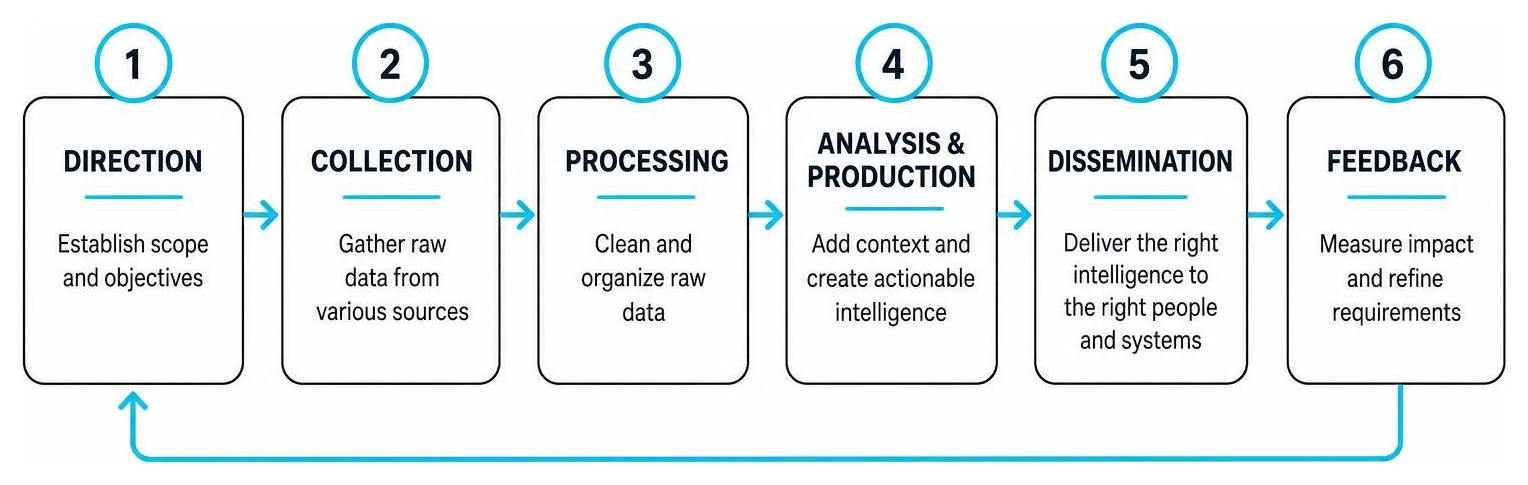
- Direction: Establish the scope and objectives. Which clients are you protecting? What are their highest-value assets? Focus your intelligence efforts on the specific threat vectors that could cause the most severe operational downtime or financial loss for those specific businesses.
- Collection: Gather raw data from a wide variety of sources, including open-source intelligence (OSINT), dark web monitoring databases, commercial vendor feeds, and network traffic logs.
- Processing: Clean and organize the raw data. This phase strips out duplicate indicators, translates raw logs into structured formats (like STIX/TAXII), and prepares the data for analysis.
- Analysis & Production: Add critical context. This is where you transform raw data into actionable intelligence. For example, instead of just flagging a malicious IP, analysis reveals that the IP belongs to a known active command-and-control (C2) server used by a specific ransomware group currently targeting healthcare providers.
- Dissemination: Deliver the right intelligence to the right people. Technical indicators go straight to firewalls and SIEMs for automated blocking, while executive summaries are packaged for client stakeholders to justify security upgrades.
- Feedback: Review the results. Did the intelligence help block an attack? Did it generate too many false positives? Use these insights to adjust your direction phase for the next cycle.
Integrating Feeds into Multi-Tenant Security Operations
The fundamental operational challenge for any MSP is scaling detection across diverse client environments without duplicating effort. Traditional security information and event management (SIEM) systems often break down when scaled across dozens of multi-tenant environments because they lack centralized correlation capabilities.
To solve this, modern service providers utilize cloud-native multi-tenant SIEMs and Security Orchestration, Automation, and Response (SOAR) platforms. By centralizing ingestion, an attack detected on one client's network can immediately trigger automated containment actions — such as adding a malicious domain to a global blocklist — across your entire client portfolio. This cross-client "network effect" is a core operational differentiator that separates basic IT support from a true MSSP: How Managed Security Service Providers Protect Modern Organizations from Cyber Threats.
Key Benefits and Implementation Strategies for Client Environments
Implementing threat intelligence directly improves the overall quality of your managed security offerings. Instead of operating on a purely reactive break-fix model, you can offer a highly resilient, proactive defense. Discover the core security services you should be offering in our guide on Cybersecurity Solutions Every Managed Services Provider (MSP) Should Offer.
By aligning your defenses with active threat intelligence, you can deliver measurable security improvements to your clients, including:
- Proactive vulnerability patching based on real-world exploitation data rather than generic severity scores
- Significantly faster incident response and containment times
- Clear, transparent reporting that proves the value of your security stack to non-technical business owners
To ensure your client-facing defenses remain robust, keep an eye on our Vulnerability Management (tag) page for continuous updates on emerging attack vectors and patching strategies.
Accelerating Patching and Vulnerability Prioritization
Every IT administrator knows the pain of patch management. With thousands of new software vulnerabilities disclosed every year, patching everything immediately is operationally impossible. If you patch blindly based on Common Vulnerability Scoring System (CVSS) scores alone, you will waste valuable engineering hours fixing low-risk, internal-facing bugs while critical, actively exploited edge vulnerabilities remain unpatched.
Threat intelligence solves this by enabling risk-based patching. By cross-referencing your clients' software inventories with real-world threat feeds, you can prioritize patches for vulnerabilities that are actively being exploited in the wild by threat actors. This is especially critical for defending against a Zero-Day Vulnerability (tag), where traditional signature-based tools will fail. Additionally, incorporating threat intelligence into your Third-Party Vendor Security Evaluation processes helps ensure that your clients' supply chain partners are not introducing unmitigated risks into their environments.
Refining Alert Triage and Incident Response
Alert fatigue is the silent killer of security teams. When your analysts are bombarded by thousands of low-priority alerts daily, critical indicators of an active compromise are easily missed.
Threat intelligence allows you to implement confidence-based alert triage. By enriching incoming alerts with real-time threat context, your SIEM can automatically escalate high-confidence alerts (such as a connection attempt to a confirmed active command-and-control server) while deprioritizing or auto-closing low-confidence anomalies.
This structured triage process allows MSPs to achieve up to an 87% faster threat detection rate and a 65% reduction in false positives. When a real security incident does occur, having immediate access to threat intelligence playbooks ensures your team can isolate affected systems and contain the threat in minutes, not days. You can explore more strategies for building rapid containment pipelines in our Incident Response (tag) section.
Tools, Platforms, and the Role of AI in Modern Threat Intelligence
MSPs have a wide variety of tools and platforms available to help them gather, analyze, and enforce threat intelligence. Choosing the right mix of open-source and commercial tools is critical to building a scalable, cost-effective security stack.
For high-end visibility and threat contextualization, solutions like Google Threat Intelligence - know who's targeting you | Google Cloud offer unparalleled global scale by combining Google's massive threat visibility with Mandiant's frontline incident response intelligence and VirusTotal's crowdsourced database. Meanwhile, fully managed options like ThreatDefend™ powered by CrowdStrike Falcon: fully managed mXDR | Vijilan Security allow MSPs to deploy enterprise-grade endpoint detection and human-led security operations without building a SOC from scratch. For network-level protection, edge routing tools like ThreatMSS for MSSP and MDR allow providers to automate IP and domain blocking directly at the firewall level.
Leveraging Open-Source and Commercial Threat Intelligence Platforms
For budget-conscious MSPs or those looking to build custom integration pipelines, open-source platforms like MISP (Malware Information Sharing Platform) are incredibly powerful. MISP allows security teams to store, correlate, and share structured threat intelligence using open standards like STIX and OpenIOC. By utilizing the PyMISP Python library, engineers can programmatically query and update threat events, making it easy to feed open-source intelligence directly into custom security tools.
On the commercial side, platforms like Dark Web Monitoring Platform for MSPs - MSP DarkIntel allow providers to automatically scan the dark web for compromised client credentials, personally identifiable information (PII), and leaked corporate assets. This provides an immediate, high-value security service that is easily understood by non-technical clients.
If your MSP lacks the internal security talent to manage these complex platforms, partnering with an outsourced Security Operations Center (SOC) provider like MDR for MSPs: 24/7 SOC Partner | At-Bay allows you to offload 24/7 monitoring, containment, and response to dedicated security experts.
The Role of AI, Automation, and Behavioral Analytics
The sheer volume of threat data generated every second makes manual analysis impossible. This is where Artificial Intelligence (AI) and automated behavioral analytics play a critical role. Modern platforms leverage large language models, like Google's Gemini, to instantly summarize complex, multi-page geopolitical threat intelligence reports into clear, actionable natural language summaries for your engineering teams.
In the SOC, advanced multi-agent AI pipelines (such as Vijilan's Praxis AI, which utilizes LangGraph) automatically investigate, enrich, and triage incoming alerts before they ever reach a human analyst. This machine-speed triage is paired with User and Entity Behavior Analytics (UEBA) to automatically establish normal activity baselines for every single client environment.
When an account that normally downloads 50MB of data daily suddenly attempts to download 5GB from an unusual geographic location at 2 AM, the system flags the anomalous behavior immediately — even if the attacker is using perfectly legitimate, stolen credentials. For a broader look at how these technologies fit into a modern security architecture, review The Ultimate Guide to Cybersecurity Tools for Modern Organizations.
Monetization, Compliance, and Overcoming Adoption Challenges
Transitioning your business from a traditional managed service provider to a security-first organization requires a clear understanding of both the operational challenges and the commercial opportunities. If you are still trying to define where your business fits on this spectrum, read our detailed comparison of MSP vs MSSP: Understanding the Difference and Choosing the Right Partner.
Overcoming the Challenges of Threat Intelligence for MSPs
The path to adopting threat intelligence is not without obstacles. The most common pitfall for MSPs is alert fatigue. If you simply turn on multiple raw threat feeds and point them directly at your engineering team, your ticketing system will quickly become unusable, leading to employee burnout and missed critical alerts.

To overcome these challenges, MSPs must:
- Implement automated filtering: Only ingest feeds that directly map to your clients' specific technologies, locations, and industries.
- Utilize edge-enforcement: Use tools like Protective DNS (PDNS) or automated firewall blocklists to block threats at the network edge, dropping the threat dwell time to zero and keeping malicious traffic completely off your SIEM.
- Partner with a master MSSP or MDR: If you lack the budget or talent to run a 24/7 SOC, do not try to build one. Partner with a specialized provider to handle the heavy lifting while you focus on client relationships.
Driving Recurring Revenue and Compliance Readiness
Threat intelligence is not just a cost center; it is one of the most powerful business growth engines available to modern MSPs. By offering white-labeled dark web monitoring, real-time threat briefings, and continuous vulnerability reporting, MSPs can easily generate an additional $2,500 to $8,500 in monthly recurring revenue (MRR) per client, operating at up to 85% profit margins.
Furthermore, offering proactive threat monitoring tools dramatically improves client retention. MSPs utilizing dark web monitoring report up to 40% higher client retention rates because they can show concrete, visual proof of the threats they are actively blocking.
Beyond direct revenue, threat intelligence is a critical tool for meeting modern compliance frameworks (such as GDPR, HIPAA, and CMMC) and satisfying the increasingly strict requirements of cyber insurance underwriters. Insurers in 2026 expect organizations to prove they have active, continuous threat detection and vulnerability management programs in place before they will issue or renew a policy.
Frequently Asked Questions
How does threat intelligence help MSPs reduce false positives?
Threat intelligence reduces false positives by providing critical context to generic security alerts. Instead of triggering an alert every time a system performs an unusual but harmless administrative task, threat intelligence engines cross-reference the activity with active adversarial TTPs and known malicious infrastructure. If the activity does not correlate with actual threat patterns or malicious indicators, the system can automatically deprioritize or auto-resolve the alert, keeping your dashboard clean.
What is the difference between open-source and commercial threat intelligence feeds?
Open-source threat feeds (like those integrated into MISP) are community-driven, free to use, and highly customizable, but they require technical expertise to set up, integrate, and maintain. Commercial feeds (such as those provided by specialized security vendors) are fully curated, verified by professional security analysts to minimize false positives, and typically come with out-of-the-box integrations for common MSP tools — though they require ongoing subscription fees.
How can small MSPs implement threat intelligence without a 24/7 SOC?
Small MSPs can easily leverage threat intelligence without the massive overhead of a 24/7 SOC by utilizing automated edge-enforcement tools and strategic partnerships. Implementing Protective DNS (PDNS) allows you to automatically block malicious outbound connections at the network edge with zero manual intervention. For deeper monitoring, partnering with a specialized Managed Detection and Response (MDR) provider allows you to offload 24/7 threat hunting and containment to an external team of experts.
Conclusion
In the modern threat landscape, running an MSP without threat intelligence is like navigating a minefield in the dark. By moving from a reactive troubleshooting model to an intelligence-driven, proactive security posture, you protect your clients from devastating supply chain attacks while transforming your business into a high-margin, security-first powerhouse.
To win more clients and build lasting trust, you must show them that security does not have to come at the expense of productivity. Discover how to balance robust protection with seamless user experiences in our guide on How MSPs Can Win More Clients by Offering Frictionless Access and Security.
For more technical deep dives, industry news analysis, and practical toolkits designed for modern security practitioners, explore the Unlocked Platform. To learn how EveryKey can help your MSP deliver frictionless, zero-trust security to your clients, visit EveryKey.