Biometric Template Security: Bridging the Gap Between Safety and Performance
You can't reset a stolen fingerprint. This guide breaks down how biometric template protection keeps that data safe — using cancelable transforms and cryptosystems — without wrecking matching accuracy.

Why Biometric Template Protection Is One of the Hardest Problems in Modern Security
Biometric template protection sits at the intersection of two uncomfortable truths: the most secure identifiers we have are also the ones we can never replace.
When a password database leaks, you force a reset. When a credit card is stolen, you cancel it. When a biometric database leaks — fingerprints, face scans, iris codes — there is no reset. No cancellation. The compromise is permanent.
That's not a theoretical risk. In 2019, a breach of Suprema's BioStar 2 platform exposed over 27.8 million records — including unencrypted fingerprint images and facial recognition templates — stored on an unsecured Elasticsearch database. In 2015, the U.S. Office of Personnel Management breach resulted in the theft of 1.1 million fingerprint records. In both cases, the affected individuals had no recourse.
Here's a quick summary of what biometric template protection means and why it matters:
What is biometric template protection?
Biometric template protection refers to a set of techniques that secure the mathematical representations of biometric data (fingerprints, faces, irises) stored in databases — so that even if a database is breached, the original biometric cannot be reconstructed, and the stolen data cannot be used across systems.
The core problem it solves:
- Biometric systems don't store your actual fingerprint — they store a mathematical template extracted from it
- Those templates can still be reverse-engineered to reconstruct the original biometric image
- Unlike passwords, you cannot issue a new fingerprint — so the protection must happen before storage
- Standard encryption (AES, RSA) doesn't fully solve this: the template must be decrypted during every match, exposing it in memory
The four properties an effective system must satisfy:
- Non-invertibility — it must be computationally infeasible to reconstruct the original biometric from the stored template
- Revocability — if a template is compromised, a new one can be issued from the same biometric source
- Non-linkability — templates stored across different systems cannot be cross-matched to the same user
- Performance — the protection scheme must not significantly degrade matching accuracy
The challenge is that satisfying all four simultaneously is genuinely hard. Despite over 20 years of research, most operational biometric systems still rely on little more than standard database encryption or secure hardware — approaches that shift the problem rather than solve it.
This guide breaks down the full landscape: the attack types that make template protection critical, the theoretical frameworks researchers have built, why they often degrade in practice, and what hybrid architectures are pushing the field forward.
Biometric template protection terms simplified:
Vulnerability Analysis: Attacks on Biometric Templates
To secure biometric templates, security practitioners must first understand how adversaries target them. Biometric systems are vulnerable at multiple points in the authentication pipeline, but the database where templates are stored remains the single point of highest risk. If an attacker gains access to this repository, the consequences are permanent.

Unlike passwords, which are easily hashed into one-way strings, biometrics present a unique challenge. An attacker who obtains a stored biometric template does not just get a random string of numbers; they get a highly structured mathematical representation of a human body. Through template reconstruction attacks, sophisticated adversaries can reverse-engineer these mathematical coordinates to reconstruct a synthetic image of the original biometric trait (such as a fingerprint or a face).
This synthetic trait can then be used to execute presentation attacks (spoofing) against physical sensors. For example, researchers have demonstrated that fingerprint sensors can be bypassed for as little as $5 using household wood glue, acetate sheets, and a standard laser printer to create a physical mold from a digital image. When When They Steal a Fingerprint You Can't Reset It, the user is permanently vulnerable across any other platform using that same biometric trait. This creates a severe domino effect, leading to a massive Biometrics Backlash: What Happens When Your Face Leaks across enterprise and consumer environments.
Adversary Prerequisite Knowledge and Attack Vectors
The feasibility and sophistication of an attack depend heavily on the adversary's level of prerequisite knowledge. Threat modeling for biometric template protection typically categorizes attackers into four distinct tiers based on what they know about the system:
- System-Agnostic Attackers: The adversary has zero knowledge of the underlying feature extraction algorithms, system parameters, or matching thresholds. They rely on brute-force attempts or generic, low-fidelity spoofing.
- Algorithm-Aware Attackers: The adversary knows the specific feature extraction model (e.g., ArcFace, CosFace, or FaceNet) used by the system. Since modern deep neural networks compress highly discriminative features into the template vector, knowing the algorithm allows the attacker to train specialized neural networks to reconstruct highly accurate face images from stolen templates.
- Helper-Data-Aware Attackers: In systems utilizing biometric cryptosystems, "helper data" is stored to assist in key reconstruction. An attacker with access to this auxiliary data can exploit its mathematical relationships to leak information about the original template.
- Full System-Compromise Attackers: The adversary has complete access to the database, the helper data, the secret keys, and the matching thresholds.
As consumer technology advances, executing these attacks becomes increasingly trivial. For instance, high-resolution DSLR cameras or even modern smartphone cameras can capture biometric traits from a distance. In the realm of voice biometrics, generative AI has lowered the barrier to entry so significantly that synthetic clones can bypass legacy voiceprints, proving that Your Voice Is Not a Password: The Deepfake Assault on Biometrics.
The Four Pillars of Biometric Template Protection
To guide the design of secure architectures, the International Organization for Standardization established the ISO/IEC 24745 standard. This framework outlines the four essential requirements that any viable biometric template protection system must satisfy:
| Requirement | Description | Why Single-Method Approaches Often Fail |
|---|---|---|
| Security (Irreversibility) | It must be computationally infeasible to reconstruct the original biometric feature vector from the protected template. | Cryptographic methods that provide high security often struggle to handle the natural noise and variations in biometric inputs. |
| Revocability (Renewability) | If a template is compromised, the system must be able to revoke it and generate a completely new, distinct template from the same physical trait. | Basic biometric cryptosystems (like secure sketches) do not naturally support template renewal without relying on external secrets. |
| Diversity (Non-linkability) | Templates generated from the same biometric trait for different applications must not allow cross-matching or database correlation. | Linear mathematical transformations often preserve relative distances, allowing attackers to link templates across databases. |
| Performance (Accuracy) | The template protection layer must not degrade the system's recognition accuracy (False Reject Rate and False Accept Rate). | Applying aggressive, non-linear distortions to guarantee irreversibility often destroys the distinctive features needed for accurate matching. |
Most legacy deployments fail to meet all four criteria. Standard database encryption (like AES-256) protects data at rest but requires decryption in memory during the matching phase, violating the irreversibility requirement at the moment of authentication. Conversely, highly secure mathematical transforms often degrade matching accuracy to unacceptable levels, forcing organizations to choose between security and usability. Balancing these trade-offs is crucial when implementing Biometrics for Authentication: How Biometric Systems Are Transforming Secure Identity Verification.
Quantifying Security, Revocability, and Non-Linkability
To move beyond theoretical assumptions, security engineers use specific metrics to quantify the strength of a template protection scheme:
- Degrees of Freedom (DoF): This measures the statistical uniqueness of a biometric representation. For example, a 2,048-bit IrisCode representation contains approximately 249 degrees of freedom, determined by analyzing the impostor score distributions across hundreds of thousands of unique iris images. Higher DoF translates to higher entropy, making brute-force attacks significantly harder.
- Entropy Loss (Mutual Information): This metric measures the amount of information leaked by the protected template (or its auxiliary helper data) about the original biometric feature vector. In secure sketch designs, minimizing entropy loss is critical to preventing leakage.
- Equal Error Rate (EER): The point where the False Accept Rate (FAR) and False Reject Rate (FRR) intersect. An effective template protection scheme must keep the EER as close to the unprotected system's baseline as possible.
In a biometric cryptosystem, the false accept rate places a mathematical upper bound on the template's non-invertibility. For instance, a system with a FAR of 0.01% implies that 1 in 10,000 zero-effort impostor attempts will succeed, restricting the theoretical non-invertibility of the system to approximately $\log_2(10^4) \approx 13.29$ bits of security. This highlights why high-precision hardware, such as those detailed in Iris Scanner Technology Explained: How Iris Recognition Systems Improve Identity Verification, is vital to providing the underlying entropy required for strong cryptographic keys.
Feature Transformation vs. Biometric Cryptosystems
The academic and industrial landscape of template protection is broadly split into two paradigms: Feature Transformation and Biometric Cryptosystems.
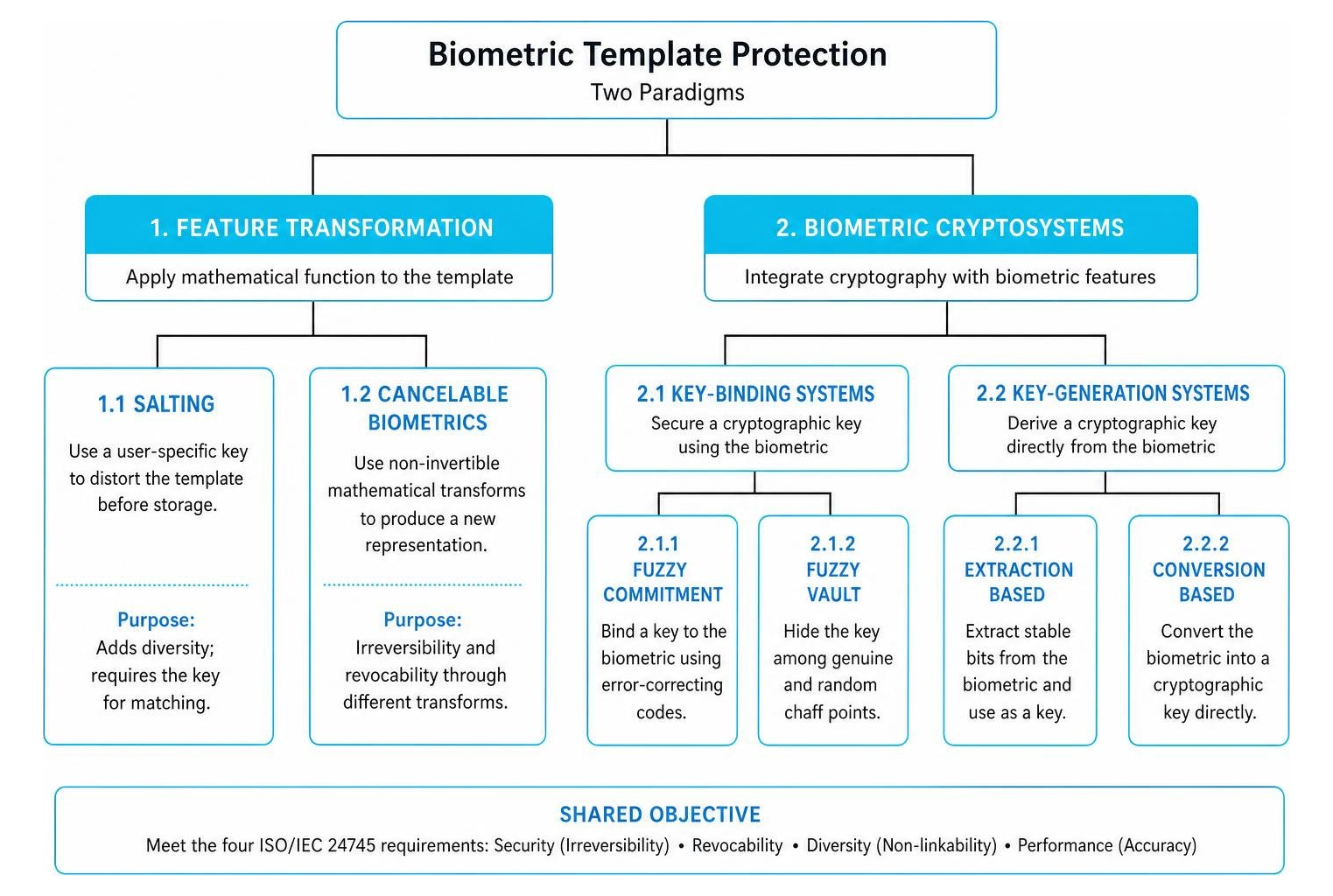
Feature transformation approaches apply a mathematical function to the biometric template before it is stored. This category includes "salting" (applying a user-specific key to distort the template) and "cancelable biometrics" (using non-invertible mathematical transforms).
Biometric cryptosystems, on the other hand, integrate cryptography directly with biometric features. They are divided into key-binding systems (where a cryptographic key is secured using the biometric template, such as fuzzy commitment or fuzzy vault schemes) and key-generation systems (where a cryptographic key is derived directly from the noisy biometric data). To understand how these align with broader corporate security, refer to Understanding Cryptographic Authentication Methods and Best Practices.
Mechanisms of Feature Transformation in Biometric Template Protection
Feature transformation relies on applying a one-way function $H$ to the biometric template $F$, resulting in a transformed template $T = H(F)$. During verification, the same transformation is applied to the query biometric, and matching is performed entirely in the transformed domain.
To prevent performance degradation, modern architectures favor registration-free and alignment-robust transformations. Traditional fingerprint matching relies on aligning minutiae points based on a core singular point, which is highly sensitive to noise. Registration-free transforms bypass this by using invariant relative relationships between minutiae points, ensuring that rotation and translation do not affect the transformed output.
A prime example of a modular, real-valued feature transformation is [2104.02239] IronMask: Modular Architecture for Protecting Deep Face Template . IronMask avoids the common pitfall of artificial binarization (converting real-valued neural network outputs into binary strings, which discards highly discriminative features). Instead, it uses a random orthogonal matrix to preserve angular distances (cosine similarity) on a unit hypersphere, achieving a True Accept Rate (TAR) of 99.79% at a False Accept Rate (FAR) of 0.0005% when paired with ArcFace.
Cryptographic Architectures and Biometric Cryptosystems
Biometric cryptosystems must accommodate the inherent noise of biological measurements. Standard cryptographic hash functions like SHA-256 are highly sensitive; a single pixel difference in a fingerprint scan will result in an entirely different hash, failing the authentication.
To solve this, cryptosystems utilize error-correcting codes (ECC) within two primary frameworks:
- Fuzzy Commitment: Suitable for fixed-length binary vectors (like IrisCodes). A cryptographic key is committed using a codeword from an error-correcting code, and the biometric template is XORed with this codeword to produce helper data.
- Fuzzy Vault: Designed for unordered point sets (like fingerprint minutiae). The cryptographic key is used to construct a polynomial, and the biometric features are mapped as points on this polynomial. "Chaff" points are added to hide the real polynomial coefficients.
- Secure Sketches: Auxiliary data (the "sketch") is generated during enrollment. During authentication, the secure sketch allows the reconstruction of the original template from a noisy query, provided the query is close enough to the original.
To scale these secure sketches without sacrificing accuracy, architectures like those in Multisketches: Practical Secure SketchesUsing Off-the-Shelf Biometric Matching Algorithms decouple the cryptographic layer from the matching engine. This allows organizations to use off-the-shelf, highly optimized matching algorithms while maintaining mathematical guarantees of template privacy.
Bridging the Gap: Theory vs. Practical Performance
The major barrier to the widespread adoption of biometric template protection is the performance gap between theoretical models and real-world execution. In ideal mathematical models, templates are clean, noise-free, and perfectly aligned. In practice, factors like sensor dirt, skin elasticity, facial expressions, and user aging introduce significant intra-subject variation.
When template protection algorithms attempt to enforce strict security boundaries, they often amplify these variations. For example, on the FVC-STD-1.0 fingerprint benchmark dataset, six state-of-the-art matching algorithms achieved an Equal Error Rate (EER) of less than 0.3% when running on raw, unprotected templates. However, when the lowest-error template protection scheme was applied to the same dataset, the EER rose to 1.54% — a five-fold increase in error rates.
To minimize these errors, developers must implement robust hardware and preprocessing layers, as detailed in the Hardware Authentication Guide 2026.
Feature Adaptation and Invariant Representations
To close this performance gap, modern systems perform feature adaptation before applying template protection. This involves transforming variable-length, noisy biometric features into stable, fixed-length invariant representations.
In fingerprint biometrics, this is achieved by converting raw minutiae coordinates into a fixed-length spectral representation. Once converted, dimensionality reduction techniques like Column Principal Component Analysis (CPCA) are applied to extract the most discriminative, noise-resistant features.
This process is highly effective when combined with feature-level fusion. For example, the methodology detailed in Securing fingerprint templates using fused structures fuses local structures (nearest neighbor minutiae) with distant structures (farthest minutiae). By combining these two complementary feature sets into a single bit-string, the system achieves an alignment-free, cancelable template that is highly robust against skin distortion.
Scaling Template Protection to Large-Scale Identification
While verification (one-to-one matching) is computationally lightweight, scaling template protection to identification (one-to-many matching) in databases containing millions of records is incredibly challenging.
In a standard identification database, the system must compare the query template against every record in the database. If each comparison requires complex cryptographic operations (such as homomorphic decryption or multi-party computation), the search latency becomes unusable. Furthermore, traditional secure sketches require auxiliary identifiers (like a username or smart card) to locate the correct helper data, limiting their use in true "biometrics-only" identification.
To address this, researchers are developing scalable, zero-identifier architectures. As explored in Scalable Secure Biometric Authentication without Auxiliary Identifiers , marrying deep learning with parallelized cryptographic search protocols allows databases to perform secure matching against millions of records in milliseconds without needing usernames or tokens.
Advanced Architectures: Hybrid Systems and Multi-Factor Protocols
Because single-method approaches struggle to satisfy all four ISO/IEC 24745 requirements simultaneously, modern enterprise architectures are moving toward hybrid systems. These systems combine the strengths of multiple protection layers — such as pairing secure sketches with image watermarking and chaotic encryption.
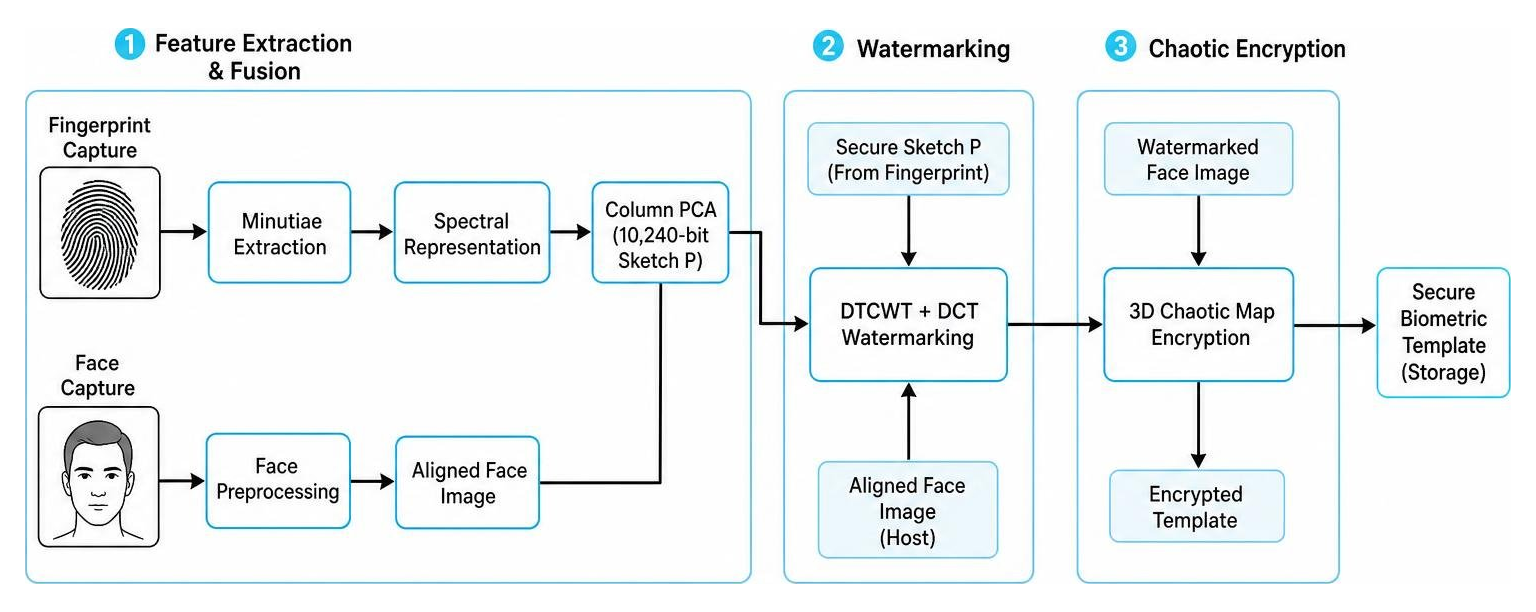
In a typical hybrid multimodal architecture:
- Feature Extraction & Fusion: Multiple biometric modalities (e.g., fingerprint and face) are captured. Fingerprint minutiae are converted into a fixed-length spectral representation, and Column PCA reduces this to a 10,240-bit binary stream (sketch P).
- Watermarking: The secure sketch of one modality (the fingerprint) is hidden inside the image of another modality (the face) using Double-Tree Complex Wavelet Transform (DTCWT) and Discrete Cosine Transform (DCT) watermarking.
- Chaotic Encryption: The watermarked image is encrypted using a 3D chaotic map encryption algorithm, achieving a keyspace larger than $10^{112}$, which is completely impervious to brute-force attacks.
By distributing the security load across multiple layers, these hybrid systems can achieve an EER of 0% on standard datasets, while ensuring that the entropy loss (mutual information) between the secure sketch and the original template is minimized to approximately 0.02, indicating near-zero information leakage. Implementing these hybrid setups is a cornerstone of The Best Authentication Methods of 2026: MFA, Biometrics, Passkeys & More.
Secret Sharing and Distributed Template Storage
One of the greatest vulnerabilities of modern biometric systems is the centralization of templates. If a hacker breaches a single database, they gain access to all enrolled identities.
To eliminate this single point of failure, organizations are implementing Shamir's Secret Sharing (SSS) schemes. Traditionally, SSS was difficult to apply to biometrics because cryptographic reconstruction occurs in a finite field, whereas biometric matching requires distance calculations in the real number domain.
However, novel secret sharing (NSS) schemes, such as the one detailed in A general and efficient biometric template protection based on a novel secret sharing - ScienceDirect , solve this by distributing template shares across multiple independent servers. The system can verify a user's identity by performing partial matching on the distributed shares without ever reconstructing the original template on a single server. This eliminates the need for traditional cryptographic key management, delivering a truly keyless, highly fault-tolerant authentication environment.
Future Research Directions in Biometric Template Protection
To fully bridge the gap between academic theory and enterprise-grade deployment, future research must focus on several open challenges:
- End-to-End Deep Learning Integration: Training neural networks to directly output secure, non-invertible, and cancelable templates, rather than relying on post-extraction mathematical transformations.
- Practical Homomorphic Encryption: Overcoming the massive computational latency of Fully Homomorphic Encryption (FHE) to allow real-time, encrypted database searches.
- Standardized Evaluation Metrics: Developing universally accepted benchmarks for measuring non-linkability and irreversibility across different biometric modalities.
- Cross-Device Interoperability: Ensuring that a protected template generated on a high-end physical scanner can be verified against a query captured on a low-cost mobile device.
Frequently Asked Questions about Biometric Template Protection
Why is standard encryption like AES insufficient for biometric templates?
Standard symmetric encryption algorithms like AES-256 are designed for exact-match data. They shift the security problem from template protection to cryptographic key management. More importantly, because biometric matching is fuzzy and requires distance calculations, the template must be decrypted in the application's memory during every authentication attempt. This exposes the raw biometric template to memory-scraping attacks at the exact moment of matching.
What are cancelable biometrics and how do they work?
Cancelable biometrics protect templates by applying intentional, non-invertible mathematical distortions (such as coordinate warping or functional transforms) to the biometric features during enrollment. The system stores only the distorted template. If the database is breached, that specific template is revoked, and a new distortion function is applied to generate a completely different template from the same physical trait, ensuring user privacy and database non-linkability.
How does a secure sketch protect biometric data?
A secure sketch is a cryptographic primitive that extracts helper data from a biometric template. This helper data does not leak sensitive information about the user (maintaining low entropy loss) but contains enough error-correcting information to reconstruct the original template when a noisy, slightly different biometric query is presented during authentication.
Conclusion
The transition of biometrics from local device unlocking to large-scale, cloud-based enterprise authentication has made biometric template protection an essential pillar of modern identity and access management. As database breaches increase in frequency and physical spoofing methods become cheaper, relying on simple database encryption is no longer an acceptable security posture.
For IT security professionals, CISOs, and engineers, the path forward requires adopting a "Privacy by Design" architecture. This means implementing alignment-robust feature transformations, leveraging hybrid cryptosystems, and exploring distributed storage models like secret sharing to ensure that biological identities remain private, secure, and revocable.
To explore how your organization can transition away from vulnerable, static credentials to a highly secure, next-generation identity architecture, read our comprehensive guide on Beyond Passwords: The Complete Guide to Security Keys, Dongles, and Next-Generation Authentication.