When They Steal a Fingerprint, You Can't Reset It
The NYC Health + Hospitals breach exposed 1.8 million people's records — including their fingerprints and palm prints. You can reset a password. You can't reset a hand. Why healthcare's biometric data is the worst thing to lose.
👋 Welcome to Unlocked
Change your password after a breach and you've mostly moved on. Change your fingerprint? You can't. That's the part of the NYC Health + Hospitals breach that should stop you cold.
The public health system disclosed that attackers — who sat inside its environment for months, by way of a third-party vendor — made off with data on at least 1.8 million people. Not just medical records and government IDs, but geolocation data and, most alarming of all, fingerprint and palm-print biometrics. The breach has already drawn a formal demand for answers from the Senate HELP Committee.
Healthcare holds the most sensitive data an organization can hold — and increasingly, the most permanent. This week we look at why stolen biometrics are a category of loss all their own, and what it means to build identity on something you can actually take back.
🔑 What Actually Happened
The intrusion followed a now-familiar shape: not a dramatic zero-day, but a quiet path in through a trusted third-party vendor, followed by months of undetected access. What makes this one different is the loot. Alongside the usual medical and identity records, the attackers took biometric templates — the digitized representations of fingerprints and palm prints used to verify who someone is.
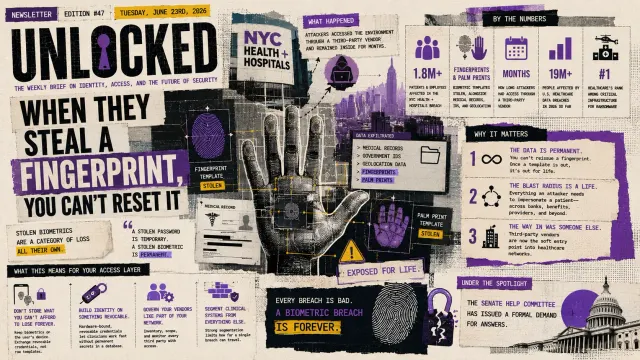
Here's the problem with that. A stolen password is a temporary crisis; you rotate it and the stolen copy becomes worthless. A stolen biometric is a permanent one. You have ten fingerprints and two palms, and you can't reissue any of them. Once a template is out, it's out for life — usable for fraud, for spoofing biometric systems, and for identity theft that can't be undone by a reset link. It's the same lesson from our recent deepfakes-versus-biometrics edition, now with real patients attached.
📉 The Numbers
- 1.8 million+ — patients and employees whose data was exposed in the NYC Health + Hospitals breach.
- Fingerprints & palm prints — biometric templates among the stolen data, alongside medical records, government IDs, and geolocation.
- Months — how long attackers had access, entering through a third-party vendor.
- 19 million+ — people affected by U.S. healthcare data breaches in 2026 so far.
- #1 — healthcare's rank among critical-infrastructure sectors for ransomware incidents.
🔍 Why Healthcare Is the Worst Place to Lose This
1. The data is permanent.
Financial data ages out; cards get reissued. A medical history and a fingerprint don't. Healthcare records are valuable on the black market precisely because they don't expire — and biometrics are the ultimate never-expires identifier.
2. The blast radius is a person's whole life.
A breached hospital record isn't one data point; it's diagnoses, IDs, location, and now biometrics bundled together — everything an attacker needs to impersonate a patient across banks, benefits, and other providers. The harm doesn't stay in the hospital.
3. The way in was someone else's system.
Third-party vendors, apps, and integrations are now the soft entry point into healthcare networks. You can harden your own environment perfectly and still be breached through a partner who wasn't. Every vendor connection is part of your attack surface.
🛡️ What This Means for Your Access Layer
Don't store what you can't afford to lose forever.
If biometrics can't be reset, the safest place for a raw template is nowhere. Prefer approaches where the biometric never leaves the user's device and only a revocable credential is exchanged — so a server breach can't leak a fingerprint that lasts a lifetime.
Build identity on something revocable.
The lesson of this breach isn't "biometrics are bad" — it's "identity should rest on something you can take back." Hardware-bound, revocable credentials let a clinician tap in fast without a shared secret sitting in a database waiting to be stolen; if a device is lost, you revoke it, not the person's hand. (That's the model behind EveryKey for healthcare.)
Govern your vendors like part of your network.
Inventory every third party with access, scope it to the minimum, and monitor it. The months-long dwell time here is the tell: the door was open and no one was watching it.
Segment clinical systems from everything else.
When an attacker gets in, segmentation decides whether they reach one archive or the whole patient population. Keep clinical, administrative, and vendor-facing systems apart.
🔑 The Bottom Line
Every breach is bad. A biometric breach is forever. Healthcare organizations sit on the richest, most permanent identity data there is, and they're being reached through partners they don't fully control. The takeaway isn't to stop using biometrics — it's to stop storing the kind of identity data that can never be reset, and to anchor access in credentials you can actually revoke.
💡 Unlocked Tip of the Week
Ask your team one question this week: "If we were breached tomorrow, what would we lose that we could never reissue?" If biometric templates or other permanent identifiers are on that list — and they're sitting in a database — that's the first thing to redesign, not the last.
🔥 Final Takeaway
We've spent years telling people to change their passwords after a breach. Nobody can change their fingerprints.
1.8 million people. Medical records, IDs, locations — and biometrics that will still identify them in fifty years. All reached through a vendor, over months, while no one was looking.
The healthcare organizations that come through this era in better shape won't be the ones with the most sensors at the door. They'll be the ones that stopped hoarding permanent identity data and moved access onto credentials they can revoke in a second — so a breach costs a reset, not a person's identity for life.
You can reset a password. You can't reset a hand. Build like you know the difference.
Stay ready. Stay resilient.
Until next time,
← Last Week: Geopolitics for Hire: When Ransomware Crews Work for Governments
📚 Sources & Related Reading
This week's sources:
- TechCrunch — NYC Health + Hospitals Says Hackers Stole Medical Data and Fingerprints (1.8M+ Affected)
- Malwarebytes — Biometrics, Diagnoses, and Bank Details Exposed in Major Healthcare Breach
- TechTarget — Biggest Healthcare Data Breaches Reported to OCR in 2026 So Far
- Paubox — More Than 19M Affected by Healthcare Data Breaches in 2026 So Far
More from Unlocked:


