The Cyber Trust Mark and the New AI Mandate: What Washington Just Changed
A June 2 executive order quietly reset the rules: AI-enabled federal cyber defense, new CISA directives within 30 days, and a required Cyber Trust Mark for connected devices. Even if you're not a federal contractor, this is about to shape what you buy and how you defend.
👋 Welcome to Unlocked
Most weeks we write about how attackers move. This week the news is about how the rules are moving.
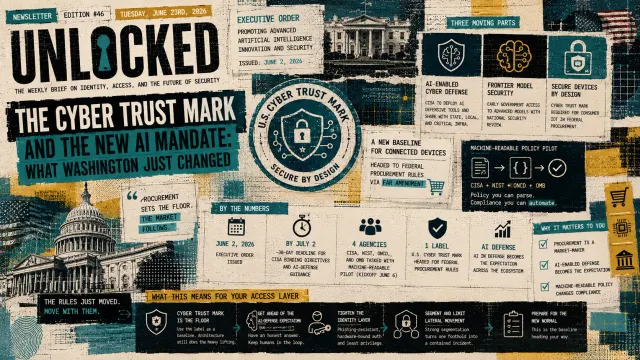
On June 2, the White House issued an executive order — Promoting Advanced Artificial Intelligence Innovation and Security — that does two things at once: it pushes the federal government to defend itself with AI, and it starts setting the terms for how AI and connected devices get secured across the economy. By July 2 — roughly a 30-day clock — CISA is directed to issue binding directives and stand up AI-enabled defensive tooling. And buried in the details is a quieter shift that will touch the private market faster than any of it: a required U.S. Cyber Trust Mark for connected devices sold to the government.
You don't have to be a federal contractor for this to reach you. Government procurement sets the floor, and the market follows.
This week we unpack what the order actually changes, and why "it's a federal thing" is the wrong way to read it.
🔑 What the Order Actually Does
Strip away the framing and there are three moving parts...
First, it makes AI-enabled cyber defense an explicit federal priority — CISA is to expand programs that put AI defensive tools in the hands of agencies, and extend access to state, local, and critical-infrastructure operators.
Second, it leans on frontier-model security, with provisions for early government access to advanced models and national-security review.
Third, it operationalizes consumer device security: the Federal Acquisition Regulatory Council is directed to amend procurement rules so federal vendors must carry the Cyber Trust Mark on consumer IoT products.
There's also a plumbing change that matters more than it sounds: a pilot for machine-readable versions of cybersecurity policy and guidance, run by CISA, NIST, ONCD, and OMB. Policy you can parse with software is policy you can automate compliance against.
📉 The Numbers
- June 2, 2026 — date the executive order was issued.
- By July 2 — the ~30-day deadline for CISA to issue binding operational directives and AI-defense guidance.
- 4 agencies — CISA, NIST, ONCD, and OMB tasked with the machine-readable policy pilot (kickoff June 6).
- 1 label — the U.S. Cyber Trust Mark, now headed for federal procurement rules via a FAR amendment.
🔍 Why It Matters Even If You're Not Federal
1. Procurement is a market-maker.
When the U.S. government says it will only buy connected devices carrying the Cyber Trust Mark, manufacturers don't build two product lines. The certified version becomes the default version, and the label starts showing up on the shelf next to everything else. Federal buying power quietly raises the security baseline for everyone.
2. AI-enabled defense becomes the expectation.
Once the federal standard is AI-assisted detection and response, that expectation flows downstream to contractors, vendors, and eventually the wider market. "Do you use AI in your defense?" stops being a differentiator and starts being a checkbox in procurement and insurance questionnaires.
3. Machine-readable policy changes compliance.
If guidance ships in a format software can read, compliance shifts from people interpreting PDFs to systems enforcing rules automatically. That's a real efficiency gain — and a sign of where audits are heading for everyone, not just agencies.
🛡️ What This Means for Your Access Layer
Read the Cyber Trust Mark as a floor, not a ceiling.
If you buy or build connected hardware, expect the label to become table stakes. Use it as a baseline procurement filter — but don't mistake a label for an architecture. Identity, segmentation, and update discipline still do the heavy lifting.
Get ahead of the AI-defense expectation.
You don't need a federal contract to be asked, by a customer or an insurer, how AI factors into your detection and response. Have an honest answer — and make sure the humans still own the decisions the AI surfaces. (We dug into the double-edged nature of AI in security in our practical guide to AI cybersecurity risks.)
Tighten the identity layer the directives assume.
Every modern federal directive rests on strong authentication and least privilege. Phishing-resistant, hardware-bound credentials and tight access scoping are the unglamorous prerequisites that make the rest of any framework actually work.
🔑 The Bottom Line
Executive orders rarely change what an attacker does next week. What they change is the slope of the field — what gets bought, what gets expected, what gets audited. This one nudges the whole market toward AI-assisted defense and labeled, accountable hardware. The organizations that read it early will be the ones quietly meeting next year's baseline this year.
💡 Unlocked Tip of the Week
Ask your team one question this week: "If a customer asked us to prove our connected products and our defenses meet the new federal baseline, could we?" If the answer is a shrug, you don't have a policy problem yet — you have a head start you're not using.
🔥 Final Takeaway
Regulation is the slow weather system behind the daily storms of breach news. It's easy to ignore until it's the reason a deal stalls or a product can't ship.
An AI-defense mandate. A device label headed into procurement rules. Policy you can read with software. None of it is dramatic. All of it moves the baseline.
The organizations that come through this in better shape won't be the ones who waited for the rules to be enforced. They'll be the ones who treated the executive order as a preview — and built toward the standard while it was still optional. Strong, accountable identity is where that work starts, federal mandate or not.
The rules just moved. Move with them.
Stay ready. Stay resilient.
Until next time,
← Last Week: The Worm in Your Supply Chain: Inside the Shai-Hulud npm Attacks
📚 Sources & Related Reading
This week's sources:
- The White House — Executive Order: Promoting Advanced Artificial Intelligence Innovation and Security
- The White House — Fact Sheet on the AI Innovation and Security Order
- Holland & Knight — Executive Order on AI Expands Cybersecurity, Federal Oversight
- Covington (Inside Privacy) — White House Releases Executive Order on Advanced AI Innovation and Security
- FCC — U.S. Cyber Trust Mark Program
More from Unlocked:


