
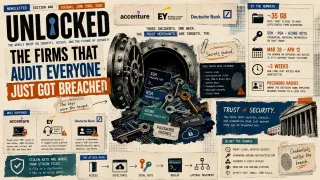
The Firms That Audit Everyone Just Got Breached
In one week, Accenture, Ernst & Young, and Deutsche Bank all turned up in breach claims — and the most valuable thing stolen wasn't files. It was keys. When the firms that certify everyone else's security get hit, the lesson is about what you store, not who you trust.

👋 Welcome to Unlocked
There's a special kind of irony in a security breach at the companies you hire to tell you whether you're secure. This week served up three of them.
In the span of a few days, Accenture, Ernst & Young, and Deutsche Bank all turned up in breach claims and leak-site listings. These are the firms that audit, consult, and underwrite everyone else's risk — and they got caught holding the bag.
But the detail worth your attention isn't the logos. It's what the attackers went after. In Accenture's case, the prize wasn't a pile of documents — it was keys and credentials. And that changes what the right lesson is.
This week we look at why the "trust merchants" are prime targets, why stolen keys are worse than stolen files, and what actually blunts the damage when — not if — secrets leak.
🔑 What Actually Happened
Three incidents, one week. A threat actor known as "888" claims to have taken roughly 35GB from Accenture — source code, configuration files, and, most notably, SSH and RSA keys plus Azure storage access keys. Separately, Ernst & Young disclosed that an unauthorized party reached its IT support-ticket platform and downloaded client tax and investment-holding documents before the access was caught. And Deutsche Bank was listed on a ransomware group's leak site alongside alleged employee records — email addresses, physical addresses, and password hashes.
A caveat worth stating plainly: some of this is attacker-supplied. Leak-site claims and stolen-data boasts are marketing as much as fact, and the full scope of each incident will take time to confirm. But the pattern is the story — and the pattern is that the organizations trusted to hold everyone else's sensitive data are being hit, and the loot is increasingly the material that unlocks further access.
📉 The Numbers
- ~35 GB — data "888" claims to have exfiltrated from Accenture, including source code and keys.
- SSH, RSA & Azure keys — the credential material reportedly in that trove, not just documents.
- March 28 – April 12 — the window an intruder had access to Ernst & Young's support-ticket platform.
- ~3 weeks — how long that access reportedly went undetected.
- Password hashes — among the Deutsche Bank employee records posted to a leak site.
🔍 Why This One Stings
1. The trust merchants are targets, too.
Consultancies, auditors, and banks concentrate the crown-jewel data of hundreds of clients in one place. That aggregation is exactly what makes them worth breaching: one successful intrusion can touch dozens of downstream organizations. "They're too sophisticated to be hit" was never true, and this week made that obvious.
2. The prize is keys, not files.
A stolen document is a disclosure problem. A stolen SSH key, RSA key, or cloud access key is an access problem — it can be replayed to log into systems, pull more data, and move laterally. When the loot is the credential itself, the breach doesn't end when the download does. It's the same theme we covered in our issue on non-human identities: the secrets are the target.
3. The way in was mundane.
No exotic zero-day here — EY's exposure ran through an IT support-ticket platform, the kind of everyday system that quietly accumulates sensitive attachments and rarely gets the scrutiny a crown-jewel database does. Attackers love the boring door nobody's watching.
🛡️ What This Means for Your Access Layer
Assume your secrets will leak — and make them worthless.
Plan as if a 35GB dump of your environment is a matter of time. Short-lived, automatically rotated, vault-issued credentials mean a leaked key expires before an attacker can use it. A secret that lives for minutes isn't much of a prize.
Make stolen keys and hashes un-loginnable.
The reason password hashes and static keys are worth stealing is that they can be replayed or cracked into access. Phishing-resistant, hardware-bound credentials break that math: there's no shared secret in a database to steal, and a captured token alone won't authenticate. You can't leak what you never stored.
Watch the boring systems.
Support desks, ticketing tools, and file-share integrations hold more sensitive data than anyone gives them credit for. Inventory them, scope their access, and monitor them like the crown jewels they quietly are.
Shrink the dwell time.
Three weeks of undetected access is three weeks too many. Detection and tight segmentation decide whether an intruder reaches one ticket queue or the whole client base.
🔑 The Bottom Line
The firms that certify everyone else's security are not immune — and their breaches are a preview of yours. The shift worth internalizing is that attackers increasingly steal the keys, not just the files. That makes "protect the data" necessary but insufficient. The real question is whether the credentials in your environment are worth anything once they're out — and the goal is to make the answer "no."
💡 Unlocked Tip of the Week
Ask your team one question this week: "If an attacker dumped our entire secrets store tomorrow, how much of it would still be valid a week later?" Every long-lived key, hardcoded credential, and reusable password on that list is a gift to the next "888." Rotate it, scope it, or replace it with something that can't be replayed.
🔥 Final Takeaway
The companies whose whole business is trust just demonstrated that trust doesn't equal security.
35GB of keys. Three weeks of quiet access. Password hashes on a leak site. None of it required outsmarting a genius — just finding the aggregated data and the credentials that unlock more of it.
The organizations that come through this in better shape won't be the ones with the most impressive logos on their vendor list. They'll be the ones who assumed the breach, and made sure the secrets it exposed were already worthless — access bound to hardware, credentials that expire, and no reusable password sitting in a database waiting to be dumped.
Everyone gets breached eventually. The question is what's still usable when they do.
Stay ready. Stay resilient.
Until next time,
← Last Week: When They Steal a Fingerprint, You Can't Reset It
📚 Sources & Related Reading
This week's sources:
- eSecurity Planet — This Week in Cybersecurity: AI-Driven Attacks, Critical Exploits, and Global Breaches
- CybersecurityNews — Weekly Cyber Security Bulletin (EY breach and more)
- GBHackers — Weekly Cybersecurity Newsletter: Top Stories, July 2026
- SharkStriker — July 2026 Data Breaches: Major Incidents & Updates
More from Unlocked:


