

Step-by-Step Guide to Identity Access Management
Identity is the new security perimeter. This guide walks through how IAM works—authentication, authorization, and access control—compares leading platforms, and shows how to fold it all into a Zero Trust strategy.

The 2026 Identity Crisis: Why Access Management Has Never Mattered More
Identity access management — the discipline of controlling who can access what inside your organization, and under what conditions — is now the central battleground of enterprise cybersecurity.
Here is a quick answer if you just need the essentials:
What is Identity Access Management (IAM)?
IAM is the set of policies, processes, and technologies that ensure only the right people (and systems) can access the right resources at the right time. It covers four core functions:
- Administration — creating, managing, and removing digital identities
- Authentication — verifying that a user or system is who it claims to be
- Authorization — defining what an authenticated identity is allowed to do
- Auditing — logging and reviewing access activity for security and compliance
The numbers tell a stark story. Thirty percent of all cyberattacks involve the theft and abuse of valid credentials. When credential theft causes a breach, it costs organizations an average of $4.67 million and takes 246 days to detect and contain. That is not a perimeter problem — it is an identity problem.
The environment making this harder has changed fast. The average enterprise team now runs across 73 different SaaS applications, each carrying its own identity silo and access policy gap. Meanwhile, nonhuman identities — API keys, service accounts, automation tokens, AI agents — already outnumber human users 10 to 1 in a typical enterprise, and generative AI is accelerating that ratio.
This is the identity sprawl problem. And it does not have a firewall solution.
Zero Trust security frameworks have moved IAM from a back-office IT function to a foundational security control. Every Zero Trust decision starts with one question: who is this, and should they have access right now? IAM is the system that answers it.
This guide walks through how IAM works, what the core components are, which platforms lead the market in 2026, and how to implement it without creating new operational bottlenecks. Whether you are a CISO building a business case, a security engineer evaluating tooling, or an IT administrator figuring out where to start — there is a practical layer here for you.
What is Identity Access Management and Why Does It Matter?
At its core, a "digital identity" is not just a username and password. It is a collection of attributes, permissions, and behavioral patterns stored in a database that represents a human (an employee, contractor, or customer) or a machine (an API, container, or service account).
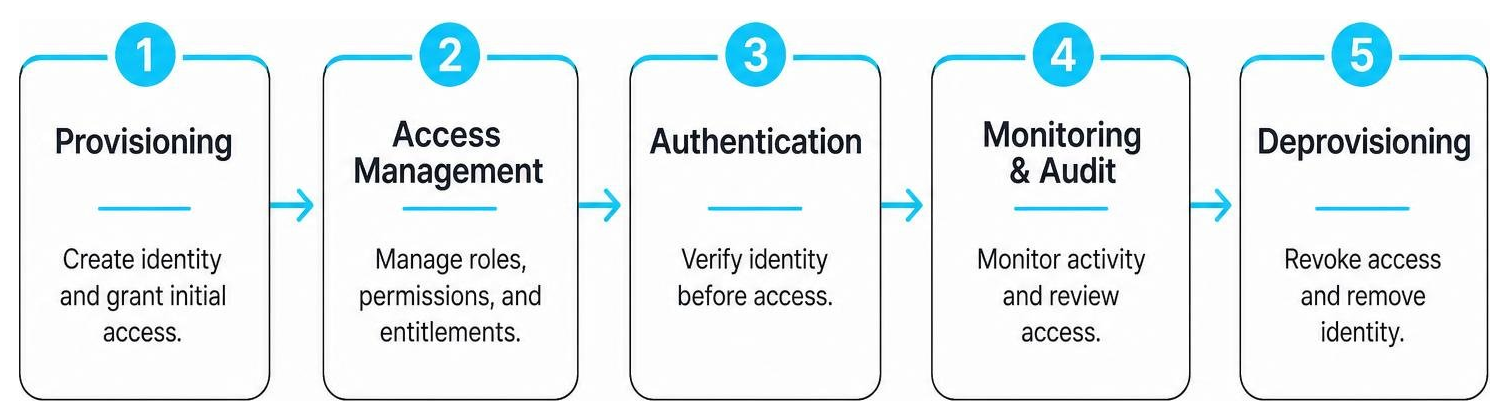
Without a centralized system to govern these identities, organizations default to "identity sprawl." When an employee joins a company, they might need access to AWS, Salesforce, GitHub, and Slack. If the IT team has to manually create these accounts, they create security gaps. When that employee leaves, a missed deprovisioning step leaves an active, orphaned account—the perfect entry point for threat actors.
This is why understanding Identity Management Benefits Why Modern Iam Is Essential For Secure Efficient Access is critical for modern business operations. It is not just about locking things down; it is about automating the lifecycle of every identity so you do not have to rely on human memory to protect your network.
The stakes are incredibly high. In the current threat landscape, attackers rarely "hack" their way in—they simply log in using stolen credentials. Phishing, session hijacking, and social engineering bypass traditional perimeter defenses with ease. By centralizing control, IAM acts as a shock absorber. In fact, implementing modern IAM technology lowers the average cost of a data breach by $189,838. To understand what happens when these systems fail, security teams should review the Identity Access Management Risks The Top Security Threats Defining 2026.
To standardize how organizations build these systems, the National Institute of Standards and Technology (NIST) maintains the NIST SP 800-63 (Digital Identity Guidelines) framework. This standard splits identity assurance into three distinct categories:
- Identity Assurance Level (IAL): How securely you verify the user's real-world identity.
- Authenticator Assurance Level (AAL): How strong the authentication process is (e.g., single-factor vs. multi-factor).
- Federation Assurance Level (FAL): How securely identity assertions are passed between different systems.
The Core Pillars of Identity Access Management
To build an IAM architecture that satisfies NIST standards and keeps auditors happy, you must address the four pillars of the identity lifecycle:
- Administration: This is the management plane. It handles user provisioning (creating accounts), deprovisioning (deleting them), self-service password resets, and role modifications. It ensures that when a marketing manager is promoted to director, their access rights update automatically.
- Authentication (AuthN): The gatekeeper. This process proves that a user is who they claim to be. Modern AuthN relies on Multi-Factor Authentication (MFA), adaptive risk-based scoring, and passwordless technologies.
- Authorization (AuthZ): The policy engine. Once AuthN proves who the user is, AuthZ decides what they are allowed to touch. It maps the authenticated identity to specific permissions, ensuring a junior developer cannot modify production database schemas.
- Auditing: The black box recorder. Auditing tracks every login attempt, policy change, and resource access event. It provides the historical logs needed to pass compliance audits and reconstruct what happened during an incident.
For a deeper dive into these fundamentals, explore Identity And Access Management Iam The Complete Guide To Security Access And Credential Management.
The Mechanics of IAM: Authentication vs. Authorization
The terms authentication and authorization are often used interchangeably by non-technical stakeholders, but confusing them in a security design is a recipe for privilege creep.
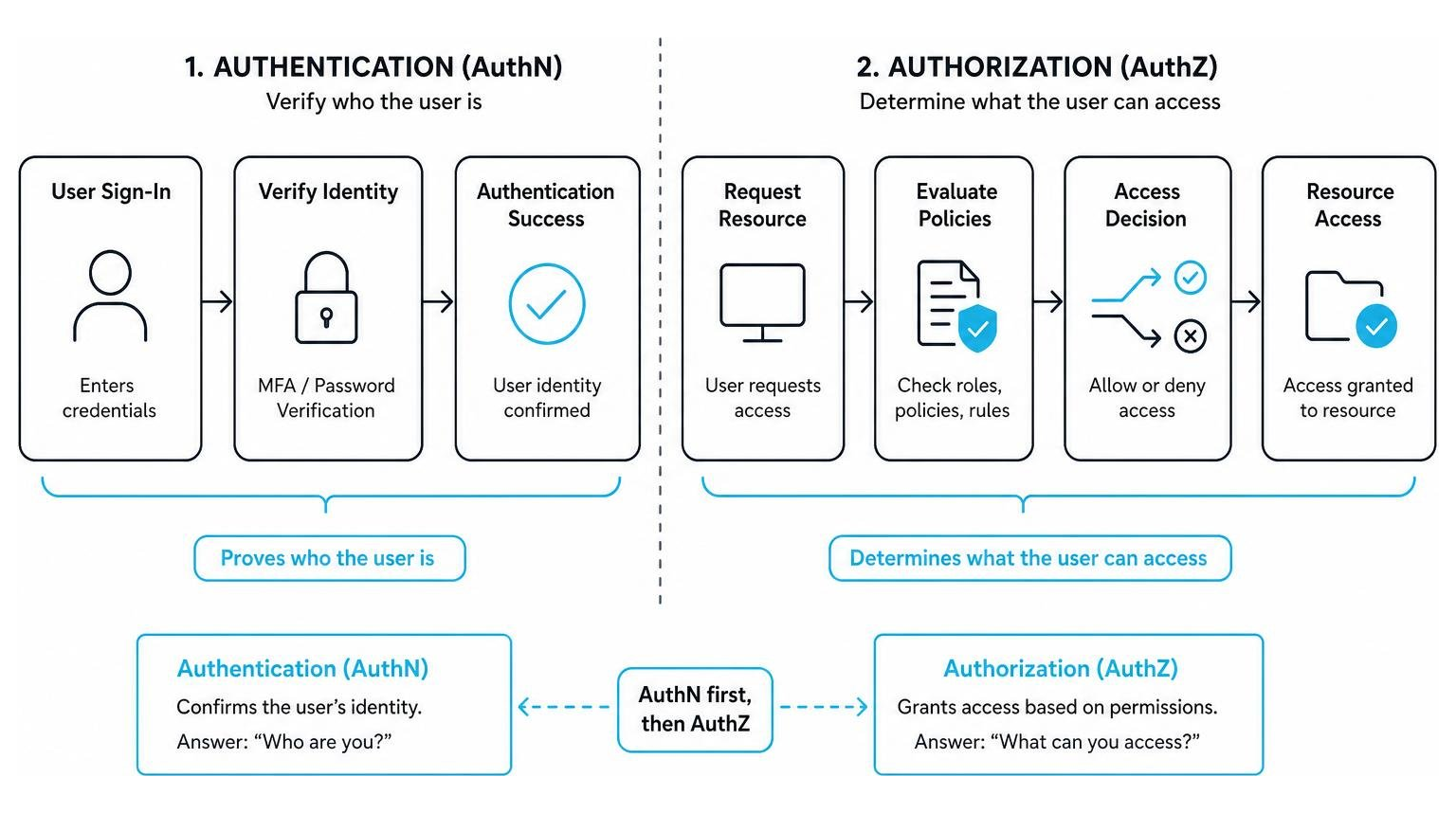
Think of it like checking into a high-security research facility:
- Authentication is showing your government-issued ID card at the front desk. The guard verifies the photo matches your face. You are now allowed inside the lobby.
- Authorization is the keycard you are handed. It is programmed to let you into the third-floor lab, but if you swipe it at the server room door, it flashes red.
Maintaining this boundary is essential for keeping a Secure Iam Protecting Digital Identities And Access In A Zero Trust World.
Authentication Protocols and Standards
To make authentication work across hundreds of different cloud platforms without forcing users to log in seventy times a day, the industry relies on standardized protocols:
- SAML 2.0 (Security Assertion Markup Language): An XML-based protocol widely used in enterprise environments. It allows an Identity Provider (IdP) to pass authorization credentials to a Service Provider (SP). While robust, SAML is increasingly viewed as legacy due to XML parsing vulnerabilities and its heavy payload size.
- OIDC (OpenID Connect): A lightweight identity layer built on top of the OAuth 2.0 framework. It uses JSON Web Tokens (JWT) to verify the identity of an end-user. It is the modern standard for web applications and mobile devices.
- FIDO2 / WebAuthn: The gold standard for modern authentication. Backed by the FIDO Alliance, FIDO2 enables passwordless, phishing-resistant authentication using public-key cryptography. It leverages built-in device authenticators (like Windows Hello or Apple FaceID) or physical security keys to eliminate credentials entirely.
If you are looking to deploy these protocols in production, choosing the right infrastructure is key. Read The Iam Tool Securing Identity And Access Management For Modern Security Needs to understand how modern tools package these protocols.
Authorization Frameworks and Access Control
Once a user is verified, the IAM system must enforce access controls. There are several ways to structure this:
- Role-Based Access Control (RBAC): Permissions are assigned to specific roles (e.g., "Billing Administrator" or "QA Engineer"), and users are assigned to those roles. This is simple to manage but can lead to "role explosion" in large enterprises.
- Attribute-Based Access Control (ABAC): A dynamic approach that evaluates attributes in real-time. These attributes can belong to the user (department, clearance level), the resource (classification level), or the environment (IP address, time of day). For example: "Allow access to the financial database only if the user is in the Finance department, accessing from a corporate-managed laptop, between 9 AM and 5 PM."
For cloud-native deployments, platforms like AWS Identity and Access Management (IAM) allow organizations to write incredibly granular ABAC and RBAC policies to manage machine-to-machine permissions at scale.
Business and Security Benefits of Modern IAM
While security practitioners view IAM through the lens of risk mitigation, business leaders often look at ROI. A well-designed IAM system delivers on both fronts.

1. Hardening the Security Posture
By enforcing MFA across all endpoints and automating the user lifecycle, IAM closes the most common entry points for attackers. Phishing campaigns fail when there are no passwords to steal, and session hijacking risks are mitigated when adaptive authentication challenges suspicious access requests.
2. Streamlining Compliance and Auditing
Modern regulatory frameworks—such as GDPR, HIPAA, and SOX—require organizations to prove who has access to sensitive data and how that access is governed. Manual audits are slow, expensive, and prone to human error. IAM platforms automate this by generating real-time compliance reports, tracking Segregation of Duties (SoD) violations, and conducting automated access certification campaigns.
3. Boosting Employee Productivity
The average employee wastes hours every year resetting forgotten passwords or waiting for IT tickets to be approved so they can access a new tool. Implementing Single Sign-On (SSO) and self-service access request portals removes these friction points, allowing teams to work without artificial IT bottlenecks.
To learn how to centralize these benefits across an enterprise IT estate, see Identity Manager Centralizing User Access And Governance In The Enterprise.
Comparing Leading Identity Access Management Platforms
No single IAM platform fits every organization. The market is split between Workforce IAM (focused on employee access and authentication) and Identity Governance and Administration (IGA) (focused on compliance, deep lifecycle management, and auditing).
| Platform | Category | Primary Strength | Best For |
|---|---|---|---|
| Microsoft Entra ID | Workforce IAM / IdP | Deep Windows/M365 integration, robust Conditional Access policies. | Organizations heavily invested in the Microsoft ecosystem. |
| Okta Workforce | Workforce IAM / IdP | Massive pre-built integration catalog, vendor-neutral cloud architecture. | Heterogeneous cloud environments using diverse SaaS apps. |
| Ping Identity | Workforce / Hybrid IAM | Highly customizable, excellent support for legacy and on-prem systems. | Large enterprises with complex hybrid cloud architectures. |
| One Identity | IGA | Deep governance, strong Active Directory and SAP integration. | Enterprises needing to close the gap between standard and privileged access. |
| SailPoint | IGA | Industry-leading identity intelligence, complex lifecycle modeling. | Highly regulated enterprises requiring advanced compliance and auditing. |
For a broader evaluation of the market, check out the Best Iam Solutions Of 2026 Top 10 Identity Access Management Platforms Compared and keep up with the platforms shaping the ecosystem in Leading Iam Solutions 2025 2026 Identity And Access Platforms Shaping The Future Of Enterprise Secur.
Workforce Identity and Access Management Solutions
Workforce IAM focuses on the daily user experience: logging in, accessing apps, and staying secure on the move.
- Microsoft Entra ID: Formerly known as Azure Active Directory, Microsoft Entra ID is the dominant enterprise IdP. Its "Conditional Access" engine allows administrators to build highly granular, risk-based access policies that evaluate signals from Microsoft Defender and Azure Sentinel in real-time.
- Okta Workforce Identity Cloud: Okta is the leading independent cloud directory. Its primary advantage is its massive integration ecosystem, allowing IT teams to connect new SaaS apps with a few clicks. It is highly intuitive for end-users and administrators alike.
- Ping Identity: Ping shines in complex, multi-generation enterprises. If you have legacy on-premises databases running alongside modern cloud applications, Ping provides the federation tools to bridge the gap without forcing a massive code rewrite.
For a detailed breakdown of these and other workforce options, read our guide on the Best Iam Solutions Of 2026.
Identity Governance and Administration (IGA) Platforms
While Workforce IAM handles the front door (authentication), IGA platforms handle the closets (who has access to what, why do they have it, and who approved it?).
- One Identity Manager: This platform focuses on business-driven governance. By using One Identity Manager, organizations can automate user provisioning across hybrid environments and use AI-assisted reporting to satisfy strict compliance mandates.
- SailPoint IdentityIQ: SailPoint is the heavyweight of identity governance. It uses machine learning to analyze access patterns, detect anomalous permissions, and automate the re-certification of thousands of users across complex enterprise applications.
- IBM Security Verify: IBM combines access management with deep governance analytics. It is particularly strong in mainframe and hybrid enterprise environments where identity threat detection is a priority.
To learn how to evaluate these governance platforms against your specific compliance needs, read the Iam Tool Guide Secure Access User Management And Compliance Explained.
Implementing IAM: Challenges, Best Practices, and Zero Trust Integration
Implementing an IAM system is not a "set-it-and-forget-it" software installation. It is a fundamental shift in how your organization handles trust.
The Shift to Zero Trust
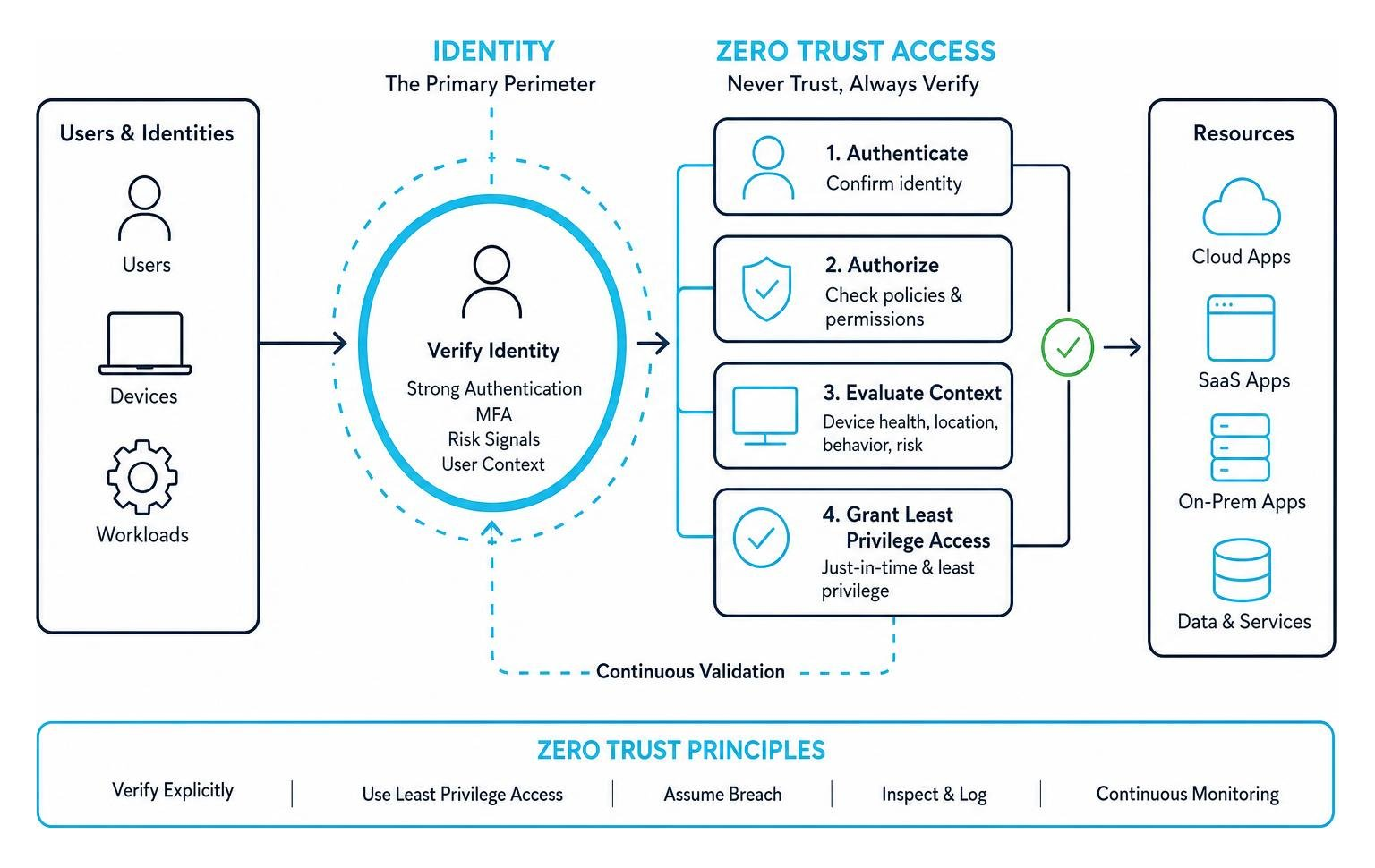
In a Zero Trust architecture, the traditional network perimeter is assumed to be compromised. Therefore, we must never trust, always verify. Identity is the new perimeter. Every access request must be authenticated, authorized, and continuously validated based on contextual data (device health, IP address, user behavior) before access is granted.
Overcoming Implementation Challenges
- Legacy System Integration: Many older enterprise applications do not support modern protocols like OIDC or SAML. Organizations must use identity proxies or tools like Ping Identity to wrap legacy systems in modern security controls.
- User Friction: If security controls are too heavy, users will find workarounds (like sharing credentials or using shadow IT). Implementing passwordless authentication and single sign-on helps balance security with user experience.
- Identity Threat Detection and Response (ITDR): Attackers are constantly finding new ways to bypass MFA (such as MFA fatigue attacks). Modern IAM deployments must integrate ITDR capabilities to continuously monitor identity systems for anomalous behavior and automatically isolate compromised accounts.
To ensure your cloud deployments remain secure, follow the steps outlined in Cloud Iam Best Practices and learn how to mitigate deployment bottlenecks with Essential Strategies For Managing Identity And Access Management Risks.
Frequently Asked Questions about IAM
What is the difference between identity management and access management?
Identity management focuses on the who. It is the database of record that stores user attributes (name, department, email) and manages their lifecycle from onboarding to offboarding. Access management focuses on the what. It uses the data from the identity system to enforce authentication policies (like MFA) and authorization rules (like RBAC) when a user tries to access a resource.
How does IAM support a Zero Trust security model?
In Zero Trust, you cannot trust a user just because they are on the corporate network. IAM provides the continuous authentication and context-aware authorization needed to verify every single request. It evaluates signals like device posture, location, and behavioral risk before dynamically granting or denying access to microsegmented resources.
Why are nonhuman identities a growing security risk in 2026?
Nonhuman identities (NHIs)—such as API keys, service accounts, and secrets used by automated workflows—now outnumber human users 10 to 1. Unlike humans, NHIs do not use MFA, they rarely change their passwords, and developers often hardcode their credentials into source code. If an attacker steals an API key, they gain persistent, unmonitored access to your cloud infrastructure. Managing these machine identities is one of the most critical security challenges of 2026.
Conclusion
Identity and Access Management is no longer just an IT checkbox—it is the foundation of modern enterprise security. As organizations navigate hybrid workforces, sprawling cloud environments, and the explosion of nonhuman identities, a centralized, automated IAM strategy is the only way to scale securely.
For organizations looking to bridge the gap between digital identity and physical access control, EveryKey offers a unique approach. By pairing enterprise identity federation with high-assurance hardware tokens, EveryKey allows users to seamlessly unlock their laptops, log into web applications passwordlessly, and open physical office doors using the same secure credential. This unified approach eliminates password friction while enforcing strict Zero Trust principles at every touchpoint.
To find the right platform for your organization's specific needs, explore our comprehensive Buyer's Guide to Secure Scalable Access.