

No More Manual Setup with Just in Time JIT Provisioning
Manual account setup slows onboarding and opens security gaps. See how just-in-time (JIT) provisioning automates user access at first login, enforces zero-trust, and trims SaaS licensing costs enterprise-wide.

The Manual Provisioning Problem That's Costing You More Than You Think
Just in time JIT provisioning is an automated method of creating user accounts in applications at the exact moment a user first logs in — no tickets, no waiting, no manual setup required.
Here's the quick version:
- What it is: An identity mechanism that auto-creates user accounts on first login using identity data from an SSO provider
- How it works: Your Identity Provider (IdP) sends user attributes (name, email, role) to a Service Provider (SP) via SAML or OIDC — the SP creates the account instantly
- Key benefit: Eliminates manual IT provisioning overhead and reduces onboarding delays
- Key limitation: JIT creates accounts but does not delete them — deprovisioning requires a separate process like SCIM
- Who it's for: Any organization using SSO across multiple SaaS applications
Think about what happens every time a new employee joins your organization. Someone opens a ticket. IT creates accounts across a dozen applications — one by one. The new hire sits idle on day one waiting for access. The engineer who was supposed to get them into the CRM forgot about Salesforce. And somewhere, an account for someone who left six months ago is still active.
That scenario isn't rare. It's the default state for organizations that rely on manual provisioning workflows.
The numbers reflect the cost. The Verizon Data Breach Investigations Report found that more than 80% of breach incidents involve compromised credentials or poorly managed access. And according to LastPass research, end users spend an average of 36 minutes per month just on password-related activities — time that compounds across hundreds of employees.
JIT provisioning addresses the front end of this problem directly: it removes the human bottleneck from user onboarding entirely. But as we'll cover in this guide, it's one piece of a larger identity architecture — not a complete solution on its own.
What is Just in Time JIT Provisioning?
At its core, just in time jit provisioning (often abbreviated as JIT provisioning) is an on-demand user onboarding mechanism. Instead of pre-creating accounts for every potential user in every corporate application, the system defers account creation until the exact millisecond a user attempts to access the application for the first time.
This architectural shift relies on a trusted relationship between two primary entities:
- The Identity Provider (IdP): The centralized system that stores and verifies user identities (such as Okta, Microsoft Entra ID, or Ping Identity).
- The Service Provider (SP): The external SaaS application or internal resource the user wants to access (such as Slack, Salesforce, or AWS).
When a user logs in, the IdP passes a bundle of cryptographically signed user attributes to the SP. If the SP recognizes the user, it logs them in. If the SP has never seen this user before, it reads the incoming attributes, instantly creates a local user profile, assigns the appropriate roles, and grants access.
This process is a fundamental building block of modern Identity and Access Management (IAM): The Complete Guide to Security, Access, and Credential Management.
Traditional Manual Provisioning vs. Just-in-Time Workflows
Before JIT and automated protocols, IT departments relied on manual provisioning. When a new employee was hired, HR would notify IT, and a sysadmin would manually create accounts across various platforms.
This manual approach introduces several pain points:
- Administrative Overhead: IT teams are bogged down by repetitive "click-ops" tasks, managing ticket queues just to grant basic application access.
- Onboarding Lag: New hires often face a "first-day friction" period where they cannot perform their duties because their accounts have not yet been created.
- Human Error: Manual data entry leads to inconsistent usernames, misspelled email addresses, and incorrect role assignments.
- Orphaned Accounts: When employees change roles or leave the company, manual offboarding is fragile. IT analysts regularly forget to revoke access, creating permanent security vulnerabilities.
By contrast, JIT workflows automate the registration step. For a deeper analysis of how this changes day-to-day operations, see our guide on Understanding Just-in-Time User Provisioning in Enterprise Environments.
How SAML SSO and Just in Time JIT Provisioning Work Together
JIT provisioning does not exist in a vacuum; it is deeply intertwined with Single Sign-On (SSO) protocols, most notably Security Assertion Markup Language (SAML) 2.0 and OpenID Connect (OIDC).
Under normal SAML SSO, the protocol simply authenticates the user. However, when JIT is enabled, the SAML assertion does double duty: it authenticates the user and carries the payload required to provision them.
The step-by-step authentication and provisioning flow works as follows:
- Access Request: The user attempts to access a Service Provider (e.g., a SaaS application) directly, or clicks on the application's icon in their IdP user dashboard.
- Redirect to IdP: If the user goes directly to the SP, the SP redirects the user's browser to the IdP for authentication.
- Authentication: The IdP verifies the user's identity. This is where organizations enforce strong security measures, such as Multi-Factor Authentication (MFA) or passwordless hardware keys.
- Assertion Generation: Once authenticated, the IdP generates a SAML assertion (an XML document) or an OIDC ID token. This token contains a digital signature (using XML certificates) and specific user attributes (such as email, givenName, surName, department, and group memberships).
- Assertion Delivery: The browser posts the signed assertion back to the SP.
- Verification and Creation: The SP verifies the cryptographic signature against the IdP's public certificate. It checks its local database for an existing user record matching the unique identifier (usually the SAML NameID or email). If no record exists, the SP's JIT engine parses the attributes and creates the account on the fly.
- Session Initiation: The SP logs the user in and establishes their session.
For a comprehensive breakdown of the underlying protocol mechanics, refer to our SAML 2.0 Authentication: Complete Guide.
JIT Provisioning vs. SCIM: Understanding the Differences
A common point of confusion for IT professionals is the difference between JIT provisioning and the System for Cross-domain Identity Management (SCIM) standard. While both automate user management, they use entirely different architectural patterns.
JIT is reactive and event-driven. It only triggers when a user actively attempts to log in. If an administrator assigns 100 users to an application in the IdP, zero accounts are created in the target application until those users actually click the login button.
SCIM is proactive and state-driven. It is an API-based protocol (typically running over REST) that synchronizes identity data in real-time. The moment an administrator assigns a user to an application in the IdP, the IdP sends a direct API request to the SP to create the account, regardless of whether the user ever logs in.
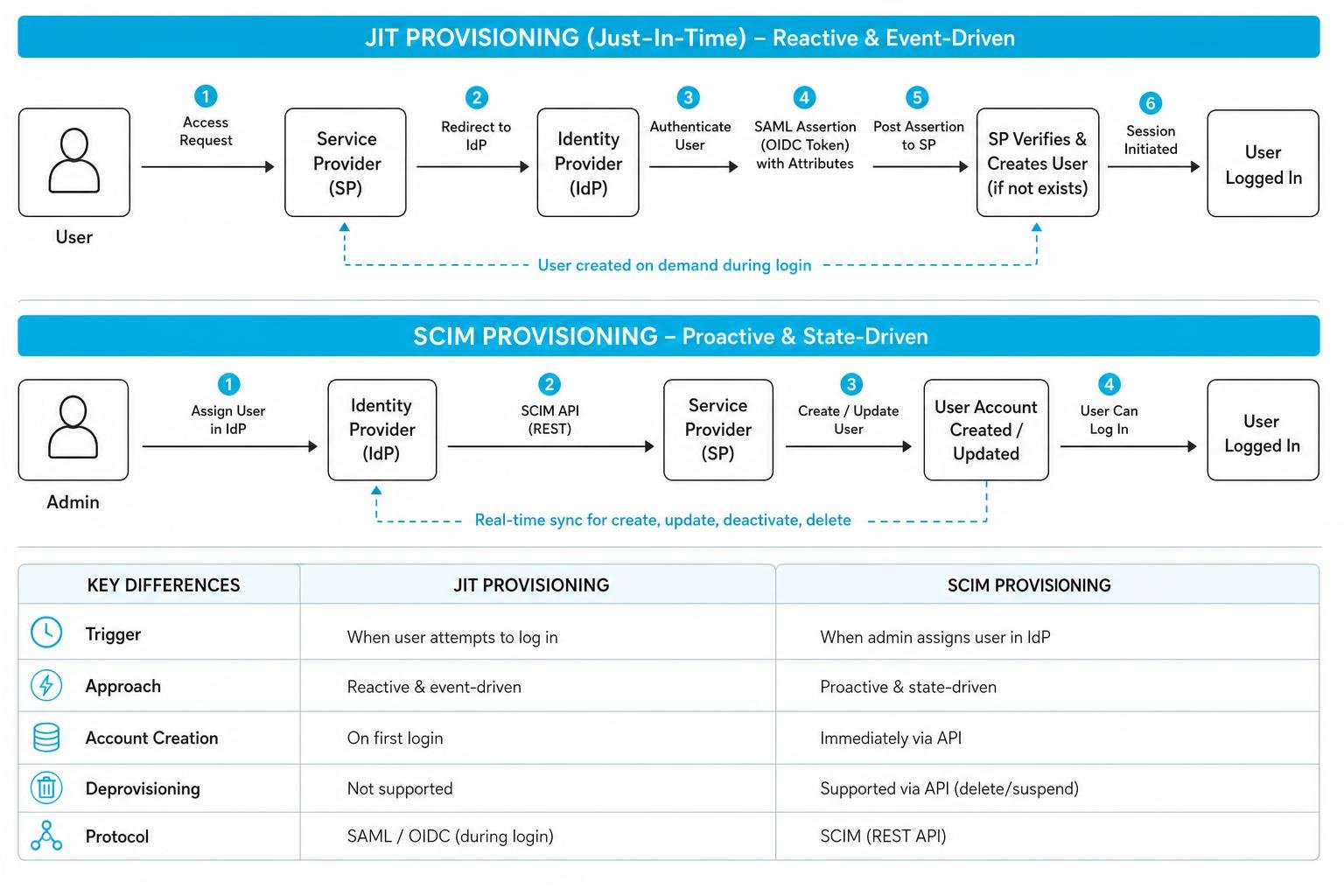
This architectural difference has massive implications for lifecycle management, especially when it comes to deprovisioning. Because JIT only runs during the login handshake, it has no way to delete or deactivate accounts. When a user is deleted from the IdP, the target application is never notified via JIT. SCIM, however, listens for changes in the IdP and immediately sends a delete or suspend API call to the SP.
To learn more about implementing API-driven identity synchronization, read our guide on Cross-Domain Identity Management: Automating and Securing User Provisioning with SCIM.
When to Use JIT vs. SCIM
Choosing between JIT and SCIM depends on your security requirements, the capabilities of your target applications, and your budget.
| Feature / Capability | Just-in-Time (JIT) Provisioning | SCIM Provisioning |
|---|---|---|
| Trigger Mechanism | User-initiated login event | Admin-initiated change in IdP (API call) |
| Protocols Used | SAML assertions / OIDC tokens | REST APIs (JSON payloads) |
| Account Creation | On-demand (at first login) | Immediate (pre-provisioned) |
| Profile Updates | Occurs only during subsequent logins | Real-time synchronization |
| Deprovisioning | Not supported natively | Fully supported (immediate deactivation) |
| Setup Complexity | Low (configured within SSO settings) | Medium-High (requires API tokens and endpoints) |
| SaaS License Optimization | High (licenses consumed only on actual use) | Moderate (licenses consumed upon assignment) |
JIT is highly effective for SaaS license optimization. If an enterprise purchases 500 licenses for an expensive developer tool, but only 50 developers actually use it, JIT ensures that accounts (and thus licenses) are only allocated to those 50 active users. Pre-provisioning via SCIM would immediately consume 500 licenses upon assignment.
The Security Architecture: Zero Trust, JIT Access, and JIT Privilege
In a modern Zero Trust security model, the guiding principle is simple: never trust, always verify. Under this framework, static, always-on access (known as standing privilege) is a significant vulnerability. If an attacker compromises a credential with permanent administrative rights, they gain immediate, unrestricted access to the network.
To combat this, security architectures have evolved to incorporate various "Just-in-Time" concepts. While just in time jit provisioning focuses on identity creation, related concepts focus on restricting access windows and privilege levels.
For a broader perspective on securing enterprise identities, check out our resource on What is Privileged Access Management?.
Enforcing Least Privilege and Zero Standing Privilege (ZSP)
Gartner's Zero Standing Privilege (ZSP) framework advocates for eliminating always-on elevated access. Instead of assigning users to permanent administrative groups, organizations should grant privileges dynamically, on-demand, and for a limited duration.
This is where JIT Access and JIT Privilege intersect with Zero Trust. By combining automated user creation with dynamic, time-bound group assignments, organizations can ensure that users only have the access they need to perform a specific task, and only for the duration of that task.
For enterprise environments running Microsoft infrastructures, this architecture is often managed through specialized tooling. You can read more in our Azure Privileged Identity Management (PIM) Overview and Guide.
Just in Time JIT Provisioning vs. JIT Access and JIT Privilege
It is critical to distinguish between these three closely related terms:
- JIT Provisioning: The automated creation of a user account profile within an application during their first login.
- JIT Access: The practice of granting a user temporary, time-bound access to a specific system or application (e.g., giving a contractor access to a production server for a 4-hour window).
- JIT Privilege: The dynamic escalation of a user's permissions within an active session (e.g., temporarily adding a standard user to the Active Directory "Domain Admins" group during a credential checkout, and automatically removing them once the task is complete).
JIT Privilege is particularly effective at mitigating residual hash compromise in Active Directory environments. Whenever a privileged user logs into a system interactively, a password hash is cached in the system's memory. Attackers can harvest these residual hashes to escalate privileges. By using JIT Privilege to dynamically add and remove accounts from privileged groups only during active tasks, organizations significantly reduce the window of opportunity for hash-harvesting attacks.
To secure the root of trust during these sensitive, high-privilege JIT workflows, organizations can deploy hardware-based security keys. EveryKey's enterprise solutions provide passwordless authentication that integrates directly with identity providers, ensuring that dynamic privilege escalation requests are cryptographically bound to physical hardware in the possession of an authorized administrator.
Implementation Best Practices and Supported Applications
Implementing JIT provisioning in an enterprise environment requires careful planning to prevent configuration errors, security gaps, and disrupted user workflows.
Before rolling out JIT, ensure your core SSO infrastructure is robust. Our Single Sign-On Documentation: A Practical Guide to Modern SSO Implementations provides a solid foundation for setting up secure federated identity connections.
Step-by-Step Configuration and Attribute Mapping
The success of a JIT deployment depends entirely on accurate attribute mapping. If the Service Provider expects an attribute named emailAddress but the Identity Provider sends mail, the JIT process will fail, and the user will receive an authentication error.
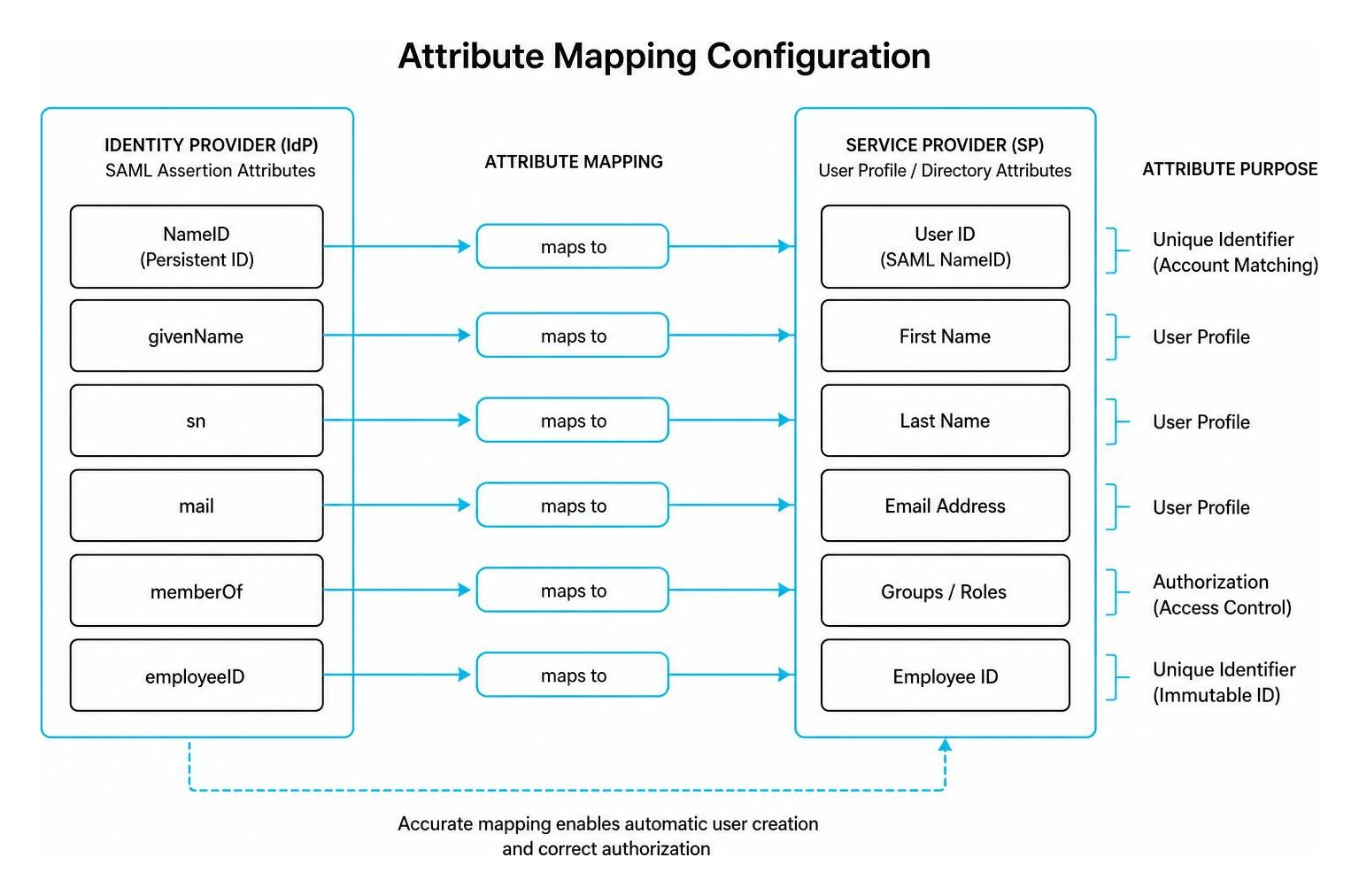
When configuring JIT, administrators must map several key attributes:
- Unique Identifier (SAML NameID): This is the anchor attribute used to match the incoming identity to an existing account. While email addresses are commonly used, they are fragile because employees occasionally change their names or email domains. Using a persistent, immutable identifier (such as an employee ID or an IdP-generated UUID) is highly recommended.
- User Profile Attributes: Basic details like
givenName(First Name),sn(Last Name), andemail. - Authorization Attributes: Group memberships or role assignments. These attributes dictate the user's permissions within the target application.
For example, when Configuring SAML JIT Provisioning in cloud infrastructures like Oracle Cloud Infrastructure (OCI), administrators define explicit attribute mappings. In OCI, JIT-provisioned users are created by default with the property isFederatedUser=true, which prevents them from bypassing the IdP to log in directly with local credentials. Additionally, setting bypassNotification=true during configuration ensures that newly provisioned users do not receive confusing, automated system-activation emails.
Supported Applications and IoT Use Cases
JIT provisioning is widely supported across enterprise software suites and cloud platforms.
- Docker Enterprise: Allows organizations to automatically provision developers into team spaces upon their first login. For detailed configuration steps, see the Just-in-Time provisioning | Docker Docs.
- AWS IoT Core: JIT principles extend beyond human identities to physical devices. In large-scale IoT deployments, manually registering thousands of smart devices is impossible. AWS IoT Core uses Just-in-Time Provisioning (JITP) to automatically register and activate device certificates when a hardware device connects to the cloud for the first time. Learn more about this machine-to-machine workflow in the Just-in-time provisioning - AWS IoT Core documentation.
Risks, Limitations, and Mitigation Strategies
While JIT provisioning is a powerful tool for automating onboarding, it introduces distinct security risks that security teams must actively manage.

The primary risks of a JIT-only architecture include:
- The Deprovisioning Gap: Because JIT is a reactive, login-time trigger, it has no native mechanism for deleting accounts. When an employee leaves the company and is deactivated in the IdP, their active sessions are terminated, but their local user account remains intact inside the target SaaS applications. These "ghost" or "orphaned" accounts represent a massive security and compliance risk.
- Privilege Creep: If a user's role changes within the organization (e.g., moving from Engineering to Product), their group memberships in the IdP will update. However, if they do not log into a specific SaaS application for several months, their outdated, elevated privileges will persist inside that application until their next login triggers a JIT update.
- Imprecise Attribute Mapping: If the group mappings between the IdP and SP are misconfigured, JIT may accidentally provision new users with excessive default privileges, such as administrative access.
Mitigating the Deprovisioning Gap
To secure a JIT-enabled environment, organizations must bridge the deprovisioning gap using one of several strategies:
- Strategic SCIM Integration: The most robust solution is to pair JIT and SCIM. Use JIT for lightweight, on-demand onboarding and license optimization, but enable SCIM to handle real-time deprovisioning and profile updates. Running JIT and SCIM in parallel on the same application can sometimes cause write-conflict errors; check with your application vendor for their recommended configuration.
- HR-Driven Offboarding Playbooks: If an application does not support SCIM, IT must maintain a strict, documented offboarding checklist. When an employee departs, automated scripts or IT analysts must manually delete their accounts from non-SCIM SaaS applications.
- Security Orchestration (SOAR) Workflows: Modern low-code security orchestration platforms (such as Tines or Torq) can automate the cleanup process. When a "User Deactivated" event fires in the IdP, the SOAR platform can trigger API calls to various downstream SaaS applications to automatically disable or delete the orphaned accounts.
Frequently Asked Questions about JIT Provisioning
Can JIT provisioning automatically deprovision users?
No. JIT provisioning is strictly a reactive process that occurs during user authentication. Because it requires a login event to trigger, it cannot perform deprovisioning, account deletion, or suspension. To automate the removal of user accounts when an employee leaves, organizations must implement SCIM or use custom API scripts.
Does JIT provisioning require SAML?
While JIT provisioning is most commonly associated with SAML 2.0 SSO, it is not strictly required. JIT can also be implemented using OpenID Connect (OIDC) tokens. The core requirement is that the authentication protocol must be capable of securely carrying user identity assertions and attributes from the Identity Provider to the Service Provider.
Which popular applications support JIT provisioning?
Many major enterprise cloud applications support JIT provisioning, including Amazon Web Services (AWS), Oracle Cloud, Adobe Creative Cloud, Slack, Salesforce, Zoom, and GitHub. However, administrators should always verify JIT support and attribute requirements with each software vendor before planning an identity rollout.
Conclusion
Just-in-Time (JIT) provisioning is an essential tool for modern enterprise identity governance. By automating user creation at the moment of first login, it eliminates administrative bottlenecks, speeds up employee onboarding, and optimizes SaaS licensing costs.
However, JIT is not a complete identity lifecycle solution. Its inability to handle deprovisioning means it must be deployed thoughtfully — ideally paired with SCIM or automated orchestration workflows to prevent the accumulation of orphaned accounts and security gaps.
At Unlocked, we advocate for a layered defense. Securing the authentication handshake that triggers JIT provisioning is critical. Combining automated provisioning workflows with hardware-based authentication security (such as EveryKey's enterprise security keys) ensures that your automated onboarding pipelines remain highly secure, resilient, and fully aligned with Zero Trust principles.
To continue building your identity and access management roadmap, explore our detailed guide on Cross-Domain Identity Management: Automating and Securing User Provisioning with SCIM.