

Enterprise IAM Best Practices for Tackling Complex Implementation Hurdles

Why Enterprise IAM Best Practices Matter Now
To implement IAM best practices enterprise teams should centralize identities, enforce phishing-resistant MFA, replace standing access with temporary roles, automate joiner-mover-leaver changes, and collect continuous proof that controls work in real applications.
- Grant only role-based, time-bound access.
- Use federation and SSO instead of separate local credentials.
- Govern machine identities, API keys, and service accounts like human users.
- Monitor access decisions and privilege changes continuously.
Credential theft remains a core business risk: Verizon's 2022 DBIR found stolen credentials in most observed web application attacks and nearly half of reported breaches. The NIST Digital Identity Guidelines, updated in August 2025, reinforce a shift toward stronger, phishing-resistant authentication and risk-based identity controls.
For enterprises, IAM is no longer just an account-management project. It is the control plane for cloud access, privileged work, compliance evidence, and breach containment.
Core Architectural Pillars: IAM Best Practices Enterprise Frameworks for Governance
Enterprise identity architecture demands a structured foundation that eliminates fragmented directories, opaque privileges, and unmonitored administrative backdoors. According to the AWS Well-Architected Framework for Identity and access management, modern governance relies on centralizing identity sources, formalizing separation of duties, and implementing rigorous boundaries between standard and privileged execution. Navigating modern enterprise identity and access management requires structuring access models around strict zero-trust baselines.
Joint guidance published by CISA and the NSA emphasizes that organizations must maintain continuous, authoritative inventories of both human and non-person entities. Local account creation inside individual cloud environments or infrastructure components breaks visibility, leaving security teams blind to access creep.
A non-negotiable architectural rule is safeguarding cloud root user accounts. Root credentials hold absolute administrative authority across all resources within an account. Enterprises must lock root credentials behind hardware-backed, phishing-resistant multi-factor authentication (MFA), store recovery credentials in physical vaults, configure automated alerts on any root login event, and prohibit root usage for daily operational tasks.
Managing human identities alongside programmatic machine entities requires distinct governance models:
| Governance Dimension | Human Identities | Machine / Non-Human Identities |
|---|---|---|
| Authentication Vector | Phishing-resistant MFA, FIDO2/WebAuthn, Passkeys, Enterprise SSO | Mutual TLS (mTLS), X.509 Certificates, Ephemeral OIDC federation tokens |
| Credential Lifetime | Session-based, revoked upon shift end or idle timeout | Short-lived dynamic tokens (15 to 60 minutes via AWS STS) |
| Access Ingestion Point | Federated identity provider (IdP) mapped via SCIM | IAM roles, service principals, Kubernetes ServiceAccounts |
| Lifecycle Trigger | HRIS events (joiner, mover, leaver workflows) | CI/CD pipeline deployment, infrastructure-as-code state changes |
| Key Operational Risk | Social engineering, credential stuffing, session hijacking | Hardcoded static secrets, leaked API keys in source control |
Implementing IAM Best Practices Enterprise Teams Need for Least-Privilege Enforcement
Least-privilege access ensures that an identity receives only the minimum permissions required to perform an assigned function—and not for a single second longer. Achieving least privilege at enterprise scale cannot be done manually; it requires automated entitlement analysis and continuous policy refinement.
Organizations can mitigate exposure by proactively identifying and managing enterprise IAM risks such as over-permissioned service accounts and dangling administrative entitlements. AWS IAM Access Analyzer plays a critical role here by validating policies against mathematical proofs of access and scanning CloudTrail telemetry. Instead of guessing which permissions an application or developer needs, engineers can run workloads under baseline staging policies, capture real-world API invocations, and use Access Analyzer to automatically generate scoped, least-privilege JSON policies based on actual runtime activity.
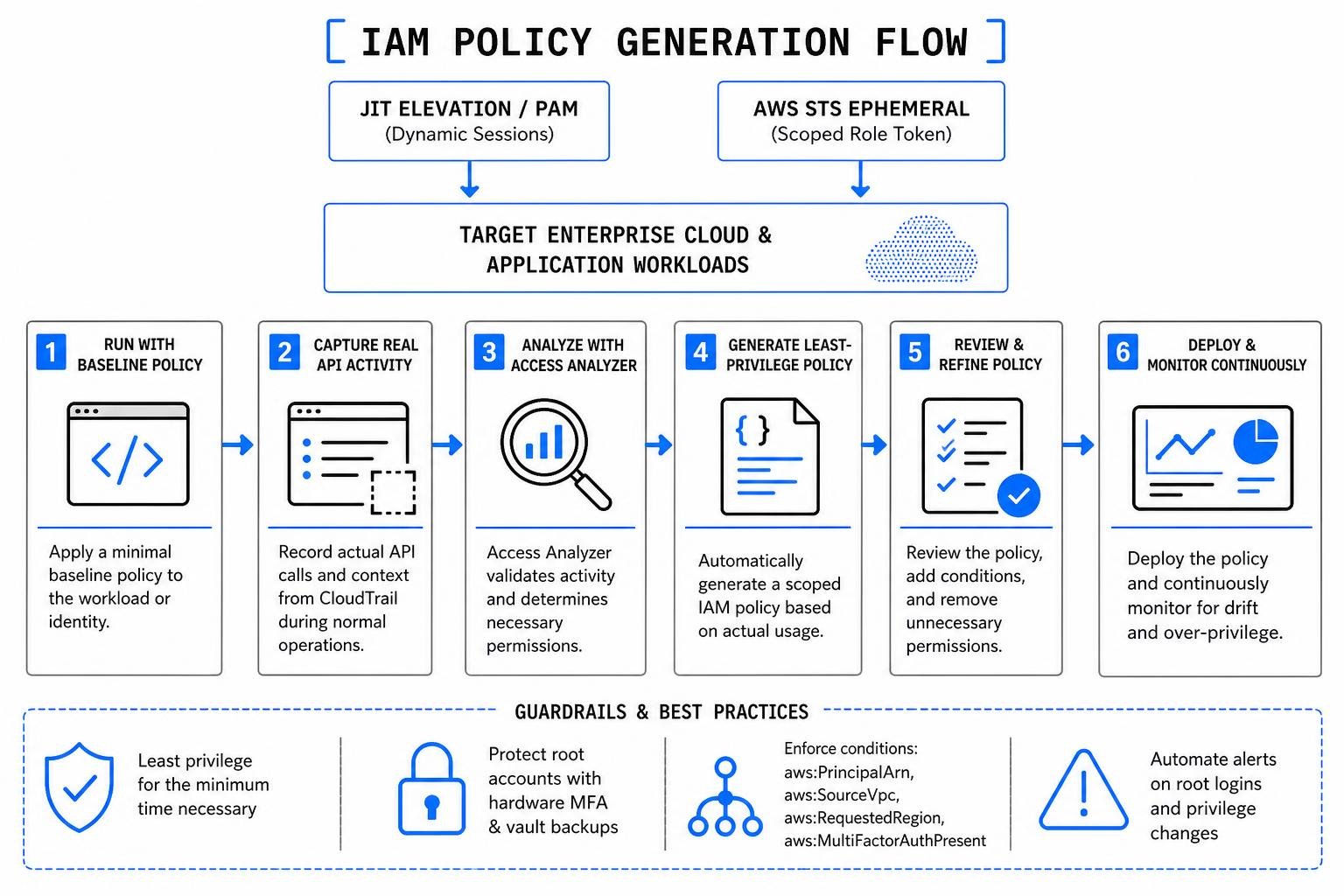
Implementing user permission management best practices involves pruning wildcard actions (*) and embedding strict IAM policy condition keys. Conditions such as aws:PrincipalArn, aws:SourceVpc, aws:RequestedRegion, and aws:MultiFactorAuthPresent ensure that even valid credentials cannot execute API calls outside designated corporate network paths or verified authentication states.
Enforcing Multi-Account Guardrails with SCPs and Permissions Boundaries
Enterprise multi-account estates require macro-level guardrails that prevent local account administrators from granting unsafe access. Within AWS Organizations, Service Control Policies (SCPs) act as organizational guardrails, defining the maximum permissions that any principal (including local IAM administrators) can exercise within member accounts.
SCPs do not grant permissions on their own; instead, they establish hard boundaries. For example, an SCP can globally prevent member accounts from:
- Disabling logging services like AWS CloudTrail or Amazon GuardDuty.
- Leaving Amazon S3 buckets publicly accessible.
- Launching workloads in unapproved geographic regions.
- Modifying security-baseline IAM roles used by central SecOps.
To delegate permissions safely without risking privilege escalation, security teams combine SCPs with IAM Permissions Boundaries. A permissions boundary is an advanced IAM feature that uses a customer-managed policy to set the maximum permissions an IAM entity (user or role) can receive.
When central platform teams delegate role creation to local DevOps teams, they require that every newly created role has an attached permissions boundary. If a developer attempts to create a role with unrestricted administrative privileges (AdministratorAccess), the permissions boundary automatically caps the effective access, neutralizing privilege escalation attempts before they reach runtime environments. Adopting these structured cloud IAM governance controls establishes scalable, multi-tenant cloud operations without bottlenecking software deployment cycles.
Lifecycle Governance: Automating Joiner, Mover, and Leaver Workflows
Access governance fails when identity lifecycle events lag behind real-world human and operational organizational changes. If an employee transfers from engineering to product management but retains database write access, the organization suffers from access creep. If an engineer departs and their cloud console or API access remains active for days, the organization risks insider threats and automated credential exploitation.
Mitigating enterprise vulnerabilities requires actively addressing modern identity and access management threats across all operational layers. Establishing a defined permissions lifecycle aligns identity states directly with verified organizational roles, preventing privileges from accumulating unnoticed over time.
Automating the Identity Lifecycle: IAM Best Practices Enterprise Workflows for Joiners, Movers, and Leavers
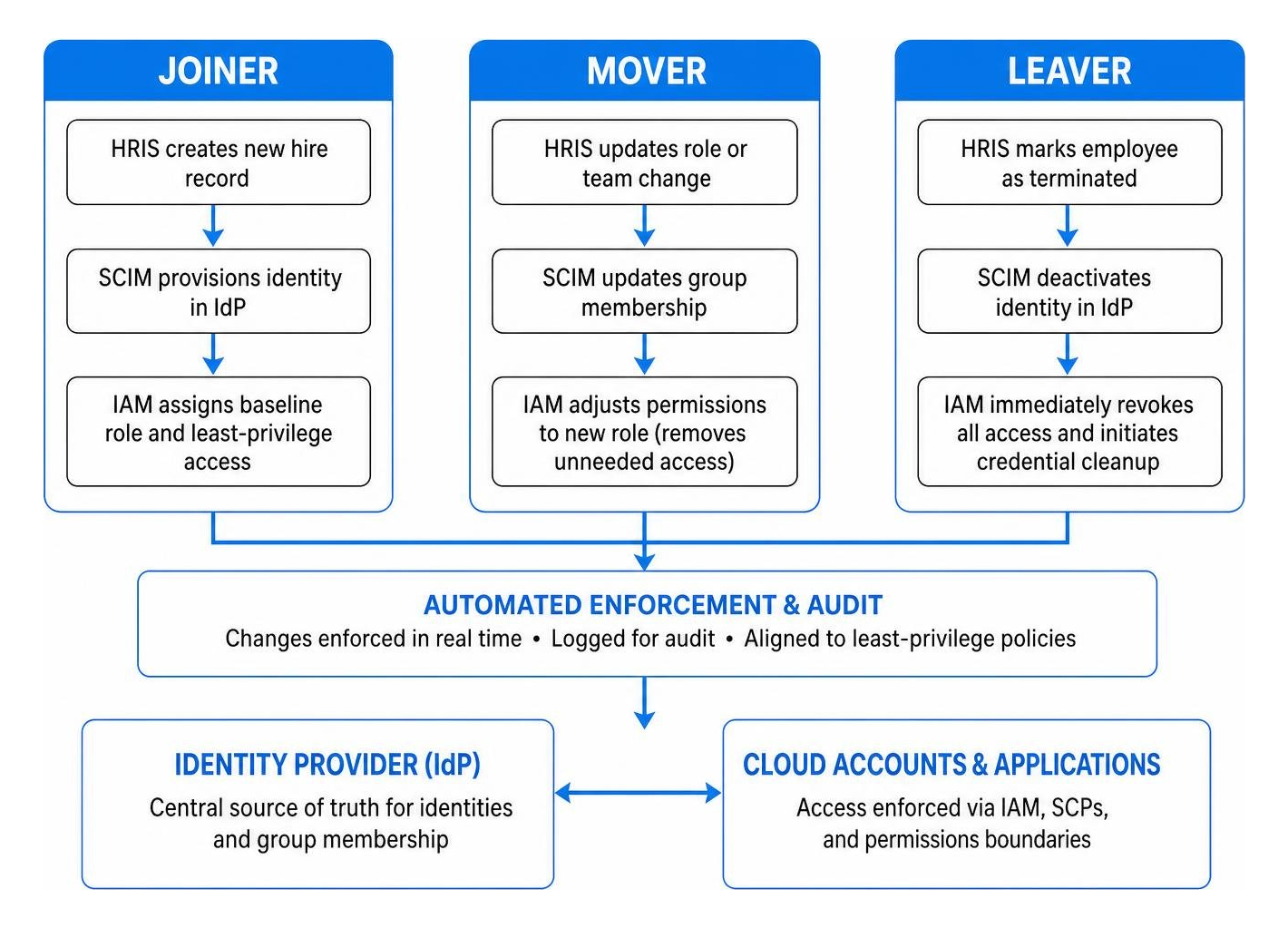
Manual onboarding checklists and spreadsheet-driven access certifications cannot keep up with modern enterprise churn. To achieve auditable lifecycle management, enterprises connect their authoritative Human Resources Information System (HRIS) directly to their central identity provider using System for Cross-domain Identity Management (SCIM) protocols.
Automated JML (Joiner, Mover, Leaver) workflows operate via deterministic event triggers:
- Joiner Phase: When a new employee is entered into the HRIS, the system fires an event that creates an IdP identity, provisions standard corporate tooling, assigns birthright RBAC groups, and issues federated single sign-on access to assigned cloud permission sets.
- Mover Phase: When an internal transfer occurs, the HRIS update triggers an automated entitlement review. The IAM engine revokes previous department-specific access groups before provisioning entitlements tied to the new role, eliminating accumulated legacy access.
- Leaver Phase: When termination occurs, the HRIS triggers an immediate webhook to the IdP. The IdP instantly revokes active sessions across all federated applications, invalidates refresh tokens, and cascades SCIM
DELETEorDEACTIVATEcommands downstream to third-party SaaS and cloud consoles, achieving near-instant account deprovisioning.
Leveraging these automated workflows yields major enterprise identity management benefits, eliminating orphan accounts and ensuring that quarterly entitlement reviews become automated delta reconciliations rather than administrative burdens.
Machine Identity Management and Non-Human Entity Lifecycle
Machine identities—including CI/CD runners, background daemon services, containers, serverless functions, and deployment pipelines—outnumber human users by broad margins in modern architectures. Managing these non-human entities requires treating machine access with the same lifecycle rigor applied to human staff, but through fully automated mechanisms.
Static credentials such as long-lived AWS IAM access keys, API tokens, and database passwords written into configuration files represent high-risk attack surfaces. Attackers routinely scan public repositories and unencrypted build logs to harvest static developer keys.
To eliminate static credentials, enterprises enforce short-lived, ephemeral authentication protocols:
- Cloud Workloads: Workloads hosted on compute platforms (EC2, ECS, EKS, Lambda) assume IAM Roles directly via metadata endpoints, receiving short-lived AWS STS credentials that rotate automatically.
- Hybrid & On-Premises Systems: On-premises servers and external build runners authenticate via AWS IAM Roles Anywhere using PKI-based X.509 certificates validated against an internal Private Certificate Authority (CA), exchanging cryptographic proof for temporary cloud session tokens.
- CI/CD Pipelines: GitHub Actions, GitLab CI, and Terraform Cloud integrate via OIDC federation, allowing pipelines to assume scoped cloud roles dynamically during build execution, discarding all authorization upon workflow completion.
Adhering to these modern authentication standards ensures that machine credentials expire within minutes, closing the window of exposure if a build runner or container is compromised.
Authentication Modernization: Phishing-Resistant MFA and Federation
Enterprise authentication must resist sophisticated adversary-in-the-middle (AiTM) proxy toolkits, such as Evilginx, which easily bypass legacy MFA methods like SMS verification codes and mobile push notifications.
Modern enterprise authentication shifts toward standards-based Identity Federation using SAML 2.0 and OpenID Connect (OIDC) paired with phishing-resistant authenticators. Implementing single sign-on enterprise implementation allows security operations to centralize authentication telemetry, enforce conditional access checks at sign-in, and terminate sessions from a single console.
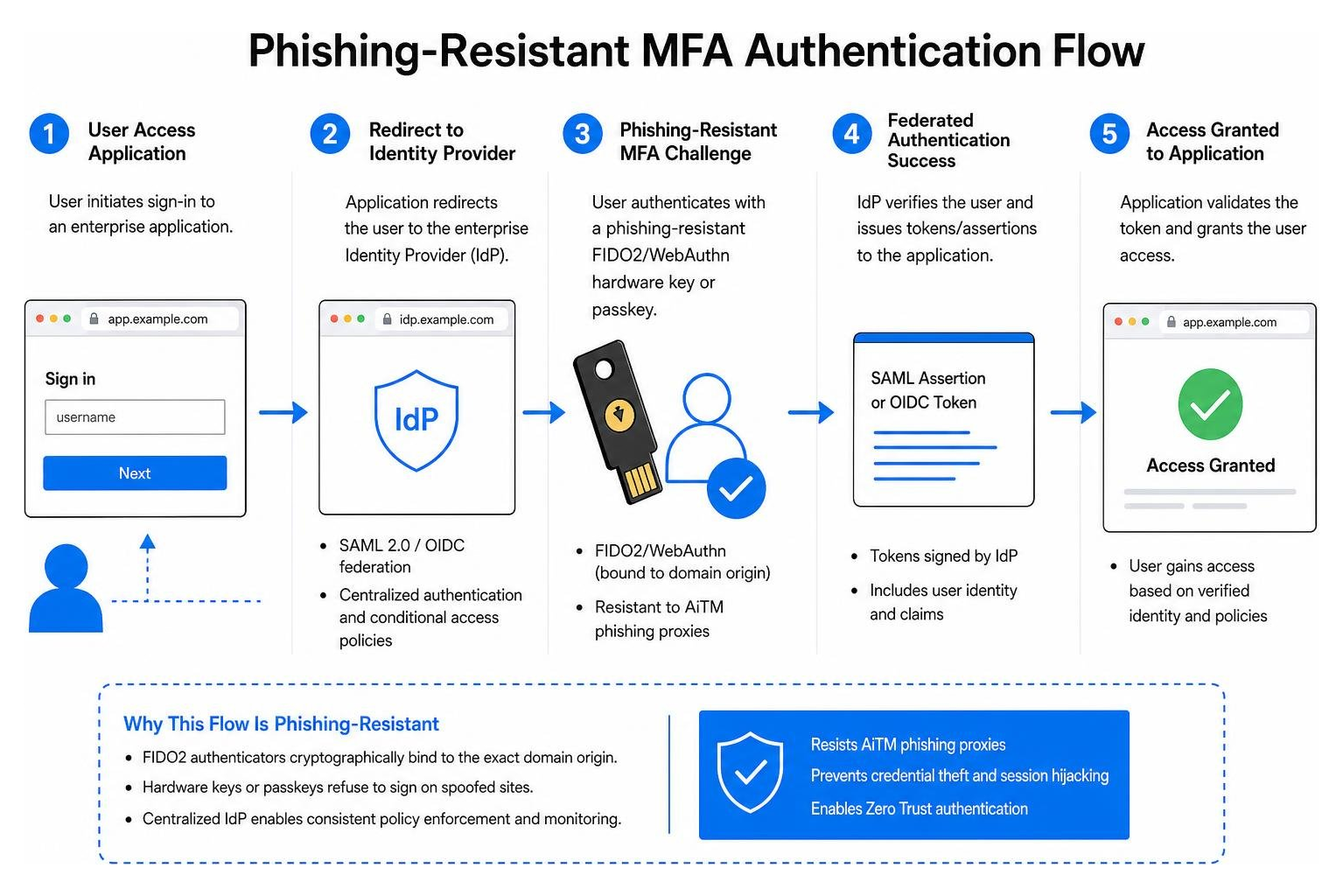
Deploying enterprise multi-factor authentication strategies requires transitioning workforce users to FIDO2/WebAuthn hardware security keys or cryptographic device passkeys. Unlike OTPs, FIDO2 authentication cryptographically binds the authentication assertion to the exact domain origin in the browser address bar. If an employee is lured to a spoofed corporate login page, the hardware authenticator refuses to sign the challenge, completely blocking credential theft and session hijacking.
For organizations balancing strict physical security requirements with workplace usability across diverse workstations, purpose-built access hardware can streamline these authentication flows. Products like EveryKey provide automated, proximity-based hardware authentication that locks systems when operators walk away and decrypts access upon approach using secure wireless protocols. Solutions in this space sit alongside established enterprise FIDO2 tokens (such as YubiKeys) and platform authenticators (like Windows Hello or Touch ID), offering security teams flexible options for hardening physical workstations and privileged terminals against physical credential abuse.
Privileged Access Management and Just-In-Time Elevation
Standing administrative privileges represent an unnecessary vulnerability in cloud and on-premises environments. When engineers maintain 24/7 root or administrator privileges, any compromised workstation or local session token allows attackers to move laterally and compromise infrastructure immediately.
Robust privileged access management controls replace standing access with Just-In-Time (JIT) elevation and Zero Standing Privileges (ZSP) models:
Enterprises achieve this through integrated PAM platforms (such as CyberArk, Teleport, or AWS IAM Identity Center with temporary permission set assignments). Engineers log in as standard unprivileged users. When elevated access is required to remediate an incident:
- The user requests short-term elevation via an integrated portal, citing a valid ticket identifier.
- The request triggers an automated approval check based on on-call schedules or requires manager sign-off.
- The PAM engine grants scoped permissions for a limited window (typically 1 to 4 hours), logging all API calls, CLI commands, and remote desktop sessions.
- When the window expires, the engine automatically revokes the session, returning the user to zero standing access.
Combining JIT access controls with zero trust security architecture integration prevents adversaries from acquiring persistent elevated access, significantly reducing the blast radius of compromised endpoints.
Continuous Compliance, Runtime Monitoring, and Audit Readiness
Compliance frameworks—including PCI DSS v4.0 (particularly Requirement 8 for strong authentication and Requirement 10 for log tracking), SOX IT General Controls (ITGCs), ISO/IEC 27001:2022 Control 5.15–5.18, and NIST SP 800-53 rev 5—mandate continuous visibility and validation over identity controls. The historical approach of gathering static audit evidence once a year fails to satisfy modern regulators and leaves enterprise blind spots unaddressed.
Meeting continuous compliance standards requires adhering to structured IAM audit logging requirements across both cloud control planes and local application tiers. Continuous evidence generation ensures organizations follow core AWS Identity and Access Management (IAM) Best Practices, turning audit preparation into an automated, background operation rather than a quarterly scramble.
Application-Layer Telemetry and Runtime Policy Verification
A frequent audit failure point is relying exclusively on centralized identity provider logs while ignoring runtime enforcement at the application layer. An IdP log shows that an identity successfully authenticated, but it does not confirm what data the identity queried or modified within the target database or SaaS application.
Securing application environments requires establishing verifiable links between identification, authentication, and authorization frameworks across both infrastructure platforms and internal software workloads.
Security operations centers (SOCs) must ingest both control plane telemetry (AWS CloudTrail, Azure Activity Logs) and application-level audit streams into Identity Threat Detection and Response (ITDR) engines. Automated SOAR playbooks monitor for high-risk identity indicators:
- Impossible Travel: An active session token used from IP addresses in disparate geographic locations within an impossible timeframe.
- Anomalous Entitlement Usage: A developer account calling sensitive cryptographic or administrative APIs that have never been invoked historically.
- Identity Dark Matter: Local accounts, service principals, and orphaned API keys created outside the central IdP, operating without governance oversight.
When anomalies are detected, the system triggers automated remediation workflows that instantly invalidate STS sessions, quarantine affected roles, and alert the on-call incident response team.
Frequently Asked Questions about Enterprise IAM
How can enterprises enforce least privilege across human and machine identities?
Enforcing least privilege across human and machine identities requires decoupling permissions from permanent accounts and relying on dynamic, short-lived credentials. For human staff, organizations implement Role-Based Access Control (RBAC) via centralized identity providers, supplementing standard access with Just-In-Time (JIT) elevation workflows for administrative tasks.
For machine entities, organizations replace static API keys and service account passwords with ephemeral tokens issued through AWS STS, IAM Roles Anywhere, or OIDC federation. Teams should run automated analysis tools like AWS IAM Access Analyzer and cloud entitlement management platforms to regularly inspect CloudTrail logs, detect unused permissions, and automatically generate scoped policies that limit access strictly to observed operational baselines.
What is the role of SCIM in preventing identity lifecycle access creep?
System for Cross-domain Identity Management (SCIM) is an open standard that automates the exchange of user identity information across different software domains and cloud applications. When integrated with an authoritative HRIS and central IdP, SCIM synchronizes user provisioning, role adjustments, and deprovisioning in real time.
When an employee changes roles or departs an organization, SCIM pushes automated schema updates downstream to target SaaS platforms, directory groups, and cloud permission sets. This immediate synchronization revokes legacy permissions and eliminates orphaned accounts, preventing unauthorized access privileges from accumulating over an identity's lifecycle.
How do organizations move from periodic IAM audits to continuous compliance?
Organizations transition from periodic audits to continuous compliance by replacing manual evidence collection with automated identity telemetry pipelines. By integrating cloud trail logs, identity provider syslogs, and application-layer access records into centralized SIEM and Identity Threat Detection and Response (ITDR) platforms, security teams continuously compare actual runtime access against established policy baselines.
Continuous compliance engines monitor for policy drift, excessive administrative privileges, and non-compliant authentication mechanisms in real time. Generating auditable compliance evidence automatically satisfies regulatory frameworks such as PCI DSS v4.0, SOX, and ISO 27001 continuously, eliminating the need for periodic, disruptive audit preparation cycles.
Conclusion: Building Resilient Enterprise Identity Architectures
Modern enterprise identity and access management has evolved far beyond basic directory maintenance; it serves as the primary security perimeter for hybrid enterprise operations. The ongoing wave of credential-theft campaigns targeting cloud infrastructures highlights the risk of relying on long-lived credentials, static administrative accounts, and perimeter-only security models.
Establishing long-term operational resilience requires security leaders to modernize their IAM strategies around zero standing privileges, automated lifecycle governance, phishing-resistant authentication, and continuous identity observability. Transitioning to short-lived machine tokens and JIT human elevation models ensures that even if credentials are intercepted, their limited lifespan minimizes potential exploitability.
Security leaders must take immediate steps to audit their identity landscapes, prune dormant administrative roles, enforce phishing-resistant MFA across all human entry points, and automate lifecycle management across both human and machine identities. To dive deeper into modern security architecture frameworks, threat intelligence, and defense-in-depth strategies, explore enterprise cybersecurity and digital protection strategies on Unlocked.