

What is Identity Governance: The Ultimate Guide to Digital ID Control
Identity governance is the control plane for enterprise access. This guide explains what IGA is, how it differs from IAM, and how it strengthens security, compliance, and zero-trust across cloud and on-prem systems.

The Identity-Centric Threat Landscape: Why Credential Control Is Now Your Primary Defense
What is identity governance — and why does it matter right now?
Here's the short answer:
Identity Governance and Administration (IGA) is the policy-driven security discipline that controls who has access to what, why they have it, and for how long — across every user, system, and application in your organization. It combines oversight (governance) and execution (administration) into a single, auditable control plane for managing digital identities throughout their entire lifecycle.
At a glance:
| Question | Answer |
|---|---|
| What does it do? | Manages and audits user access rights across all systems |
| Who needs it? | Any organization with more than a handful of users and applications |
| How is it different from IAM? | IAM handles how users log in; IGA governs whether they should have access at all |
| Key capabilities | Lifecycle management, access certification, role management, SoD enforcement |
| Why now? | Compromised credentials drive 16% of all data breaches — and abuse of valid accounts accounts for 30% of cyberattacks |
The perimeter is gone. Identity is the new battleground.
The Okta support system compromise and the Snowflake credential stuffing campaigns — both of which exposed sensitive customer data at scale — made one thing painfully clear: attackers don't break in anymore, they log in. They use stolen credentials, exploit overprivileged accounts, and move laterally through systems that were never designed to question whether a valid login should have access to a given resource.
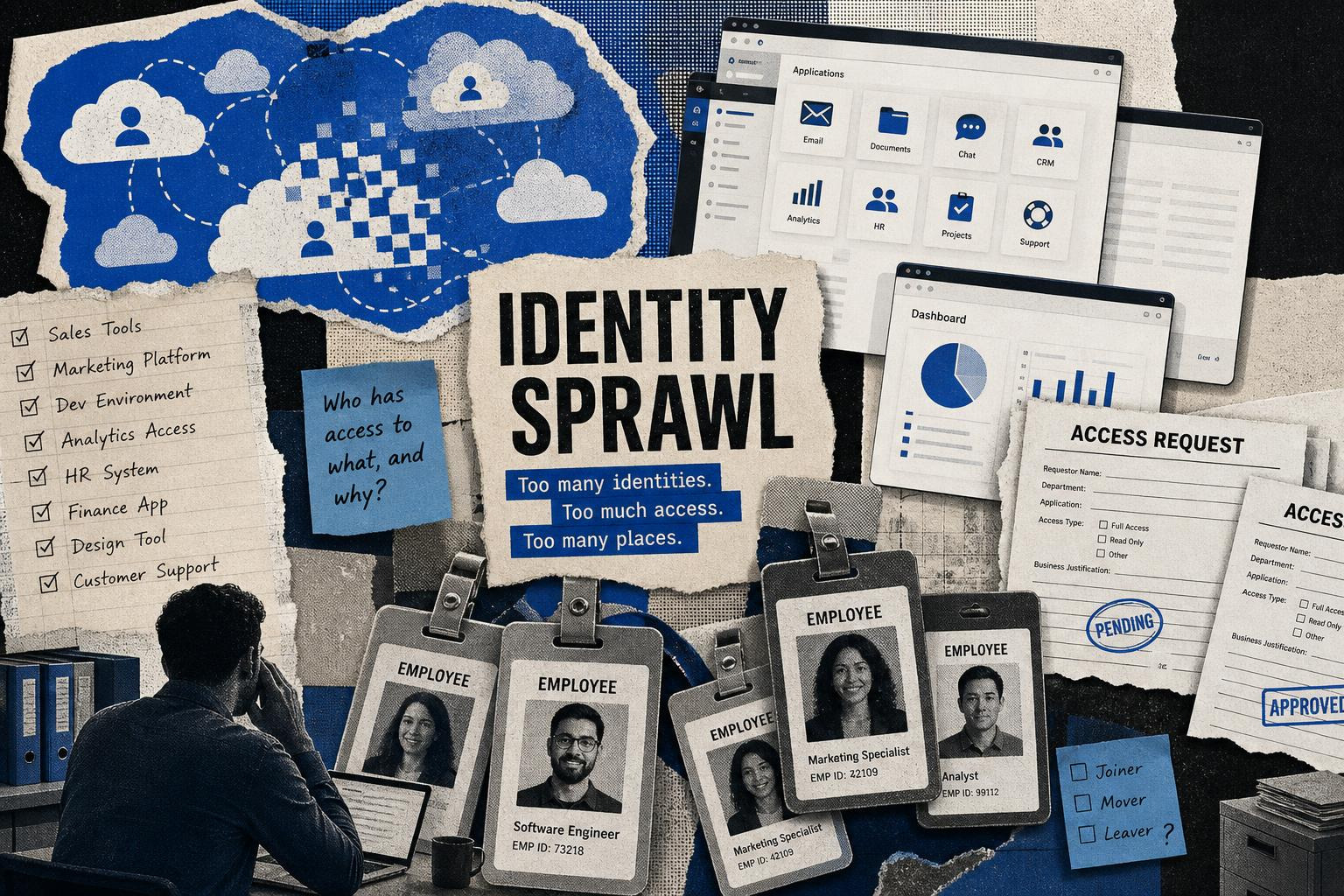
Traditional perimeter defenses — firewalls, VPNs, network segmentation — offer little protection once a threat actor is operating inside the identity layer. And the identity layer is sprawling. The average enterprise now runs over 100 SaaS applications. Employees join, change roles, and leave. Contractors get access and are forgotten. Service accounts accumulate permissions nobody reviews. Overprivileged service accounts alone triggered 46.4% of cloud security alerts in the second half of 2024 and enabled 62.2% of lateral movement incidents.
This is the problem identity governance is built to solve.
For CISOs, this is a board-level risk conversation. For security engineers, it's an operational gap in your toolchain. For IT administrators carrying security responsibilities at smaller organizations, it's the difference between a defensible access posture and a breach waiting to happen.
Understanding what identity governance actually is — and how it fits alongside your existing IAM infrastructure — is the foundation for getting it right.
Defining What is Identity Governance in Modern Cybersecurity
To fully grasp the scope of identity governance, we must look at it as the strategic control plane of your security architecture. In modern environments, what is identity governance translates to a formalized ecosystem of policies, automated workflows, and continuous auditing mechanisms.
Historically, identity management was treated as a basic IT ticketing chore: a new employee starts, an admin manually creates an Active Directory account, assigns them to a few security groups, and calls it a day. Today, that manual approach is a major liability. Modern IGA platforms act as a centralized policy engine, ensuring that every digital identity—whether human or machine—is mapped, monitored, and strictly controlled.
This framework aligns directly with established industry standards:
- NIST SP 800-63 (Digital Identity Guidelines): Provides technical requirements for identity proofing, authentication, and federation. IGA ensures that the lifecycle of these validated identities matches the organization's risk tolerance.
- CIS Control 5 (Account Management): Mandates that organizations maintain an active inventory of all accounts, revoke dormant access, and prevent unauthorized privilege escalation.
By implementing a centralized identity manager, organizations move away from fragmented, application-specific silos and establish a single source of truth for all digital permissions.
What is Identity Governance vs. Identity Administration?
While often grouped under the single acronym IGA, Identity Governance and Administration is actually composed of two distinct, yet deeply integrated, functional domains.
- Governance (Oversight and Control): This is the strategic, risk-focused half. Governance defines the rules of the road. It involves role engineering (defining who should have access based on business function), risk modeling, Segregation of Duties (SoD) policy enforcement, and compliance auditing. Governance answers the question: Is our current access landscape aligned with our security policies and regulatory obligations?
- Administration (Operations and Execution): This is the tactical, execution-focused half. Administration handles the day-to-day work of provisioning and deprovisioning accounts, processing self-service access requests, managing password resets, and synchronizing identity data across target systems. Administration answers the question: How do we efficiently execute access changes across our entire IT ecosystem?
IGA vs. IAM: Understanding the Functional Differences
It is common for organizations to confuse Identity and Access Management (IAM) with Identity Governance and Administration (IGA). In fact, many security leaders mistakenly believe that because they have deployed a Single Sign-On (SSO) and Multi-Factor Authentication (MFA) solution, they have solved their identity security problems.
This is a dangerous misconception. To put it simply: IAM handles the front door, while IGA handles what happens once you are inside the building.
- The Authentication/Authorization Layer (IAM): IAM is transactional and operates in real time. When a user attempts to log in, IAM checks their credentials, triggers an MFA prompt, and establishes an active session. It is concerned with authentication (verifying who you are) and basic authorization (verifying what you can access at this exact moment).
- The Compliance and Lifecycle Layer (IGA): IGA is historical, structural, and lifecycle-focused. It does not sit in the active login path. Instead, it continuously monitors the relationships between users, roles, and permissions over time. It manages the Joiner-Mover-Leaver (JML) pipeline, executes recurring entitlement reviews, and generates compliance-ready audit trails.
To understand the core differences between these two domains, consider this breakdown:
| Capability | Identity & Access Management (IAM) | Identity Governance & Administration (IGA) |
|---|---|---|
| Primary Focus | Operational access, authentication, and session management | Policy enforcement, compliance, and lifecycle auditing |
| Core Technologies | MFA, Federation (SAML, OIDC), Directory Services | Access Certification, Role-Based Access Control (RBAC), JML Workflows |
| Time Horizon | Real-time / transactional (Is this user who they say they are right now?) | Lifecycle / historical (Should this user have had this access for the last six months?) |
| Audit Value | Logs authentication events and active sessions | Generates compliance-ready reports on entitlements and Segregation of Duties (SoD) |
To explore this distinction further, you can read our deep dive on the complete guide to identification in cyber security.
Why Modern Enterprises Need Identity Governance
The massive shift toward decentralized, cloud-first operations has turned identity management into an incredibly complex challenge. In the past, an enterprise identity program only had to worry about employees logging into on-premises systems via Active Directory.
Today, the modern enterprise is highly fragmented:
- Hybrid and Multi-Cloud Complexity: Organizations run workloads across AWS, Microsoft Azure, and Google Cloud Platform (GCP), each with its own highly complex, proprietary Identity and Access Management (IAM) structures.
- SaaS Sprawl: In 2024, the average enterprise utilized 112 SaaS applications. For organizations with more than 5,000 employees, that number jumped to 158. Many of these apps are purchased directly by business units without IT oversight, contributing to massive shadow IT risks.
- Diverse User Ecosystems: Access must be managed not just for full-time employees, but for a rotating door of external contractors, vendors, partners, and temporary workers.
Managing this sprawling ecosystem manually using spreadsheets and basic helpdesk tickets is an impossible task. It introduces significant human error, results in delayed onboarding, and leaves organizations blind to who has access to their most sensitive data.
Why Identity Governance Matters for Zero Trust
The foundational premise of a Zero Trust architecture is simple: never trust, always verify. However, you cannot continuously verify access if you do not have a clear, dynamic understanding of what permissions actually exist across your environment.
This is why modern IGA is the cornerstone of any mature Zero Trust IAM strategy.
Legacy security models relied on static, broad permissions. Once an employee was assigned to a department, they retained those permissions indefinitely. IGA shifts the paradigm to dynamic, policy-driven least privilege. By continuously analyzing user roles, active project scopes, and organizational changes, an IGA platform can automatically scale back access rights. If a user’s role changes, their old permissions are immediately pruned, minimizing the potential "blast radius" if their credentials are ever compromised.
Mitigating Identity Risks: Orphaned Accounts and Insider Threats
Unmanaged identities are the low-hanging fruit that threat actors look for when planning an attack. Without robust identity governance, organizations routinely fall victim to several common identity vulnerabilities:
- Orphaned Accounts: When an employee or contractor leaves the company, their main directory account might be disabled, but their direct accounts on isolated SaaS applications, development environments, or legacy databases often remain active. Attackers actively seek out these dormant, unmonitored accounts to gain a quiet, persistent foothold (aligned with MITRE ATT&CK T1078 - Valid Accounts).
- Privilege Creep: As employees move through different roles within an organization, they are granted new permissions to perform their new duties. However, their old permissions are rarely revoked. Over time, long-tenured employees accumulate a toxic mountain of excessive privileges, making them high-value targets for credential theft.
- Overprivileged Machine Identities: Non-human identities—such as service accounts, automated API integrations, and cloud workloads—frequently hold vast, unrestricted administrative privileges that are rarely rotated or reviewed.
By implementing continuous discovery and automated access reviews, IGA platforms identify and eliminate these high-risk blind spots before they can be exploited. For a deeper look at these vulnerabilities, see our guide on identifying and managing IAM risks.
Core Capabilities and Features of IGA Solutions
To understand how modern IGA platforms solve these challenges, we need to examine their core capabilities. According to leading industry guides, including Microsoft Entra ID Governance and CyberArk's Modern IGA Framework, an effective governance solution must cover several fundamental areas:
- Identity Lifecycle Management: Automates Joiner-Mover-Leaver (JML) workflows, HR-driven provisioning, and self-service portals.
- Entitlement Governance: Manages fine-grained entitlements, enforces Segregation of Duties (SoD), and orchestrates access certification campaigns.
- Intelligent Analytics: Leverages ML-driven role mining, peer outlier detection, and automated low-risk approvals.
Identity Lifecycle Management
Identity Lifecycle Management (ILM) is the process of managing a user's digital footprint from their first day of work to their final departure. This is commonly referred to as the Joiner-Mover-Leaver (JML) pipeline:
- The Joiner (Onboarding): When a new employee is hired, their details are entered into an HR system (like Workday, BambooHR, or SuccessFactors). The IGA platform detects this event and automatically provisions their user accounts, email addresses, and baseline application access based on their assigned role. This ensures they are productive on day one without requiring manual IT intervention.
- The Mover (Role Transitions): When an employee changes departments, receives a promotion, or joins a temporary project, their access must adapt. The IGA platform automatically adjusts their permissions—granting new necessary tools while systematically revoking access that is no longer relevant to their new position.
- The Leaver (Offboarding): When an employee leaves the organization, time is of the essence. The IGA platform triggers an automated offboarding workflow that instantly disables accounts, revokes active sessions, and deprovisions access across all connected SaaS and on-premises applications, closing any potential entry points for disgruntled former employees or external attackers.
Entitlement Management and Access Certification
While basic IAM tools can manage high-level group memberships, modern IGA goes much deeper by governing fine-grained entitlements within applications. For example, rather than simply knowing a user has access to Salesforce, an IGA tool tracks whether that user has permission to export customer databases or modify billing details.
This level of control is critical for enforcing several key governance principles:
- Segregation of Duties (SoD): SoD prevents conflicts of interest and fraud by ensuring that no single user has enough permissions to execute a high-risk transaction end-to-end. For instance, an IGA system will flag a "toxic access combination" if a user has the ability to both create a new vendor in the financial system and authorize payments to that same vendor.
- Access Certification Campaigns: Compliance frameworks mandate that organizations periodically review and certify user access. IGA platforms automate this process by generating user-friendly review packages for managers and application owners. Instead of dealing with massive, confusing spreadsheets, reviewers can easily approve or revoke access via a centralized portal.
For more on how digital identity shapes access control and privacy, read our analysis of data identity explained.
The Role of AI and Machine Learning in Modern IGA
A challenge in identity governance is "reviewer fatigue." When managers are forced to manually review hundreds of access permissions for their team members every quarter, they often resort to rubber-stamping approvals just to get through the chore. This completely defeats the purpose of the review and introduces severe security risks.
Modern, cloud-native IGA solutions address this by integrating artificial intelligence and machine learning:
- Peer Group Analysis: The system analyzes access patterns across similar job titles, departments, and locations. If a financial analyst requests access to a specific database that 95% of their peers also use, the system can automatically approve it or flag it as low-risk. Conversely, if they request access to a development environment that no other analyst uses, the system flags it as an anomaly for close human inspection.
- Predictive Access Recommendations: AI can proactively suggest roles and access packages based on real-time usage data rather than relying on static, outdated business definitions.
- Automated Low-Risk Approvals: By automating standard, low-risk requests, AI-driven IGA platforms can reduce the volume of access reviews requiring manual intervention by up to 75%, allowing security teams to focus their attention on high-risk, privileged entitlements.
Achieving Regulatory Compliance with IGA
For many organizations, the initial driver for implementing an identity governance program is compliance. Major regulatory standards place a heavy emphasis on controlling, auditing, and securing access to sensitive data:
- GDPR (General Data Protection Regulation): Requires strict control over who can access the personal data of EU citizens. Violations can lead to severe financial penalties of up to $22 million or 4% of global annual revenue, whichever is higher.
- HIPAA (Health Insurance Portability and Accountability Act): Mandates rigorous access controls and detailed activity logging for any system containing electronic protected health information (ePHI).
- SOX (Sarbanes-Oxley Act) Section 404: Requires public companies to establish and maintain internal controls over financial reporting, which directly includes securing access to financial systems and enforcing Segregation of Duties.
- PCI DSS v4.0: Requirements 7 and 8 explicitly mandate that organizations restrict access to cardholder data based on business need-to-know, implement robust authentication, and conduct regular user access reviews.
| Framework | Key Requirements & Impact |
|---|---|
| GDPR | Requires strict control over personal data access. Violations can lead to severe financial penalties of up to $22 million or 4% of global annual revenue. |
| HIPAA | Mandates rigorous access controls and detailed activity logging for any system containing electronic protected health information (ePHI). |
| SOX (Sec 404) | Requires public companies to establish and maintain internal controls over financial reporting, including securing access and enforcing Segregation of Duties. |
| PCI DSS v4.0 | Requirements 7 and 8 explicitly mandate restricting access to cardholder data based on business need-to-know and conducting regular user access reviews. |
By mapping your access controls to the NIST Cybersecurity Framework (CSF 2.0), specifically the PR.AA (Identity Management, Authentication, and Access Control) category, you build a defensible security posture that satisfies multiple auditors simultaneously.
Streamlining Audits and Policy Enforcement
Preparing for an IT audit without an IGA tool is an absolute nightmare. It typically involves weeks of manual labor: exporting user lists from dozens of applications, cross-referencing them with HR records, and trying to track down email approvals from months prior.
Modern identity governance tools transform this process from a reactive, painful scramble into a continuous, automated state of audit readiness:
- Continuous Compliance Monitoring: Instead of checking compliance once a year, IGA platforms continuously monitor your environment for policy violations (such as SoD conflicts or orphaned accounts) and alert security teams immediately.
- Auditor-Friendly Reporting: With a few clicks, you can generate comprehensive, immutable audit trails showing exactly who approved a specific permission, when it was granted, and why. According to research on modern cloud-native IGA deployments, organizations can achieve up to an 80% reduction in audit preparation time, saving an average of $600,000 annually in operational and audit-related costs.
To learn more about how a robust identity strategy improves compliance, check out our guide on the benefits of modern IAM.
Integrating IGA into Your Security Infrastructure
An identity governance platform cannot operate in a vacuum. To be effective, it must serve as the central hub of a highly connected security ecosystem, orchestrating policies and data across multiple systems:
- Directory Services & IdPs: Integrates with primary identity providers (such as Microsoft Entra ID, Okta, or Ping Identity) and legacy on-premises directories (Active Directory, LDAP) to synchronize user accounts and attributes.
- Security Operations & Monitoring: Feeds identity data into SIEM platforms (like Splunk or Microsoft Sentinel) to correlate unusual network behavior with a user's specific role and active entitlements.
- Privileged Access Management (PAM): Coordinates with PAM tools to enforce Just-In-Time (JIT) access and govern high-risk administrative accounts.
Governing Non-Human and Privileged Identities
As modern enterprise environments scale, managing human users is only half the battle. The explosion of microservices, cloud resources, and automation has led to a massive influx of non-human identities (NHIs)—including service accounts, API keys, automated bots, and workloads. These machine identities are highly vulnerable because they often hold static, administrative-level privileges and lack basic security controls like MFA.
Modern IGA frameworks treat non-human identities as first-class citizens, applying the exact same governance policies, lifecycle workflows, and periodic access reviews that are used for human employees.
Furthermore, integrating IGA with Privileged Access Management (PAM) solutions ensures that high-risk administrative accounts are subject to strict governance. When an administrator requires elevated permissions, the IGA platform can validate their business justification and coordinate with the PAM tool to grant Just-In-Time (JIT) access, which is automatically revoked once the task is complete.
Securing the Physical-Digital Boundary
While software-based governance is critical, a truly robust defense-in-depth posture must address the physical security of the endpoints used to access these critical administrative systems. If an administrative endpoint is compromised via physical theft or session hijacking, even the most advanced software policies can be bypassed.
This is where hardware-based security keys, such as those provided by EveryKey, play a vital role. By introducing a physical token that uses proximity-based, military-grade encryption to automatically lock and unlock devices, organizations can establish an uncompromisable, passwordless root of trust.
Integrating this hardware-level verification with your broader identity governance framework ensures that administrative access to critical infrastructure, directory services, and database environments is only granted when the authorized human operator is physically present at the endpoint.
For a deeper analysis of how these authentication factors work together, see our guide on identification, authentication, and authorization in cybersecurity.
Deployment Models: SaaS, On-Premises, and Managed IGA
When choosing an identity governance solution, organizations must evaluate which deployment model best aligns with their technical capabilities, budget, and compliance needs:
- SaaS-Based IGA (IGA-as-a-Service): This has quickly become the standard for modern enterprises. SaaS-based solutions offer rapid deployment, lower upfront capital expenditure, automatic updates, and rich, out-of-the-box API connectors for popular cloud applications. They are highly scalable and significantly reduce the maintenance burden on internal IT teams.
- On-Premises and Hybrid IGA: While more complex to deploy and maintain, on-premises solutions are still favored by organizations in highly regulated industries (such as defense or banking) that have strict data sovereignty requirements or need to govern a massive footprint of legacy, custom-built mainframe applications.
- Managed IGA for SMBs: Many small and medium-sized businesses face the same compliance and security challenges as large enterprises but lack the budget and specialized in-house security staff to run a complex IGA program. For these organizations, partnering with a Managed Security Service Provider (MSSP) to deliver Managed IGA is a highly effective, cost-efficient path forward.
Frequently Asked Questions about Identity Governance
Does IGA replace my existing IAM or directory solution?
No. IGA does not replace your Identity and Access Management (IAM) tools or your primary directory services (like Active Directory or Entra ID). Instead, they are complementary systems.
IAM and directory services handle the operational execution of authentication (verifying who you are and letting you log in), while IGA serves as the policy and auditing framework on top, determining whether you should have that access in the first place, managing your access lifecycle, and verifying compliance.
How often should our organization perform access certifications?
The frequency of access reviews depends heavily on your industry, regulatory requirements, and the risk level of the resources in question.
As a general best practice, standard employee access to non-sensitive business applications can be certified annually or semi-annually. However, high-risk entitlements, access to financial systems (subject to SOX), and all privileged administrative accounts should undergo quarterly reviews or even continuous, automated micro-certifications.
What is a toxic access combination in IGA?
A toxic access combination occurs when a single user holds conflicting entitlements that violate Segregation of Duties (SoD) policies.
A classic example is an employee having the technical permission to both create a new vendor profile and authorize payments to that same vendor. This creates a severe risk of internal fraud and abuse. IGA platforms are designed to automatically detect, block, and flag these toxic combinations before they can be exploited.
Conclusion: Securing the Identity Frontier
Building a resilient cybersecurity posture in today’s highly fragmented, cloud-first world requires a fundamental shift in how we think about digital trust. Relying solely on perimeter security or basic authentication is no longer enough to protect sensitive business assets.
To truly secure your organization, you must implement a robust, policy-driven identity governance program that provides complete visibility, automates the user lifecycle, and continuously enforces the principle of least privilege.
By combining modern, AI-powered IGA frameworks with hardware-level security keys—such as those offered by EveryKey—organizations can establish a comprehensive, physical-to-digital security boundary that protects administrative endpoints, eliminates the risk of credential theft, and ensures continuous compliance.
To find the right identity security solutions for your organization, explore our comprehensive guide to the best identity access management solutions of 2026.