
The Hidden Security Risks of Using a Two Factor Authentication SMS Service

Why a Two Factor Authentication SMS Service Can Create Hidden Risk
A two factor authentication SMS service adds a one-time code to a password login. That stops many automated credential-stuffing attacks, but it does not provide phishing-resistant authentication. Attackers can steal codes through SIM swaps, telecom routing attacks, smishing, or real-time phishing proxies.
For most organizations, the practical approach is:
- Keep SMS as a tightly controlled fallback, not the only MFA option.
- Remove SMS from privileged accounts, password resets, and high-value transactions.
- Prioritize passkeys, FIDO2 security keys, or authenticator apps for users with elevated access.
This matters because passwords remain a common entry point: weak, stolen, and reused passwords are among the most common ways attackers get in. SMS codes improve on passwords alone, but the phone number behind the code can become another target.
As of September 2026, SMS remains widely used because it works on almost any mobile phone and requires no app install. But recent telecom-focused threat activity and ongoing SMS fraud have made the trade-off clearer: convenience does not equal strong identity proof. Unlocked, Everykey's blog, examines where SMS verification still fits and where it creates avoidable exposure.
Two factor authentication sms service basics:
Architecture and Vulnerabilities of a Two Factor Authentication SMS Service
Deploying SMS-based one-time passcodes (OTPs) introduces an external, untrusted communication network directly into your authentication boundary. Gaining a complete view of multi-factor authentication vulnerabilities requires examining the cellular routing layers that deliver these text messages.
When an identity provider dispatches an SMS verification token, that token traverses public telecom switches, cellular aggregation hubs, and legacy signaling protocols before arriving on the user's handset.
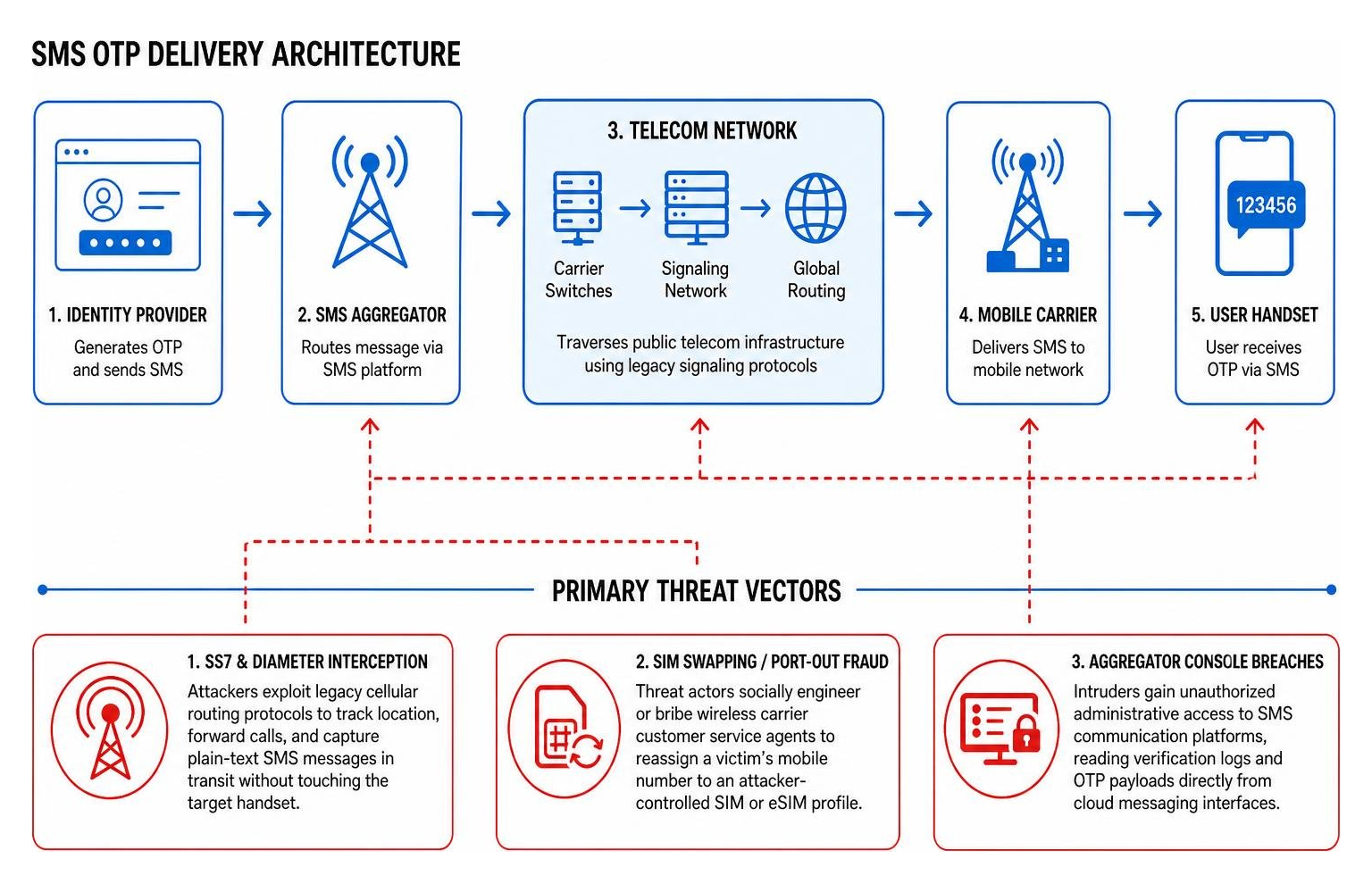
The primary telecom attack vectors breaking SMS security include:
- Signaling System 7 (SS7) & Diameter Interception: Attackers exploit legacy cellular routing protocols to track location, forward calls, and capture plain-text SMS messages in transit without touching the target handset.
- SIM Swapping / Port-Out Fraud: Threat actors socially engineer or bribe wireless carrier customer service agents to reassign a victim's mobile number to an attacker-controlled physical SIM or eSIM profile.
- Aggregator Console Breaches: Intruders gain unauthorized administrative access to SMS communication platforms, reading verification logs and OTP payloads directly from cloud messaging interfaces.
- Adversary-in-the-Middle (AitM) Phishing Kits: Reverse-proxy phishing frameworks harvest passwords and SMS one-time passcodes simultaneously in real time, bypassing out-of-band delivery entirely.
- Letter of Authorization (LoA) Manipulation: Rogue entities abuse wholesale messaging carrier routing records (such as NetNumber ALT-SPID assignments) using fraudulent transfer requests to silently siphon enterprise SMS traffic.
Core Components of a Two Factor Authentication SMS Service
An enterprise SMS verification architecture relies on a chain of programmatic tools and telecom integrations:
- REST APIs & Verification Endpoints: Web applications make RESTful HTTP calls to services like the Twilio Verify API or Mobile Text Alerts endpoints, passing destination phone numbers and service identifiers.
- Dynamic OTP Generation Engines: Cryptographic engines generate time-bounded pseudo-random tokens (typically 4 to 8 decimal digits) with short expiration lifetimes (usually 3 to 5 minutes).
- SMS Gateway Aggregators: Software-to-telecom bridges translate HTTP requests into standard Short Message Peer-to-Peer (SMPP) protocol packets for carrier networks.
- Number Provisioning & Route Registrations: Senders route verification traffic over Short Codes (dedicated 5–6 digit numbers with high throughput), 10-Digit Long Codes (A2P 10DLC compliant paths), or verified Toll-Free numbers to maintain throughput and minimize carrier-level spam filtering.
- Line-Type & Carrier Intelligence: Intelligent verification pipelines leverage carrier lookup APIs to inspect phone metadata, immediately detecting VoIP numbers, landlines, or suspended SIM states to block fraudulent attempts.
Protocol Exploits, SIM Swapping, and Telecom Breaches
The underlying telecommunications backbone was engineered decades before internet-scale identity challenges existed. SS7 and its 4G/5G successor Diameter trust commands originating from roaming partner carriers implicitly. This architectural flaw allows threat actors with network access to redirect SMS traffic globally.
The severity of telecom routing exploitation became unmistakably clear during the Salt Typhoon cyber espionage campaign detailed in joint FBI and CISA threat advisories released in late 2024 and updated through early 2026. In this breach, sophisticated state-sponsored threat groups deeply penetrated major telecommunications carriers, manipulating core routing infrastructure and accessing plaintext data streams. Incidents like these illustrate that an SMS one-time passcode cannot guarantee out-of-band integrity when the underlying transport medium is compromised.
Beyond global network compromise, manual manipulation remains a high-volume threat. Unauthorized porting and Letter of Authorization (LoA) abuse allow bad actors to lease inexpensive access to wholesale messaging switches. By submitting forged carrier documentation, attackers reassign text-messaging routes to unauthorized endpoints without triggering a complete cellular voice outage.
Combined with automated MFA phishing attacks, where reverse-proxy tools proxy authentication prompts directly to genuine login portals, SMS delivers zero resistance against modern social engineering and credential theft.
API Scraping and Aggregator Supply Chain Risks
SMS aggregators and authentication API platforms represent high-value targets in the identity supply chain. A vulnerability in an authentication vendor's public endpoint can expose massive sets of end-user identity metadata.

A notable demonstration of this supply chain fragility occurred in July 2024 when threat actors enumerated an unauthenticated API endpoint at a major MFA platform (Twilio Authy), scraping and compiling over 33 million verified phone numbers and user account records that circulated on breach forums into 2025 and 2026.
Attackers subsequently cross-referenced these phone records with compromised database leaks on dark web forums to run precision SIM swapping and smishing operations. When threat actors map exact phone numbers to corporate accounts, the security margin of text-message verification shrinks dramatically.
Why Organizations Still Rely on SMS Verification Despite the Risks
Despite continuous warnings regarding telecom vulnerabilities, enterprise usage of SMS 2-factor authentication remains vast across consumer-facing platforms, enterprise applications, and legacy systems.
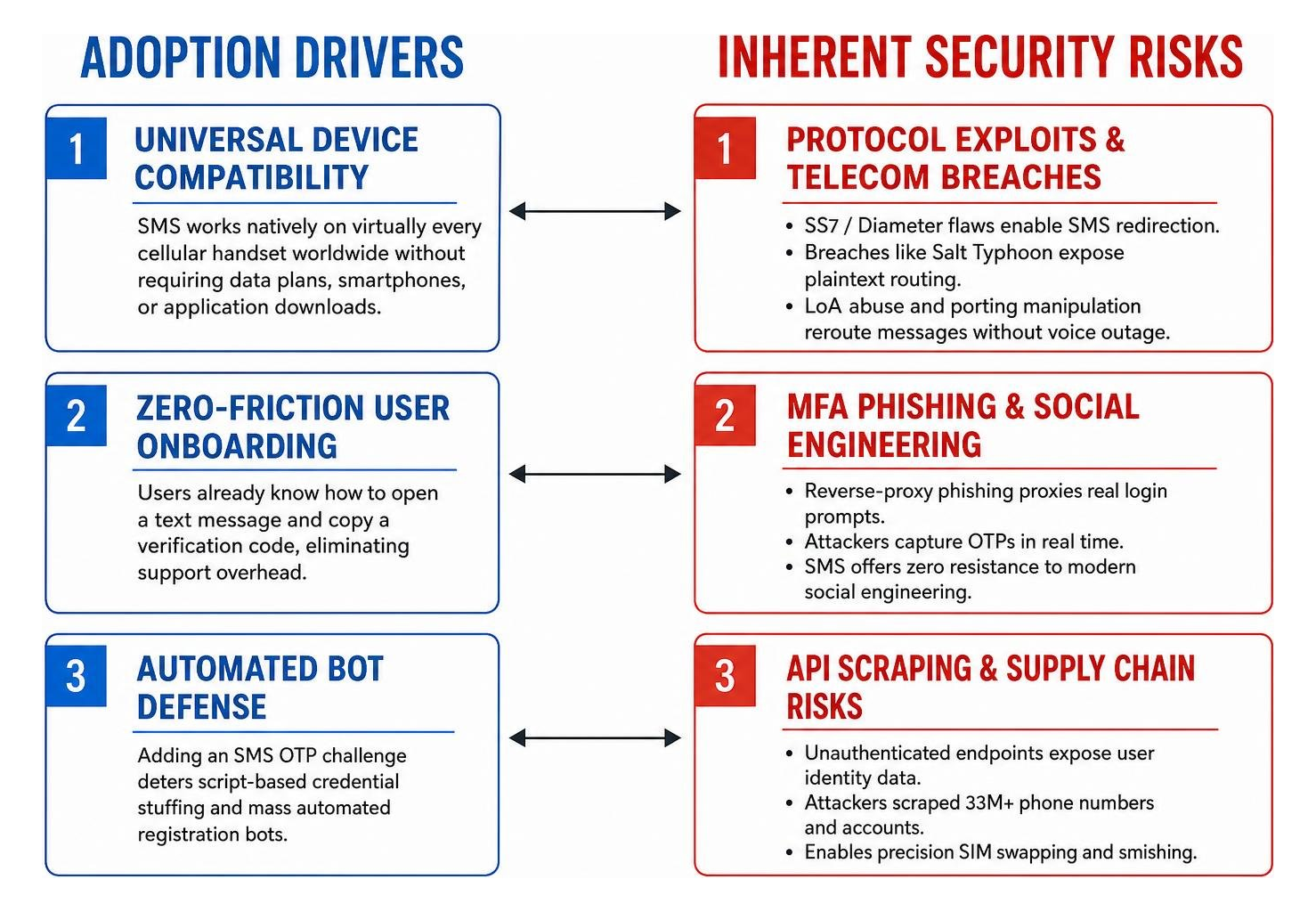
Organizations continue relying on SMS authentication for specific structural reasons:
- Universal Device Compatibility: SMS functions natively on virtually every cellular handset worldwide without requiring data plans, smartphones, or application downloads.
- Zero-Friction User Onboarding: Consumers already know how to open a text message and copy a verification code, eliminating support overhead associated with onboarding.
- Automated Bot Defense: Adding an SMS OTP challenge deters script-based credential stuffing and mass automated registration bots.
- Emergency Fallback Workflows: When users lose hardware authenticators or migrate between mobile devices, SMS is frequently left as an identity recovery failsafe.
The Friction vs. Security Dilemma in Consumer IAM
For consumer-facing platforms, security policies interact directly with customer conversion funnels. Product and growth teams resist authentication methods that introduce barriers at checkout or account registration. Requiring a consumer to download a dedicated authenticator application or configure a passkey can lead to dropped sessions and customer churn.
SMS authentication offers an intuitive user experience across age groups and technical skill levels. Furthermore, enterprise IT helpdesks face lower immediate support volumes from text messaging compared to lost authenticator seeds or forgotten device credentials. However, this convenience introduces hidden financial and operational costs, including carrier delivery fees, surging toll fraud rates (such as international revenue-sharing SMS pumping fraud), and elevated breach exposure.
Technical Criteria When Selecting a Two Factor Authentication SMS Service
When an organization must deploy or maintain SMS verification for low-risk user journeys or consumer onboarding, the underlying service must satisfy strict operational and security criteria:
| Evaluation Criterion | Production Standard | Security / Operational Objective |
|---|---|---|
| Delivery Latency | Sub-5-Second Delivery | Prevents user-initiated resend attempts that trigger replay confusion and API abuse. |
| API Idempotency | X-Request-Id Support |
Prevents duplicate SMS generation caused by network retries, connection timeouts, or double-clicks. |
| VoIP / Virtual Carrier Blocking | Native Carrier Type Lookup | Identifies and filters disposable VoIP numbers and non-fixed lines before dispatching an OTP. |
| Toll Fraud & Velocity Defenses | Machine-learning rate limiters | Blocks automated SMS pumping fraud across high-risk international numbering plans. |
| Multi-Channel Fallbacks | WhatsApp, Voice, Email | Offers programmatic fallback paths when specific cellular networks experience routing outages. |
Developers building custom verification workflows can integrate specialized tools such as SMSDING for low-latency delivery or use developer platforms like SMSPin during automated QA and staging flows. For unified enterprise messaging, the Twilio SMS API provides programmable delivery controls, verification logic, and automated fraud-guard filters across global carriers.
Modern Alternatives: Moving Beyond SMS-Based Verification
To establish true resilience against credential-stealing proxies and telecom vulnerabilities, organizations are migrating toward cryptographic, application-based, and hardware-backed authentication methods.
| Authentication Method | Phishing Resistance | Telecom Exploit Resistance | User Convenience | Cost / Complexity | NIST SP 800-63B Alignment |
|---|---|---|---|---|---|
| SMS OTP | None (Vulnerable to AitM) | None (Vulnerable to SS7 / SIM Swap) | High (Universal) | Low–Moderate (Carrier Fees) | Restricted / Deprecated for High Assurance |
| TOTP Authenticator Apps | Low (Vulnerable to AitM) | High (Zero Carrier Dependency) | Moderate (Requires App) | Low (Software-based) | Approved (Out-of-Band Software Token) |
| Push Notification (Number Matching) | Low–Moderate (Fatigue resistant) | High (Zero Carrier Dependency) | High (Single tap) | Moderate (IAM Provider Dependent) | Approved (Out-of-Band Software Token) |
| FIDO2 / WebAuthn Passkeys | High (Cryptographically Bound) | High (Immune to Telecom Exploits) | High (Biometric Touch / PIN) | Moderate (Infrastructure Setup) | Highest (AAL3 Phishing-Resistant) |
| FIDO2 Hardware Security Keys | High (Cryptographically Bound) | High (Immune to Telecom Exploits) | Moderate (Physical Dongle) | High (Hardware Deployment) | Highest (AAL3 Phishing-Resistant) |
A detailed evaluation of the 2FA authentication types guide helps security teams map these authentication factors against specific user roles and operational profiles.
App-Based TOTP and Push Authentication
Software authenticators remove the cellular carrier from the verification loop. By adhering to the IETF RFC 6238 standard for Time-Based One-Time Passwords (TOTP), mobile apps generate ephemeral 6-digit tokens using a shared secret seed and the current Unix epoch time.
Selecting a dedicated solution from the best 2-factor authenticator guide eliminates risks associated with cellular signaling, SIM hijacking, and intercepted SMS packets. When utilizing cloud-backed push authenticators, security teams should mandate number matching challenges (where the user must input digits displayed on the login screen into their authenticator app) to neutralize MFA push fatigue attacks.
FIDO2, WebAuthn, and Hardware Security Tokens
The gold standard for zero-trust identity architectures is asymmetric public-key cryptography, governed by the FIDO Alliance and W3C WebAuthn standards.
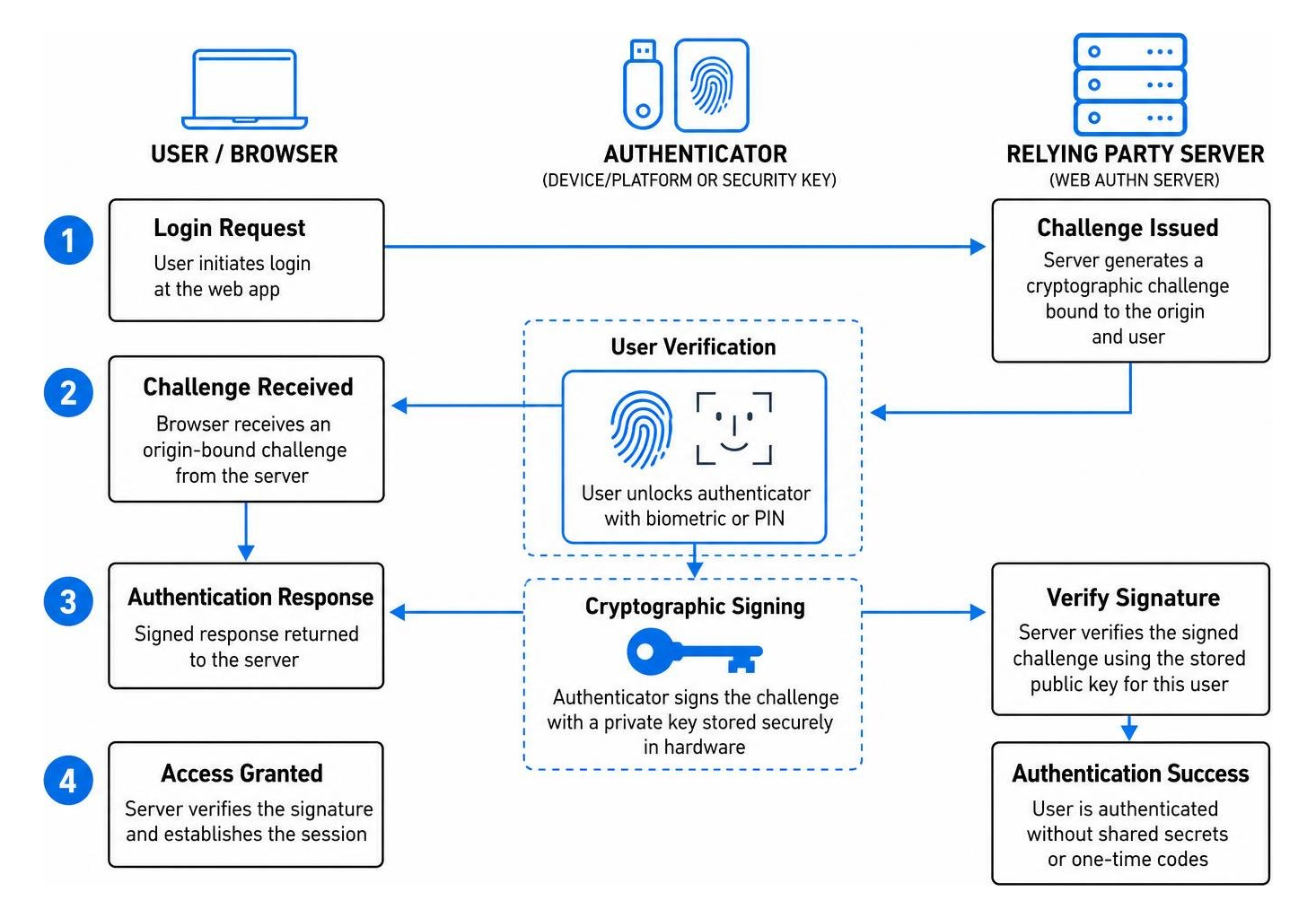
Under a FIDO2 framework:
- The authentication server issues an origin-bound cryptographic challenge to the client browser.
- The user unlocks their authenticator (such as an embedded platform passkey or an external token) using biometric verification or a local device PIN.
- The authenticator signs the challenge using a locally stored private key that never leaves the hardware security boundary.
- The signed challenge is verified by the server using the registered public key.
Deploying a dedicated hardware security key makes authentication resistant to adversary-in-the-middle phishing and independent of telecom networks. EveryKey is a small wireless key. Your computer unlocks when you walk up and locks the moment you walk away, and it works alongside your MFA.
Regulatory Compliance and Migration Strategy for IT Leaders
Standards organizations and cybersecurity agencies maintain clear positions regarding SMS authentication:
- NIST SP 800-63B (Digital Identity Guidelines): Formally classifies SMS as a "Restricted" out-of-band authenticator across Authenticator Assurance Level 2 (AAL2), explicitly highlighting its vulnerability to SIM swapping and signaling-level interception. NIST prohibits SMS for Authenticator Assurance Level 3 (AAL3).
- CISA Guidance: The Cybersecurity and Infrastructure Security Agency mandates that federal agencies and critical infrastructure operators migrate rapidly toward phishing-resistant MFA (FIDO2/WebAuthn), warning against reliance on voice and SMS channels.
- European Banking Authority (EBA) & GDPR: Regulatory frameworks under PSD2/PSD3 and GDPR emphasize secure transaction authorization and strong data protection boundaries, penalizing institutions that fail to implement robust controls against known telecom fraud vectors.
Securing administrative access is critical. Domain administrators are high-value targets for credential probing and account takeover. Relying on SMS verification for domain administrators, identity tier-0 systems, or root cloud consoles creates immediate operational risk.
Step-by-Step Transition Plan from SMS to Phishing-Resistant MFA
Organizations transitioning their workforce and consumer bases away from SMS verification can follow a structured phase-out strategy:
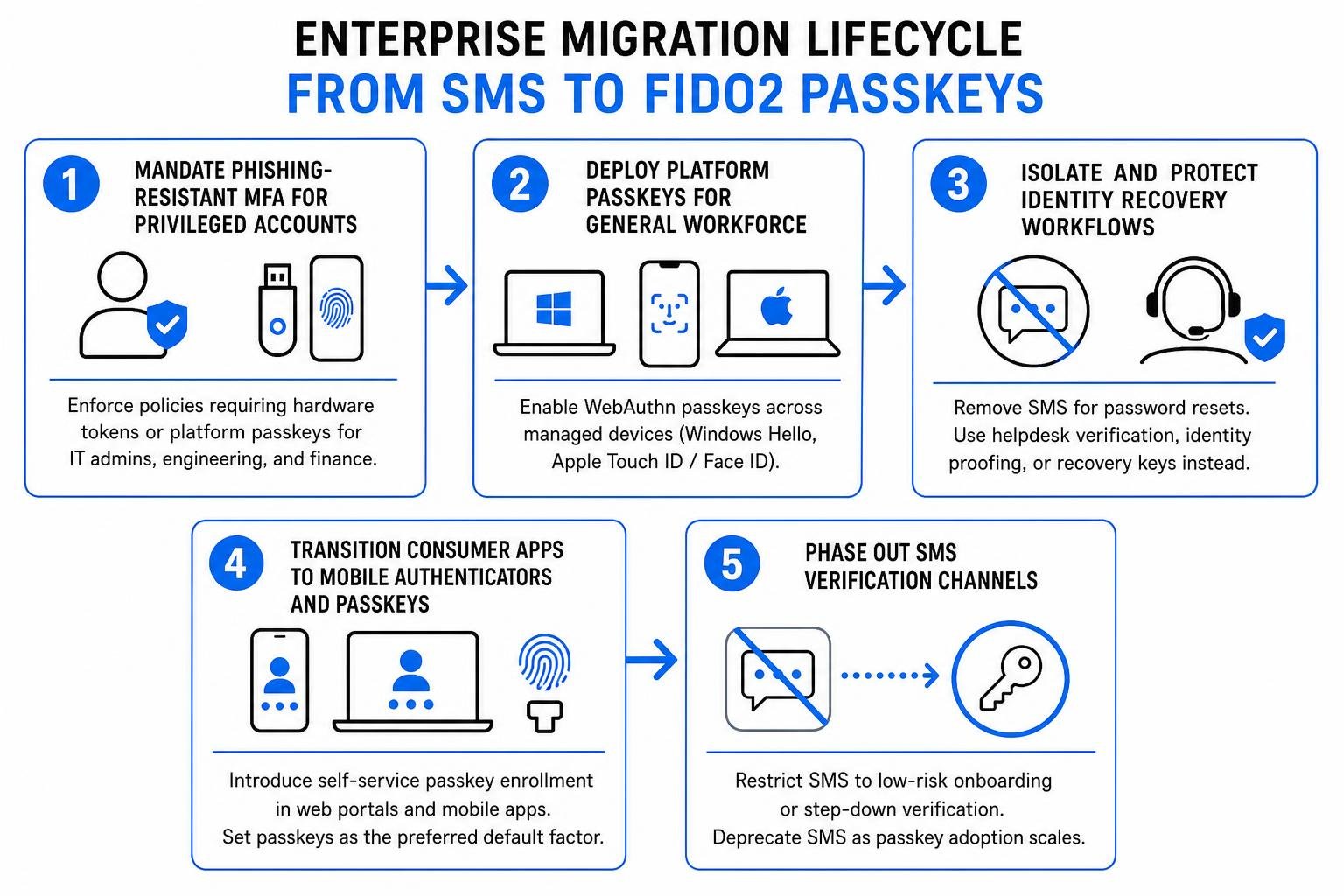
- Mandate Phishing-Resistant MFA for Privileged Accounts: Enforce strict Conditional Access or IAM policies requiring hardware tokens or platform passkeys for IT administrators, engineering leads, and finance teams.
- Deploy Platform Passkeys for General Workforce: Enable WebAuthn passkey enrollment across corporate managed devices (Windows Hello, Apple Touch ID/Face ID), providing a biometric login flow.
- Isolate and Protect Identity Recovery Workflows: Remove SMS as an option for automated password resets. Route password resets through managed helpdesk verification, enterprise identity proofing, or pre-registered recovery keys.
- Transition Consumer Applications to Mobile Authenticators and Passkeys: Introduce self-service passkey enrollment within consumer web portals and mobile applications, setting passkeys as the preferred default factor.
- Phase Out SMS Verification Channels: Restrict SMS exclusively to low-risk onboarding or step-down verification, ultimately deprecating the protocol as passkey adoption scales across your user directory.
Frequently Asked Questions About SMS Authentication Services
Why did NIST deprecate SMS as an out-of-band authentication factor?
NIST restricted SMS in SP 800-63B due to structural telecom vulnerabilities that cannot be mitigated at the application layer. These include SS7 protocol exploitation, network-level eavesdropping, SIM-swap attacks via carrier customer service manipulation, and vulnerability to automated SMS intercept malware.
Can an SMS 2FA service protect against automated brute-force attacks?
Yes. SMS 2FA stops basic automated credential stuffing, brute-force dictionary scripts, and bulk unsophisticated attacks by requiring a second factor. However, it fails to protect against real-time adversary-in-the-middle (AitM) phishing proxies, targeted social engineering, or telecom-level interception.
How can enterprises mitigate SMS 2FA risks if migration is delayed?
If legacy dependencies require temporary SMS use, organizations should implement carrier-lookup APIs to block virtual VoIP numbers, enforce strict API rate limiting, apply geo-velocity blocks against high-risk international routing prefixes, and restrict SMS codes entirely from password-reset paths.
Conclusion
A two factor authentication SMS service provides an improvement over standalone passwords, but its reliance on legacy telecommunications infrastructure leaves modern organizations exposed to SIM swapping, AitM phishing proxies, and carrier-level interception.
Treating SMS verification as a temporary bridge rather than a permanent security control allows IT and security leaders to build resilient, future-ready defense-in-depth architectures. Phasing out SMS across privileged user groups and adopting the best authentication methods of 2026—such as FIDO2 hardware keys, platform passkeys, and cryptographic authenticator apps—ensures enterprise identities remain secure against emerging modern threats.