
Quantum Resistant Cryptography Algorithms Explained
NIST has standardized ML-KEM, ML-DSA, and SLH-DSA — but migrating before quantum computers crack today's encryption is the real challenge. Here's how enterprise security teams can start.

What Are Quantum Resistant Cryptography Algorithms — and Why They Matter Right Now
Quantum resistant cryptography algorithms are the new generation of encryption methods designed to stay secure even when large-scale quantum computers exist — and as of May 2026, the transition to these algorithms is no longer a future concern. It is an active, urgent priority.
Here is a quick summary of the NIST-standardized quantum-safe algorithms you need to know:
| Standard | Algorithm | Purpose | Mathematical Basis |
|---|---|---|---|
| FIPS 203 | ML-KEM (Kyber) | Key encapsulation | Module Learning with Errors |
| FIPS 204 | ML-DSA (Dilithium) | Digital signatures | Module lattice problems |
| FIPS 205 | SLH-DSA (SPHINCS+) | Digital signatures | Hash functions |
| FIPS 206 | FN-DSA (Falcon) | Digital signatures | NTRU lattices |
| FIPS 207 (draft) | HQC | Backup KEM | Error-correcting codes |
Today's public-key encryption — RSA, ECC, Diffie-Hellman — rests on math problems that are practically impossible for classical computers to solve. Quantum computers change that equation entirely.
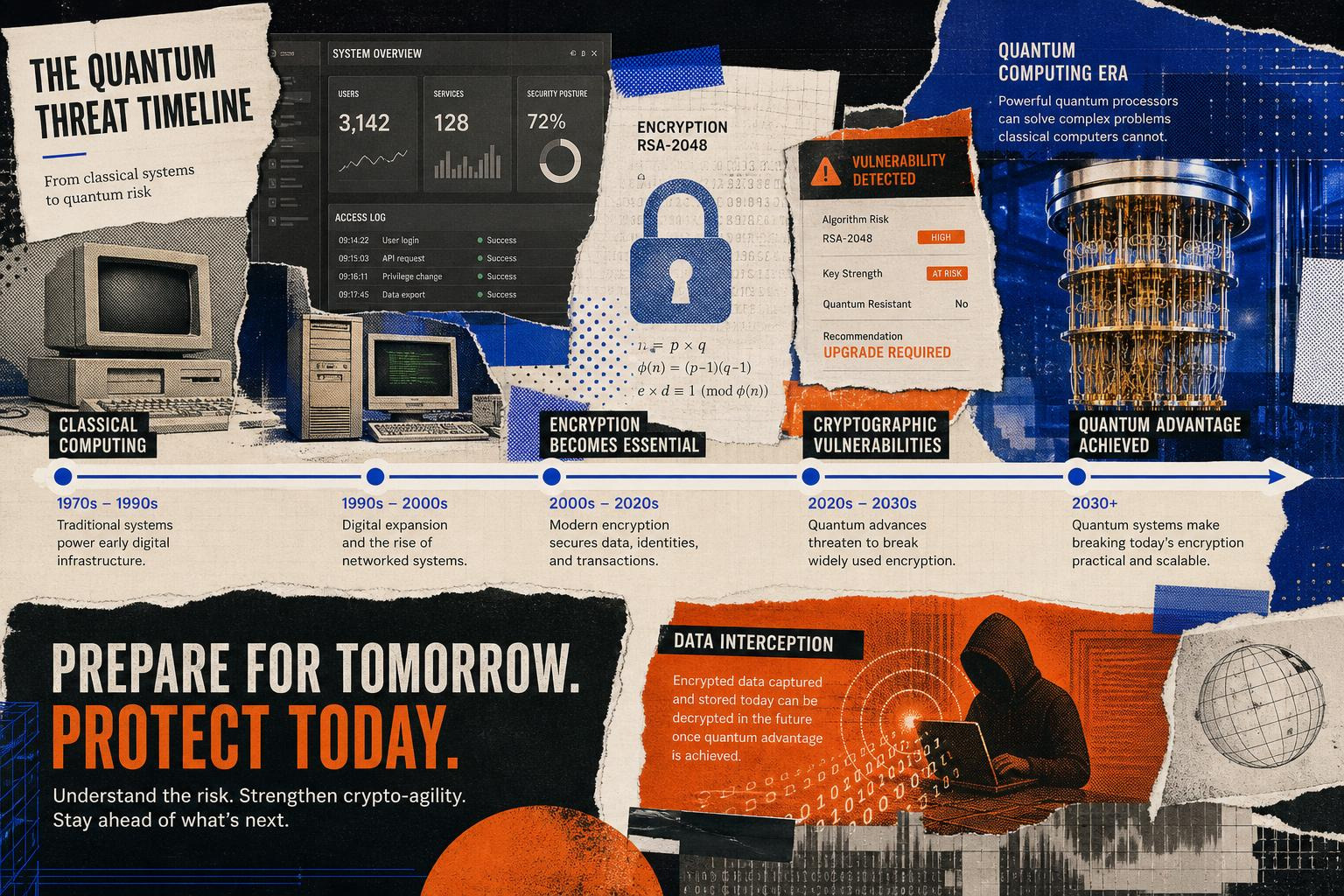
A sufficiently powerful quantum computer running Shor's algorithm could break RSA and elliptic curve cryptography in a fraction of the time it would take today's fastest supercomputers. That machine doesn't exist yet at scale. But the window to prepare is closing faster than most organizations realize.
Here is why: full cryptographic migrations take years, not months. Supply chains, embedded hardware, legacy protocols, and compliance frameworks all move slowly. And there is already an active threat — adversaries are intercepting and storing encrypted data today, betting they can decrypt it once quantum capability arrives. This is the "harvest now, decrypt later" attack model, and it is not theoretical.
In August 2024, NIST finalized its first three post-quantum cryptography standards — the culmination of an eight-year standardization effort that began in 2016. That milestone triggered what some experts are calling the largest cryptographic transition in the history of the internet.
This guide breaks down every major family of quantum-resistant algorithms, explains the NIST standards in plain terms, compares performance and key-size trade-offs, and walks through what a realistic enterprise migration actually looks like.
The Quantum Threat to Modern Encryption Standards
To understand why we need new math, we have to look at how current public-key cryptography works. Popular schemes like RSA and Elliptic Curve Cryptography (ECC) rely on a fundamental asymmetry: some math operations are incredibly easy to perform in one direction but virtually impossible to reverse without a key.
For RSA, the barrier is integer factorization. Multiplying two massive prime numbers together is trivial; finding those prime factors from their product takes classical supercomputers thousands of years. ECC relies on a similar structural barrier known as the discrete logarithm problem.
Quantum computing introduces an entirely different computational model. Instead of classical bits that represent either a 0 or a 1, quantum computers use qubits. Through the physical phenomena of superposition (allowing qubits to exist in multiple states simultaneously) and entanglement (linking qubits so the state of one instantly influences another), quantum systems can process complex mathematical landscapes in parallel.
This architectural shift allows quantum systems to run algorithms that bypass classical limits:
- Shor's Algorithm: Published by Peter Shor in 1994, this algorithm can solve both integer factorization and discrete logarithms in polynomial time. Once a cryptographically relevant quantum computer (CRQC) is built, every standard asymmetric protocol—including RSA, Diffie-Hellman, and ECDH—will instantly become obsolete.
- Grover's Algorithm: This algorithm targets symmetric cryptography (like AES) and hashing functions (like SHA-3) by offering a quadratic speedup for searching unsorted databases. Fortunately, Grover's algorithm does not break symmetric encryption; it merely halves its effective security level. Protecting symmetric assets simply requires doubling key lengths—meaning AES-256 remains highly secure in a post-quantum world, yielding a comfortable 128 bits of quantum security.
The 'Harvest Now, Decrypt Later' Threat Model
A common misconception among IT decision-makers is that quantum security is a 2030s problem. It isn't. Adversaries are actively executing Harvest Now, Decrypt Later (HNDL) operations.
In an HNDL attack, state-sponsored groups and sophisticated actors intercept and store highly encrypted, sensitive data transiting public channels today. They do not need to decrypt it immediately. They simply archive the raw ciphertexts, waiting for quantum hardware to mature.
For data with short shelf-lives—such as daily retail transactions—HNDL is a minor concern. But for intellectual property, military secrets, national security communications, and long-term healthcare records, the compromise of confidentiality a decade from now is a catastrophic risk today.
Michele Mosca of the Institute for Quantum Computing formalized this urgency with Mosca’s Theorem (also known as Mosca's Inequality):
$$\text{If } X + Y > Z, \text{ then you should be worried.}$$
Where:
- $X$ = The time it takes to migrate your systems to quantum-safe alternatives.
- $Y$ = The duration your data must remain secure (data longevity).
- $Z$ = The time it takes to develop a cryptographically relevant quantum computer.
If your organization requires ten years to audit and update its infrastructure ($X = 10$), and you handle financial records that must remain confidential for fifteen years ($Y = 15$), you need a total runway of 25 years. If a CRQC emerges in ten years ($Z = 10$), your current systems are already failing to protect your data.
Core Families of Quantum Resistant Cryptography Algorithms
Because Shor’s algorithm systematically dismantles the mathematical foundations of factoring and discrete logarithms, cryptographers had to look elsewhere for hard mathematical problems. Today’s post-quantum landscape is built on several diverse mathematical families that classical and quantum systems alike find incredibly difficult to solve.

Lattice-Based Cryptography and Learning with Errors
Lattice-based cryptography is the most dominant and versatile family. It relies on the geometry of multi-dimensional grids (lattices) containing infinite points.
The core security of these schemes is anchored to geometric problems like the Shortest Vector Problem (SVP) and the Closest Vector Problem (CVP). In thousands of dimensions, finding the point in a lattice closest to a random coordinate is incredibly complex.
Most practical lattice implementations use the Learning with Errors (LWE) problem or its variants. LWE involves solving systems of linear equations with added noise (small errors). Without knowing the secret, recovering the variables is computationally infeasible.
To improve efficiency, cryptographers developed Learning with Rounding (LWR), which replaces random error generation with deterministic rounding. This eliminates the need for complex Gaussian noise sampling, which is historically slow and prone to side-channel attacks.
A notable exploration of this approach is detailed in Lizard: Cut Off the Tail! A Practical Post-quantum Public-Key Encryption from LWE and LWR, which demonstrates how combining LWE and LWR can yield highly practical, high-speed public-key encryption schemes.
Code-Based, Hash-Based, and Multivariate Cryptography
While lattices are highly popular, maintaining mathematical diversity is crucial. If a breakthrough classical algorithm suddenly solves lattice structures, alternative mathematical families will keep the digital economy secure.
- Code-Based Cryptography: This family is built on error-correcting codes. The classic McEliece cryptosystem, introduced in 1978, is the gold standard here. It hides a secret error-correcting code (typically a Goppa code) by adding random errors to a message. Only the holder of the private key knows how to quickly decode and correct those errors. McEliece has resisted over 40 years of intense cryptanalysis, making it one of our most trusted post-quantum options, though it suffers from exceptionally large public key sizes (often exceeding 1 MB).
- Hash-Based Cryptography: Hash-based signature schemes rely entirely on the security of standard cryptographic hash functions (such as SHA-2 or SHA-3). Because they do not rely on complex algebraic structures, their security assumptions are incredibly conservative. If your hash function is secure, your digital signature is secure. Schemes like SPHINCS+ provide highly reliable, stateless digital signatures, though they generate larger signature sizes and require more processing overhead than lattice-based alternatives.
- Multivariate Quadratic Cryptography: These schemes rely on the difficulty of solving systems of non-linear equations over finite fields. While early multivariate schemes suffered from vulnerabilities, modern designs have made significant leaps. For example, the MAYO Specification Document - Round 2 outlines a highly optimized multivariate signature scheme that achieves remarkably compact public key sizes compared to traditional "Oil and Vinegar" multivariate approaches.
The Rise and Fall of Isogeny-Based Cryptography
For a long time, isogeny-based cryptography—specifically Supersingular Isogeny Diffie-Hellman (SIDH)—was viewed as a highly promising post-quantum candidate. It offered extremely small key sizes, comparable to classical ECC, which made it highly attractive for bandwidth-constrained environments.
However, in August 2022, researchers Wouter Castryck and Thomas Decru published a devastating classical attack that completely broke SIDH. The attack exploited auxiliary point information shared during key exchanges, allowing an ordinary classical single-core processor to recover private keys in under an hour.
The collapse of SIDH, which was standardized under the draft Supersingular Isogeny Key Encapsulation (SIKE) submission, served as a stark reminder of the risks of early adoption. It validated NIST's conservative approach and underscored the absolute necessity of crypto-agility—the ability to rapidly swap out compromised algorithms without rewriting entire software architectures.
NIST Standardization and Approved Post-Quantum Algorithms
The global shift toward quantum resistance is steered by the National Institute of Standards and Technology (NIST). NIST launched its PQC standardization project in 2016, evaluating dozens of candidate designs over several rounds.
By August 2024, NIST finalized its first three official Federal Information Processing Standards (FIPS), followed by additional selections to ensure a diversified portfolio of backup algorithms.
More details on this ongoing evaluation process can be explored at the official Post-Quantum Cryptography | CSRC) page.
ML-KEM (FIPS 203) for Key Encapsulation
ML-KEM (Module-Lattice-Based Key-Encapsulation Mechanism), derived from the CRYSTALS-Kyber algorithm, is the primary standard for general-purpose encryption and key exchange.
As specified in the Module-Lattice-Based Key-Encapsulation Mechanism Standard, ML-KEM is used to securely establish a shared symmetric secret key over an untrusted public channel. Its security is rooted in the Module Learning with Errors (MLWE) problem.
ML-KEM is highly efficient, offering fast execution times and reasonably small key sizes. It is defined across three parameter sets to match different security levels:
- ML-KEM-512: Designed to meet NIST Security Category 1 (equivalent to the security of AES-128).
- ML-KEM-768: Meets NIST Security Category 3 (equivalent to AES-192), widely considered the "sweet spot" balancing performance and robust security.
- ML-KEM-1024: Meets NIST Security Category 5 (equivalent to AES-256), intended for long-term, high-security applications.
ML-DSA (FIPS 204) and SLH-DSA (FIPS 205) for Digital Signatures
For authentication, identity verification, and document signing, NIST standardized two distinct signature frameworks:
- ML-DSA (FIPS 204): Formerly known as CRYSTALS-Dilithium, this is the primary recommended standard for digital signatures. Like ML-KEM, it is built on module lattice problems. It provides excellent performance, fast signature generation, and verification speeds, making it the default choice for most enterprise PKI (Public Key Infrastructure) upgrades.
- SLH-DSA (FIPS 205): Formerly known as SPHINCS+, this is a stateless hash-based digital signature standard. Because it relies entirely on the security of underlying hash functions (like SHA-256 or SHAKE-256) rather than lattices, it serves as an invaluable mathematical backup. If a structural vulnerability is ever discovered in lattice-based math, SLH-DSA will remain secure. However, it requires significantly larger signatures and higher computational overhead.
To round out the signature portfolio, NIST is finalizing FN-DSA (FIPS 206, based on Falcon), which offers smaller signature sizes but requires complex floating-point math, making it less suitable for low-power embedded devices.
Furthermore, NIST continues to build out its backup options. In early 2026, NIST announced the standardization of HQC (Hamming Quasi-Cyclic, slated for FIPS 207) as a code-based key encapsulation backup to ensure robust cryptographic diversity.
Technical Comparison and Migration Challenges
Moving from classical algorithms to post-quantum standards involves significant engineering trade-offs. Unlike the transition from RSA to ECC—which actually reduced key sizes and increased speeds—moving to post-quantum cryptography requires handling larger keys, larger signatures, and increased processing requirements.
| Algorithm | NIST Security Level | Public Key Size (Bytes) | Private Key Size (Bytes) | Ciphertext / Signature Size (Bytes) |
|---|---|---|---|---|
| RSA-2048 (Classical) | Vulnerable | 256 | 2,048 | 256 |
| ECDSA P-256 (Classical) | Vulnerable | 64 | 32 | 64 |
| ML-KEM-768 (FIPS 203) | 3 (AES-192 equivalent) | 1,184 | 2,400 | 1,088 |
| ML-DSA-65 (FIPS 204) | 3 (AES-192 equivalent) | 1,952 | 4,032 | 3,300 |
| SLH-DSA-128s (FIPS 205) | 1 (AES-128 equivalent) | 32 | 64 | 7,856 |
| Classic McEliece-348864 | 1 (AES-128 equivalent) | 261,120 | 6,452 | 128 |
Performance Trade-offs of Quantum Resistant Cryptography Algorithms
The data in the table above highlights several critical implementation challenges:
- Network Packet Fragmentation: A classical ECDSA P-256 signature is only 64 bytes. An ML-DSA-65 signature is 3,300 bytes—more than a 50x increase. In network protocols like TLS, this expansion can cause handshake packets to exceed the standard Ethernet Maximum Transmission Unit (MTU) of 1,500 bytes. This forces packet fragmentation at the IP layer, leading to packet drops, increased latency, and connection failures on poorly configured network equipment.
- Memory Footprint on Embedded Systems: For IoT devices, smart cards, and industrial controllers, memory is highly constrained. Storing an ML-DSA private key of over 4 KB, or processing the heavy mathematical operations of SLH-DSA, can easily overwhelm low-power microcontrollers that lack hardware acceleration for lattice arithmetic.
- Cryptographic Storage Overhead: For databases, blockchain systems, and signed documents, storing larger signatures and public keys drastically increases storage costs and transaction fees over time.
Implementing Quantum Resistant Cryptography Algorithms in Enterprise Networks
To mitigate these risks and ensure a smooth migration, the security industry has embraced a hybrid cryptographic model.
Instead of completely replacing classical algorithms overnight, hybrid systems run classical and post-quantum algorithms in parallel. For instance, a hybrid TLS 1.3 handshake negotiates a shared secret using both ECDH (X25519) and ML-KEM-768. The final session key is derived by hashing the secrets from both algorithms.
This approach guarantees that even if a newly deployed post-quantum algorithm is discovered to have a mathematical flaw or implementation vulnerability, the session remains fully protected by the classical algorithm.
Several industry leaders have already successfully deployed these hybrid architectures:
- Signal Protocol: In 2023, Signal upgraded its underlying protocol to PQXDH (Post-Quantum Extended Diffie-Hellman), combining X25519 with ML-KEM-768 to secure end-to-end encrypted messaging.
- Apple iMessage: In 2024, Apple rolled out its PQ3 protocol, a level-3 quantum-resistant security upgrade that integrates hybrid post-quantum key exchange with continuous rekeying to limit the blast radius of any potential key compromise.
- Google Chrome & Cloudflare: Google and Cloudflare have fully integrated hybrid post-quantum key exchange (X25519 + ML-KEM) into mainstream web browsers and content delivery networks, protecting millions of daily TLS connections.
Frequently Asked Questions about Post-Quantum Cryptography
Is AES-256 secure against quantum attacks?
Yes. Grover's algorithm reduces the brute-force search space of symmetric encryption quadratically, effectively cutting its security in half. This means AES-128 provides 64 bits of quantum security (which is vulnerable), while AES-256 maintains 128 bits of quantum security. A 128-bit security level is globally recognized as computationally unbreakable for the foreseeable future.
When will quantum computers break current encryption?
Estimates vary, but most physicists and cryptographers point to a window between 2030 and 2035. IBM's Quantum Development Roadmap projects highly advanced, error-corrected quantum systems operating by the early 2030s. However, because of the Harvest Now, Decrypt Later threat, organizations must secure their systems long before the first physical machine is constructed.
What is crypto-agility and why is it important?
Crypto-agility is the design philosophy of building software and network architectures so that cryptographic primitives (like algorithms, key sizes, and protocols) can be quickly swapped out via configuration files or simple updates, without requiring a complete rewrite of the underlying codebase. The collapse of SIKE in 2022 proved that no algorithm is guaranteed to be secure forever; systems must be agile enough to adapt to new cryptographic breakthroughs instantly.
Conclusion
The transition to quantum-safe security is not a project to be delayed; it is a multi-year operational shift that must begin today. Organizations must start by auditing their current cryptographic footprint, identifying where vulnerable asymmetric algorithms are deployed across their networks, databases, and third-party integrations.
As an independent cybersecurity knowledge resource, Unlocked is committed to helping security practitioners navigate this complex landscape. For organizations looking to future-proof their identity systems, physical access controls, and overall security posture, adopting a proactive, zero-trust approach to cryptography is essential.
To learn more about modern, secure access solutions and how to prepare your enterprise for the post-quantum era, explore A new chapter for access: meet the new EveryKey or sign up for our platform at the Unlocked Portal. Keep your systems agile, monitor your legacy dependencies, and build your defenses today for the threats of tomorrow.