

Beginner's Guide to Malware Threat Intelligence Basics

Introduction
Malware threat intelligence is the practice of collecting, analyzing, and applying technical data about malicious software, adversary infrastructure, and attack behaviors to detect, contain, and prevent cyber threats. By transforming raw indicators into machine-readable context—such as adversary tactics, techniques, and procedures (TTPs) and command-and-control (C2) mappings—it enables security operations centers (SOCs) to correlate isolated endpoint alerts with known campaigns and neutralize intrusions before data exfiltration occurs.
This structured insight is critical as the global digital landscape faces relentless pressure from automated malware production and organized cybercrime syndicates. Security telemetry indicates that over 560,000 new pieces of malware are detected every day, contributing to a historical index exceeding one billion distinct malicious binaries observed worldwide.
The financial fallout of malicious intrusions remains severe. IBM's Cost of a Data Breach Report put the global average cost of a data breach at $4.44 million in 2025. Meanwhile, enterprise ransomware threats have escalated: the average ransom payment has grown from under $100,000 to more than $300,000, extortion demands regularly reach upwards of $70 million, and high-profile incidents have resulted in actual payments as large as $40 million to restore business continuity. When an enterprise experiences over 4,000 ransomware intrusions reported across North America daily, manual alert triage fails without actionable intelligence.
What is Malware Threat Intelligence? Core Concepts and Scope
Malware intelligence is a specialized discipline within cyber defense that focuses on discovering, characterizing, tracking, and dissecting malicious code and the threat actors deploying it. Rather than treating an intrusion as an isolated binary running in memory, it examines the technical provenance, capability sets, communications infrastructure, and operational motives behind an infection.
At its core, malware intelligence answers several foundational questions:
- Which specific malware family has invaded the perimeter?
- Which threat actor group or affiliate operates this payload?
- What evasion mechanisms, lateral movement pathways, and persistence scripts does it leverage?
- Which command-and-control (C2) domains, IP subnets, or decentralized networks does it use for data exfiltration?
By combining adversary profiling with granular family taxonomies, analysts can map observed behavior directly to the MITRE ATT&CK framework. Understanding these patterns allows engineering teams to implement proactive network filters and endpoint policies well before an intrusion progresses to data exfiltration. For a broader overview of how intelligence functions across multiple disciplines, explore our foundational guide on understanding threat intelligence: a practical guide for cyber defense.
Malware Intelligence vs. General Cyber Threat Intelligence
While cyber threat intelligence (CTI) encompasses a wide spectrum of threat tracking—including geopolitical motives, brand impersonation, credential harvesting, vulnerability disclosures, and hacktivism—malware threat intelligence zooms in on technical execution.
Malware intelligence focuses on:
- Deep Binary Analysis: Static and dynamic reverse engineering of portable executables (PE), Mach-O binaries, ELF files, and script-based payloads (PowerShell, VBScript, Python, Node.js).
- Indicator Extraction: Parsing configuration blocks out of compiled samples to extract hardcoded C2 addresses, fall-back domains, AES encryption keys, and botnet campaign identifiers.
- C2 Telemetry Analysis: Tracking active server nodes, dead-drop resolvers, fast-flux DNS configurations, and domain generation algorithms (DGAs).
- Behavioral Correlation: Generating high-confidence detection artifacts—such as YARA signatures, Sigma rules, and endpoint behavioral patterns—to feed automated detection systems.
Modern Delivery Vectors: From Living-off-the-Land Runtimes to Recruitment Lures
Adversaries continually refine their initial access tradecraft to bypass traditional signature scanners and secure email gateways.
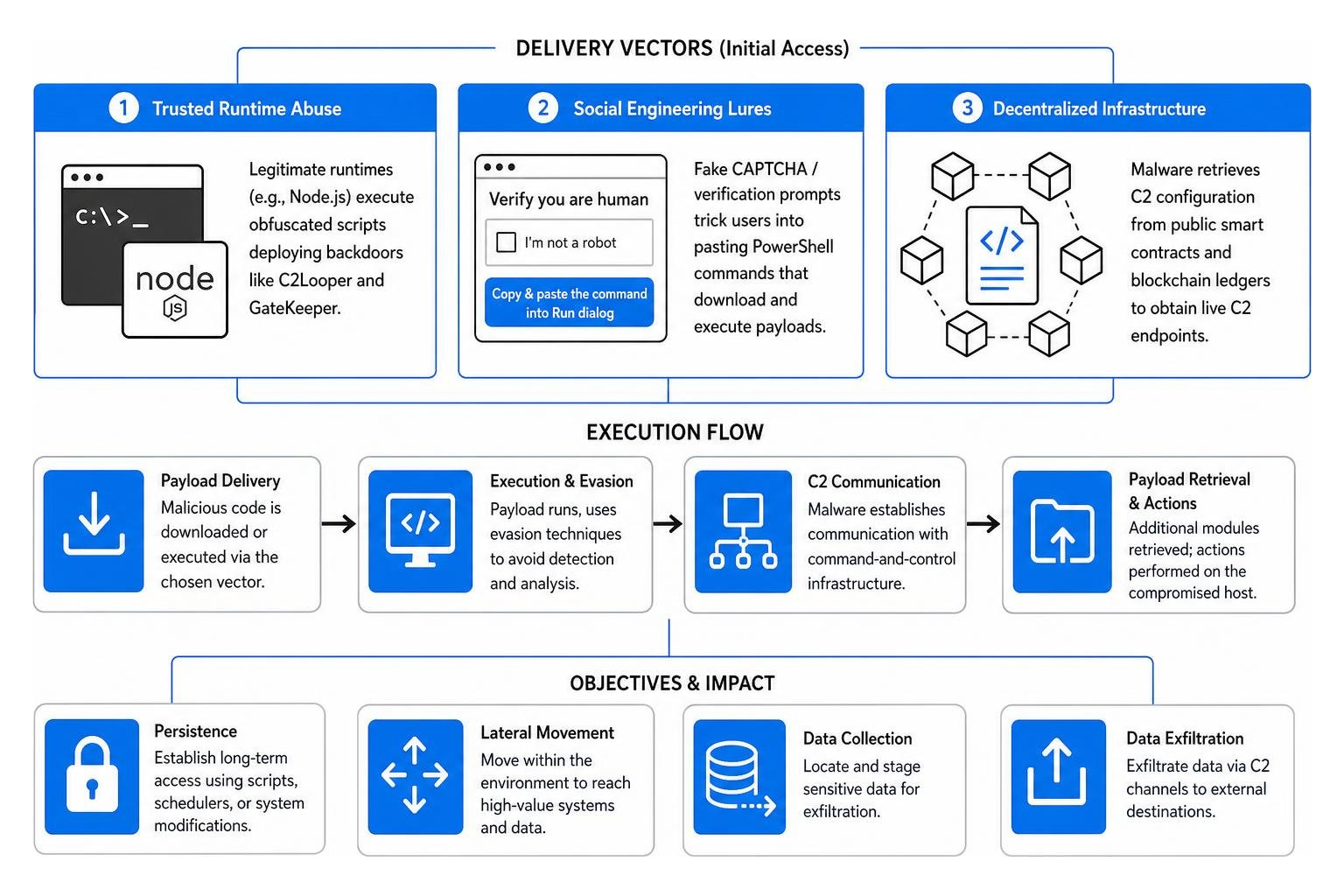
Over the past six months, real-world campaign reporting has highlighted several sophisticated delivery mechanics:
- Trusted Runtime Abuse (Living-off-the-Land): Threat actors have weaponized legitimate developer utilities. In early 2026, security analysts identified campaigns where adversaries deployed official Node.js binaries (
node.exe) directly onto target systems. Because the runtime is a signed, trusted utility, security controls allowed execution while the runtime executed obfuscated scripts deploying backdoors like C2Looper and GateKeeper. - Social Engineering via "ClickFix" CAPTCHA Lures: Throughout 2024 and expanding in 2026, stealer distributors (including operators behind Lumma Stealer and ClearFake) have widely deployed fake browser verification and CAPTCHA prompts. Victims are instructed to copy and paste PowerShell command strings into their system run dialogs, which immediately downloads and executes memory-only infostealers.
- Decentralized Infrastructure (EtherHiding): Adversaries increasingly store dynamic C2 configuration parameters on public smart contracts and blockchain ledgers. When malware executes, it queries decentralized ledgers to retrieve up-to-date C2 IP addresses, making defensive IP blacklisting ineffective without proactive ledger tracking.
- Targeted Developer Recruitment Schemes: APT campaigns, such as those run by Nimbus Manticore, target software engineers on developer boards. Attackers present coding tests packaged in ZIP archives containing trojanized
npmdependencies. When the candidate compiles or tests the application, scripts silently drop cross-platform remote access trojans (e.g., NodeRabbit, PollCat) onto Windows, macOS, or Linux endpoints.
For deeper insights into counteracting deceptive payloads and living-off-the-land techniques, see our analysis on malware evasion techniques & countermeasures.
The Threat Intelligence Lifecycle for Malware Analysis
Transforming massive streams of raw, noisy indicators into operational security measures requires an iterative methodology: the Threat Intelligence Lifecycle. When applied to malware investigations, this framework turns suspicious files into validated, proactive countermeasures.
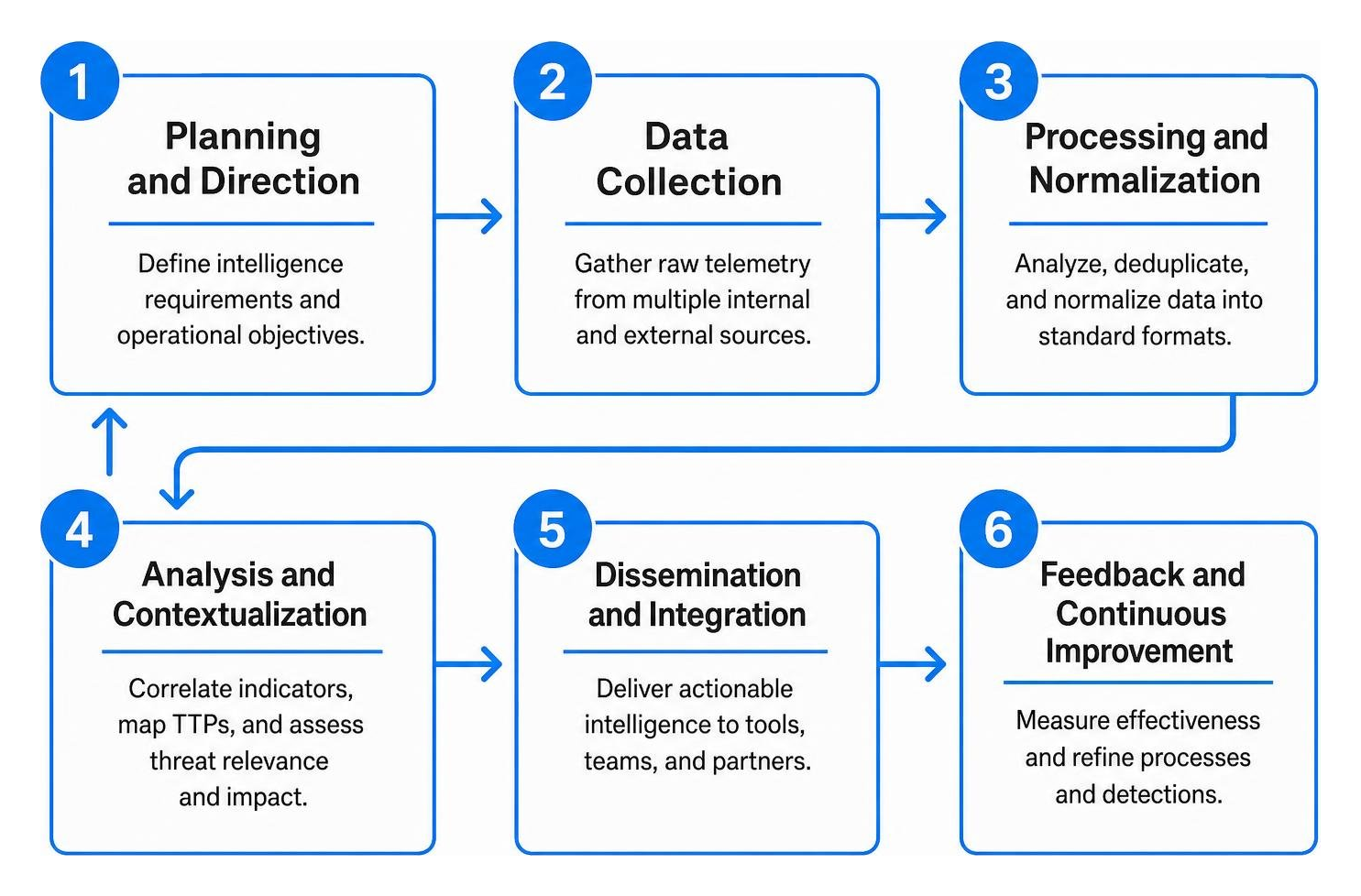
Implementing the Six-Phase Malware Threat Intelligence Cycle
- Planning and Direction: Security leadership sets explicit operational objectives. For example: "Identify and block all incoming credential-stealer families targeting our remote workforce over Microsoft 365 and web access vectors."
- Data Collection: Automated ingestion engines gather raw telemetry from endpoints, commercial and open-source intelligence feeds, internal network sensors, spam traps, incident reports, and public file-scanning sandboxes.
- Processing and Normalization: Raw binaries, network payloads, and text strings are processed through static and dynamic analysis sandboxes. Deduplication engines remove redundant entries, and parsers extract network indicators, registry changes, process trees, and API calls into standard formats.
- Analysis: Security analysts evaluate extracted artifacts to identify malware families, map observed activity to adversary campaigns, and assign confidence and severity scores based on behavioral context.
- Dissemination: High-confidence indicators and detection logic are immediately pushed to downstream defensive tools (SIEM correlation rules, EDR behavioral blocking engines, SOAR playbooks, and perimeter firewalls).
- Feedback and Evaluation: Defenders monitor telemetry to determine whether the intelligence prevented intrusions or caused false positives, refining requirements for the next cycle.
Developing an effective defense requires pairing this lifecycle with comprehensive enterprise malware protection strategies.
Strategic, Operational, and Tactical Malware Intelligence
Malware intelligence serves different operational tiers within an enterprise. Balancing tactical indicators, operational tracking, and strategic metrics ensures comprehensive defense:
| Intelligence Tier | Target Audience | Primary Focus | Key Data Elements & Frameworks | Lifecycle Lifespan |
|---|---|---|---|---|
| Tactical | SOC Analysts, Incident Responders | Technical signatures, immediate threat indicators, and IOCs | MD5/SHA256 hashes, IP addresses, C2 URLs, YARA rules, Sigma detection rules | Hours to Weeks (High volatility) |
| Operational | Threat Hunters, Detection Engineers | Attack campaign context, actor tradecraft, adversary TTPs | MITRE ATT&CK techniques, lateral movement methods, initial access playbooks | Months (Moderate persistence) |
| Strategic | CISOs, Risk Officers, Board Members | Business impact, actor motivation, risk mitigation metrics | Financial exposure metrics, industry threat trends, MITRE D3FEND planning | Years (Long-term decision making) |
Technical Ingestion and Analysis: Formats, Schemas, and Tools
Modern SOCs ingest thousands of indicators every minute. Making this volume actionable requires standardized data schemas and resilient integration pipelines.
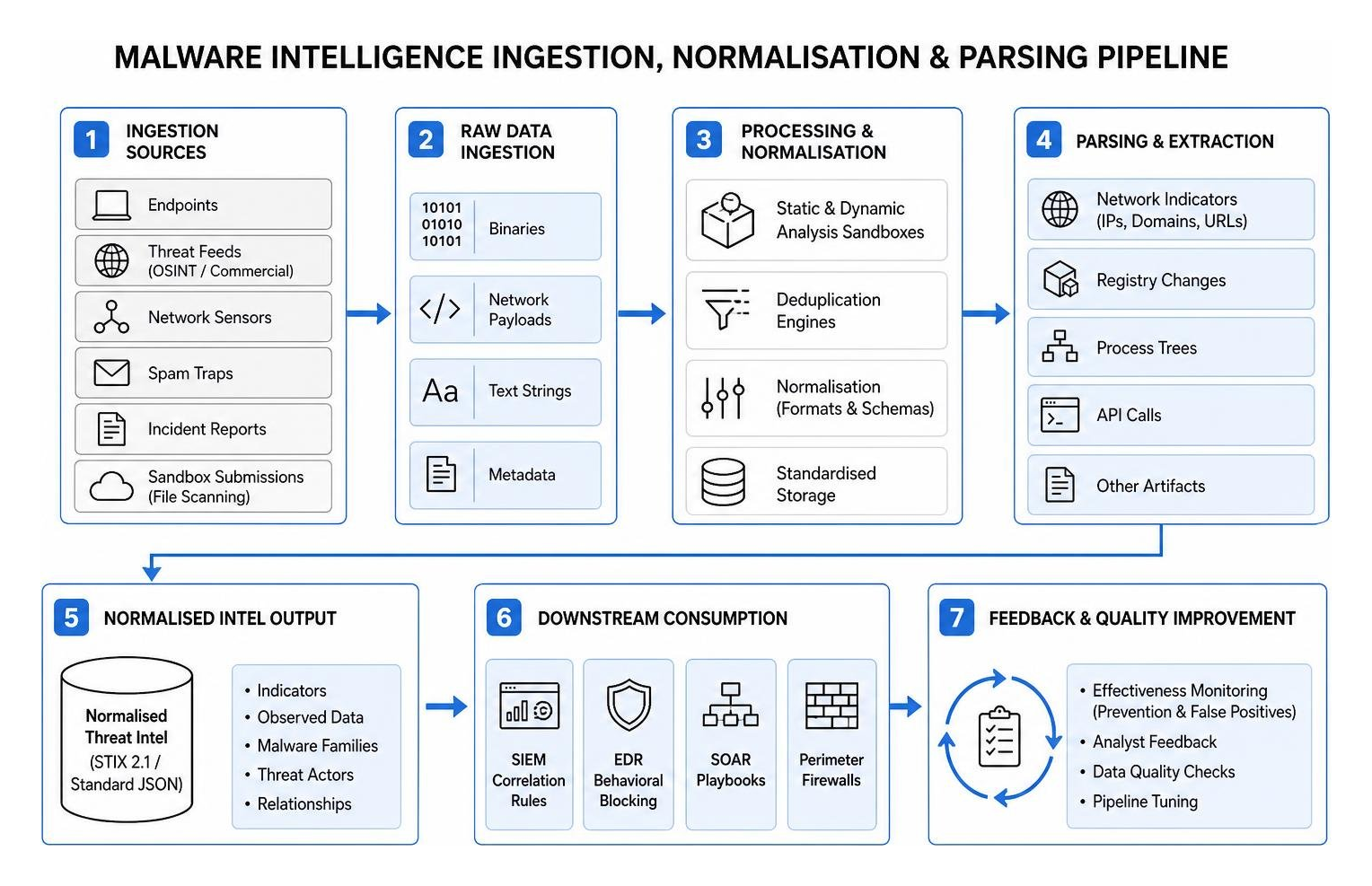
Standardized Taxonomies: STIX 2.1, JSON Feeds, and MITRE ATT&CK
To share malware intelligence between disparate systems without data loss, the cybersecurity industry relies on standardized structures:
- STIX 2.1 (Structured Threat Information Expression): A graph-based schema representing relationships between indicators, attack patterns, observed data, malware families, and threat actors using standard JSON objects.
- Structured JSON Feeds: Machine-readable formats providing rapid key-value lookups for IP reputation, file hashes, and active C2 nodes. For example, the MetaDefender InSights JSON feed format delivers high-speed indicator snapshots annotated with numeric threat scores (1–10) and confidence metrics to streamline automated ingestion.
- MITRE ATT&CK and D3FEND: ATT&CK catalogues specific adversary execution techniques (such as Process Hollowing, T1055.012), while D3FEND maps direct defensive countermeasures (such as Process Spawn Analysis, D3-PSA) to guide threat engineering.
To establish automated delivery channels within your security operations, check our guide on malware threat intelligence feeds.
Evaluating Open-Source vs. Commercial Malware Threat Intelligence Platforms
Selecting the right intelligence platform depends on engineering capacity, budget, and data sovereignty requirements:
- Open-Source Platforms:
- MISP (Open Source Threat Intelligence Platform): Highly popular across CERTs, government entities, and financial institutions, MISP tracks over 6,400 GitHub stars and 1,600 forks. It provides rich taxonomy support (ATT&CK, TLP), built-in correlation engines, and extensive API automation via PyMISP.
- MalwareIntel: An open-source, graph-driven platform aggregating intelligence from over 117 public feeds. It indexes more than 4,300 malware families, 1.7 million IOCs, and 3,600 detection rules (Sigma and YARA), pairing ATT&CK technique classifications with D3FEND defensive mitigations.
- Commercial Threat Intelligence Platforms:
- Google Threat Intelligence Platform: Combines global internet telemetry with VirusTotal malware submissions and Mandiant frontline incident response insights, utilizing Gemini models for automated threat summarization.
- ReversingLabs Spectra Intelligence: Maintains a threat repository of over 422 billion files, processing millions of new daily samples and supporting low-latency API lookups with explainable binary classification.
- Platforms such as CYBERDUDEBIVASH® SENTINEL APEX and MalwareIntel offer specialized feeds, real-time risk scoring, and structured STIX 2.1 intelligence bundles.
For an extensive architectural evaluation of market-leading options, consult our breakdown of the top 10 threat intelligence tools.
Operationalizing Malware Intelligence in Enterprise Security Stacks
Intelligence creates value only when it directly informs detection, containment, and response workflows.
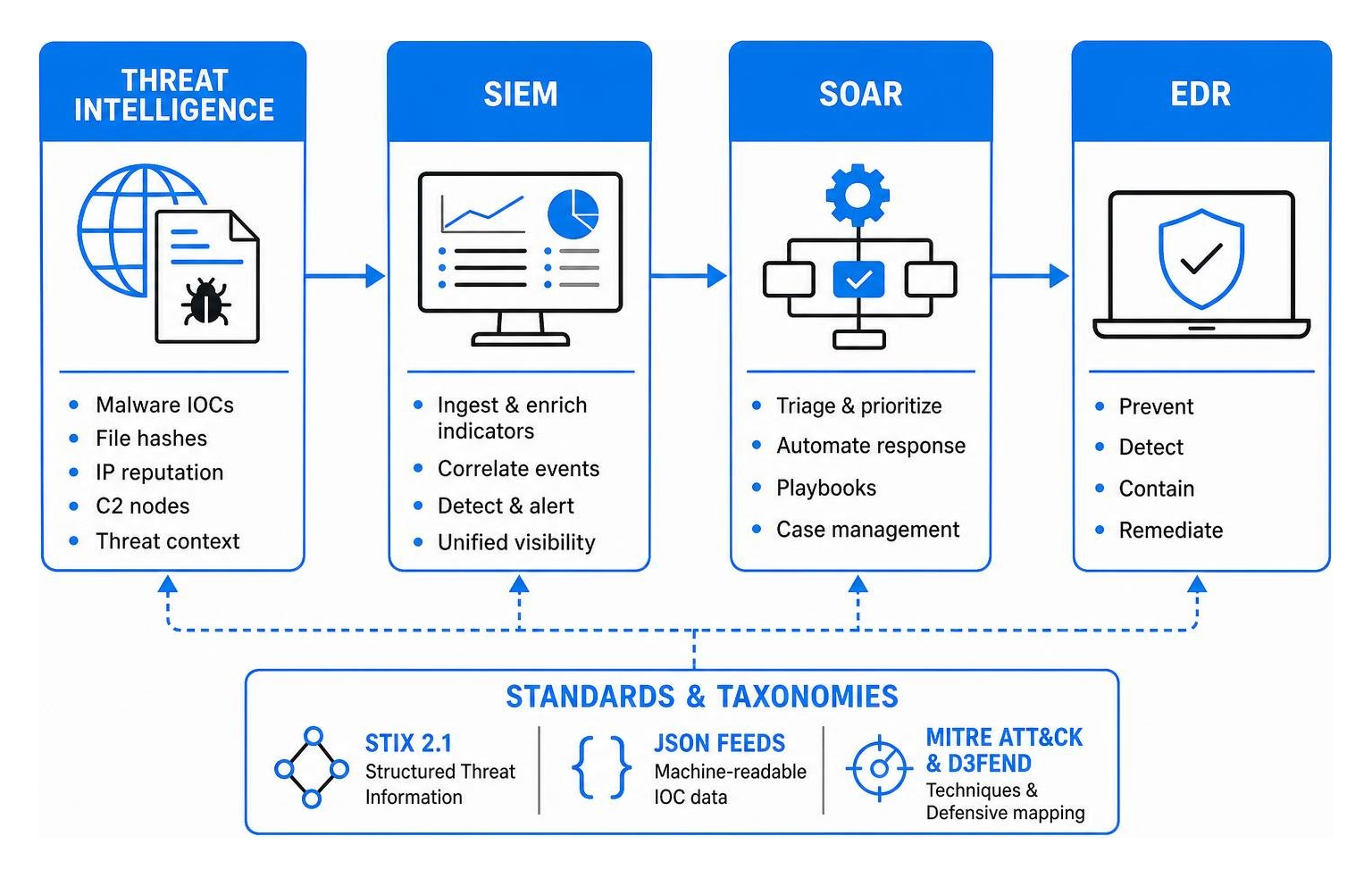
SIEM, SOAR, and EDR Integration Architecture
Modern enterprise architectures automate the ingestion and distribution of threat intelligence across defensive layers:
- Indicator Ingestion and Enrichment: The intelligence platform ingests verified indicators and queries APIs—such as the Carbon Black Threat Intel API—to enrich internal endpoint alerts with file prevalence scores, historical reputations, and associated network domains.
- SIEM Correlation and Rule Tuning: Normalized threat feeds stream directly into SIEM tools (e.g., Microsoft Sentinel, Splunk, Elastic Security) to match endpoint process execution logs and proxy telemetry against known malicious infrastructure.
- SOAR Orchestration: Playbooks instantly isolate endpoints when an EDR detects an executable whose SHA256 matches an active ransomware campaign. Automated runbooks update firewall egress blocklists and revoke active OAuth tokens.
- Behavioral Blocking at the Endpoint: Modern EDR agents use memory-based behavioral inspection to terminate execution chains when an unknown process exhibits known malware patterns, such as unauthorized volume shadow copy deletion (
vssadmin delete shadows).
To optimize your endpoint defenses, read about malware protection behavioral blocking and explore holistic architectures for malware protection for enterprises.
Community Sharing Best Practices: MISP, ISACs, and TLP Standards
Defending against organized cybercrime requires collaborative intelligence sharing across trusted enterprise networks and industry-specific Information Sharing and Analysis Centers (ISACs).
To govern shared data safely, organizations use the Traffic Light Protocol (TLP 2.0):
- TLP:RED: Highly sensitive information restricted exclusively to individual meeting participants; cannot be shared outside the direct session.
- TLP:AMBER: Limited disclosure; restricted to the recipient organization and trusted clients who need to know to take action.
- TLP:AMBER+STRICT: Restricted strictly to the recipient organization's internal personnel.
- TLP:GREEN: Information can be shared across the recipient's entire sector or partner community.
- TLP:CLEAR: Publicly releasable information without distribution restrictions.
When sharing indicators within MISP communities or CIRCL instances, organizations protect data confidentiality by applying strict role-based access controls, encrypting data payloads with verified PGP keys, and enforcing organizational boundary filters.
Frequently Asked Questions About Malware Intelligence
How does malware threat intelligence reduce the financial impact of data breaches?
Malware threat intelligence directly targets the costliest phase of an attack: the dwell time between initial access and remediation. With the average cost of detection and escalation reaching $1.47 million, providing SOC teams with validated indicators and behavioral profiles allows them to detect intruders early in the kill chain. Rapid containment prevents lateral spread and data exfiltration, drastically lowering total incident costs.
What is the difference between an IOC and a TTP in malware analysis?
An Indicator of Compromise (IOC) is an atomic artifact, such as a file hash (SHA256), IP address, or domain name. IOCs are trivial for adversaries to modify by recompiling code or renting new hosting nodes.
A Tactic, Technique, and Procedure (TTP) describes the broader operational methodology used by a threat actor (for example, injecting code into system binaries or executing PowerShell via disguised shortcuts). As modeled in David Bianco’s Pyramid of Pain, detecting and blocking TTPs causes significantly higher disruption for adversaries than blocking simple atomic indicators.
How can security teams mitigate alert fatigue caused by high-volume threat feeds?
To prevent alert fatigue, security teams should implement automated confidence scoring, maintain strict warning lists to filter benign system utilities, and cross-reference indicators with internal asset criticality before generating high-priority alerts. Ingesting feeds through scoring engines ensures that only indicators matching high-confidence thresholds (e.g., risk score > 80/100) trigger automated blocking, while lower-confidence indicators remain preserved for retrospective threat hunting.
Conclusion
Building an effective defense against today's malware threats requires moving beyond static signature databases to adopt an agile, intelligence-led posture. By establishing an automated intelligence lifecycle, standardizing on frameworks like STIX 2.1 and MITRE ATT&CK, and integrating rich contextual feeds into SIEM, SOAR, and EDR platforms, organizations can anticipate and disrupt complex campaigns before damage occurs.
Unlocked is Everykey's blog. It publishes technical research and operational guidance to help security professionals protect modern enterprise infrastructure. Continuous visibility across evolving attack surfaces remains the cornerstone of modern digital resilience. Explore malware threat intelligence feeds to discover high-fidelity data sources and strengthen your defensive capabilities today.