Stop the Bleeding with Modern Enterprise Malware Protection Strategies
Antivirus is one layer, not a strategy. This guide covers EDR, next-gen firewalls, email gateways, Zero Trust, and MDR — the full enterprise defense stack.

The Enterprise Malware Threat Has Outgrown Your Antivirus
Enterprise malware protection strategies are the layered, organization-wide frameworks that combine endpoint controls, network defenses, behavioral detection, identity hardening, and incident response to prevent, detect, and contain malicious software across complex business environments.
Here's what a modern enterprise malware protection framework looks like at a glance:
| Layer | Key Controls |
|---|---|
| Endpoint | EDR/XDR, NGAV, application allowlisting |
| Network | NGFW, micro-segmentation, deep packet inspection |
| Secure Email Gateway (SEG), sandboxing | |
| Identity | MFA, least privilege, Zero Trust architecture |
| Detection | UEBA, behavioral analysis, ML-driven threat hunting |
| Recovery | Immutable backups, tested IR playbooks, NIST SP 800-61r2 |
The threat environment in May 2026 is not the one your signature-based tools were built for.
According to the CrowdStrike 2025 Global Threat Report, 79% of detections are now malware-free — meaning adversaries are moving through environments using stolen credentials and legitimate system tools rather than dropping traditional executables. The average breakout time, the window between initial access and lateral movement, has fallen to 48 minutes. In one documented case, it was 51 seconds.
Meanwhile, the attack surface keeps expanding. Every new SaaS integration, remote worker, IoT device, and cloud workload is another entry point. Social engineering accounted for the top initial access vector in 36% of incident response cases between May 2024 and May 2025 — and 66% of those attacks specifically targeted privileged accounts.
The consequences of getting this wrong are not abstract. The 2017 NotPetya attack — still one of the most studied malware incidents in history — caused over $10 billion in damages globally, paralyzing shipping giant Maersk and dozens of other enterprises that simply couldn't contain the spread fast enough.
The core problem with legacy antivirus is architectural: it is file-centric and reactive. It waits for a known bad file to appear, matches it against a signature database, and flags it. Against fileless malware running entirely in memory, polymorphic variants that mutate their own code on every replication, or a threat actor living off legitimate admin tools like PowerShell and WMI, that model offers almost no protection.
Modern enterprise malware defense requires a shift from detection by signature to detection by behavior — and from cleaning up individual machines to protecting the environment as a whole.
This guide covers exactly how to build that framework.
Core Components of a Modern Defense Strategy
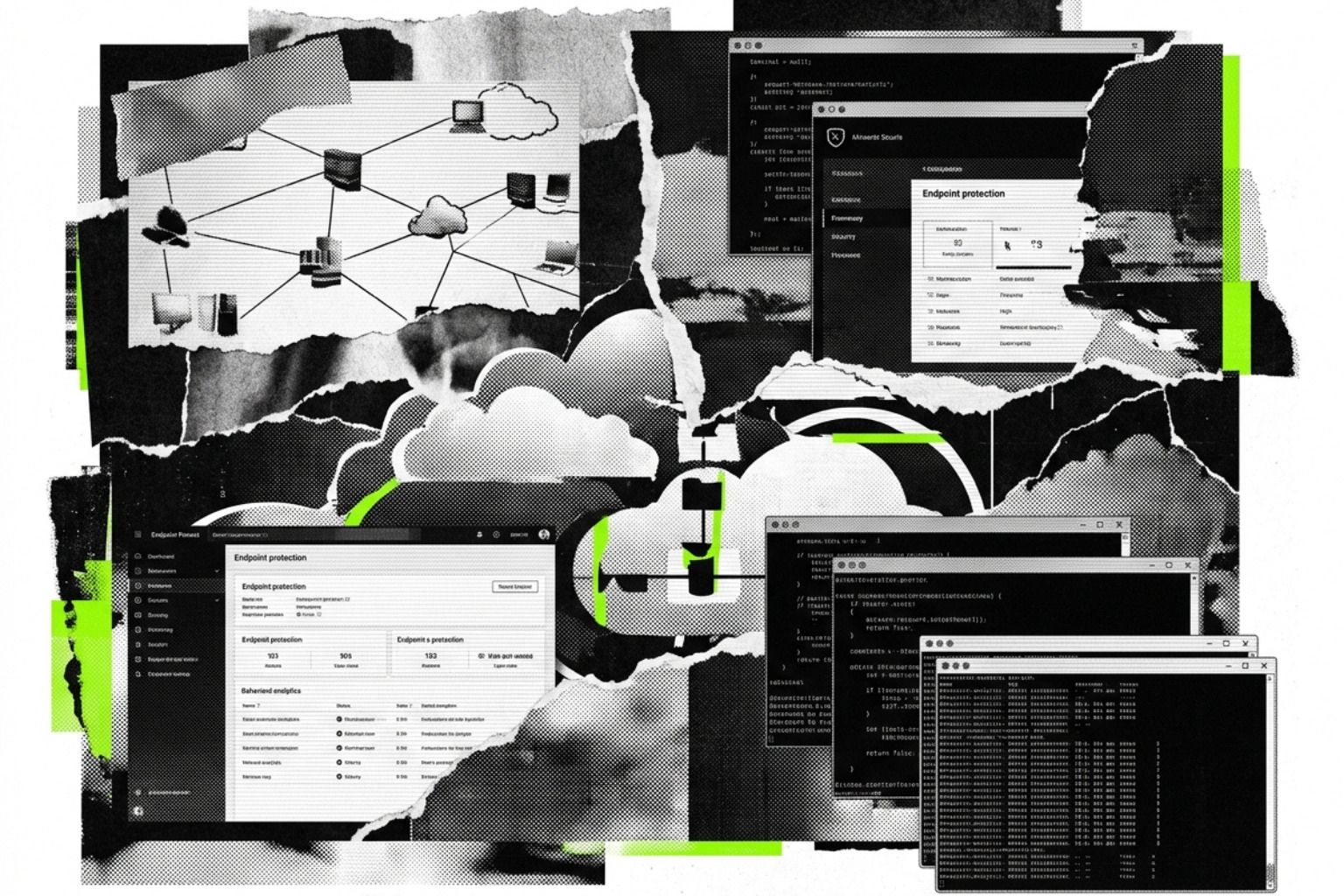
A "set and forget" approach to security is the fastest way to become a headline. To resist modern threats, organizations must deploy a multi-layered defense-in-depth architecture. This ensures that if a threat bypasses the "main gate," there are internal checkpoints to stop it before it reaches the crown jewels.
Endpoint Detection and Response (EDR)
The endpoint is the new perimeter. Modern EDR and XDR platforms provide deep visibility into device activity that traditional antivirus misses. Instead of just looking for malicious files, EDR records process executions, registry changes, and network connections. This allows security teams to trace the origin of an attack, see exactly what an adversary did, and isolate the infected host with a single click to prevent lateral movement.
Next-Generation Firewalls (NGFW) and Deep Packet Inspection
Traditional firewalls filtered traffic based on source and destination. Modern enterprise malware protection strategies rely on NGFWs that perform Deep Packet Inspection (DPI). These tools "look inside" the data packets to identify malicious payloads, even when they are hidden within legitimate-looking traffic. By integrating threat intelligence feeds, these firewalls can automatically block communication with known Command and Control (C2) servers.
Secure Email Gateways (SEG)
Email remains the primary entry point for malware. A robust SEG uses sandboxing—executing attachments in an isolated virtual environment—to see if they exhibit malicious behavior before they ever reach the user's inbox. This is critical for catching zero-day threats that haven't been cataloged by signature databases yet.
Implementing Zero Trust as a Defense Layer
The Zero Trust model operates on a simple premise: Never trust, always verify. In a traditional network, once you were "inside," you were trusted. In a Zero Trust environment, every access request is treated as potentially hostile.
By implementing identity-first security solutions, enterprises can enforce:
- Least Privilege Access: Users only get access to the specific data and applications they need for their job.
- Micro-segmentation: Dividing the network into small, isolated zones. If a workstation in the marketing department is infected, micro-segmentation prevents the malware from reaching the financial databases.
- Continuous Authentication: Verifying the user's identity and device health every time they attempt to access a resource, not just at the initial login.
The Role of Managed Detection and Response (MDR)
For many mid-to-large enterprises, the sheer volume of security alerts is overwhelming. This is where Managed Detection and Response (MDR) becomes a force multiplier. MDR provides 24/7 alert triage and human-led threat hunting. While AI can catch 99% of threats, that final 1% often requires a human analyst to connect the dots and realize that a series of "low-level" alerts actually represents a sophisticated APT (Advanced Persistent Threat) in progress.
Advanced Detection: Behavioral Analysis and AI-Driven Defense
If an adversary uses a brand-new, never-before-seen malware variant, signature-based tools are useless. This is why behavioral analysis and machine learning (ML) are now the gold standard for detection.
Machine Learning and Heuristics
Modern security engines are trained on millions of samples of both malicious and benign code. Instead of looking for a specific "fingerprint," they look for "intent." If a PDF file suddenly tries to execute a PowerShell script that modifies boot records, the system identifies this as malicious behavior and kills the process instantly. This approach is highly effective against polymorphic malware, which changes its signature every time it replicates to evade hash-based scanners.
User and Entity Behavior Analytics (UEBA)
Malware isn't the only threat; sometimes the "malware" is a compromised user account. UEBA establishes a baseline of "normal" behavior for every user and device on the network. If an accountant who usually works 9-to-5 suddenly starts downloading gigabytes of data from a server they’ve never accessed at 3 AM on a Sunday, UEBA flags the anomaly. This is a critical component of enterprise malware protection strategies for detecting insider threats and credential theft.
Neutralizing Fileless and Polymorphic Variants
Fileless malware is particularly insidious because it leaves no footprint on the hard drive. It lives in the system's RAM and uses "Living-off-the-Land" (LotL) tactics, abusing legitimate tools like Windows Management Instrumentation (WMI) or PowerShell.
To combat this, enterprises must:
- Harden Execution Policies: Restrict the ability of scripts to run unless they are digitally signed.
- Memory Scanning: Use security tools capable of inspecting system memory for injected code.
- Endpoint Logging: Ensure that all script executions are logged and sent to a central SIEM (Security Information and Event Management) for analysis.
Measuring the Efficacy of Your Defense Stack
How do you know if your strategy is actually working? You can't just count the number of blocked attacks. You need to track operational metrics that reflect your resilience:
- Mean Time to Detect (MTTD): How long does a threat sit in your environment before you find it?
- Mean Time to Respond (MTTR): Once found, how long does it take to neutralize?
- Breakout Time: Can you stop an attacker before they move laterally (currently averaging 48 minutes)?
- False Positive Rate: Are your tools drowning your team in "noise," leading to alert fatigue?
The 2026 Threat Landscape: AI-Powered Attacks and RaaS
The malware industry has become professionalized. Adversaries now operate like software companies, complete with help desks, R&D departments, and affiliate programs.
| Feature | Traditional Antivirus | Modern Malware Protection |
|---|---|---|
| Primary Method | Signature matching | Behavioral AI & ML |
| Visibility | File-centric (isolated) | Environment-wide telemetry |
| Response | Delete/Quarantine | Automated isolation & rollback |
| Focus | Known threats | Zero-days & "Malware-free" attacks |
| Integration | Standalone agent | Integrated into XDR/Zero Trust |
Ransomware-as-a-Service (RaaS) and Infostealers
RaaS allows even low-skilled criminals to launch devastating attacks by "renting" sophisticated ransomware payloads. Simultaneously, infostealers have become the "entry drug" of cybercrime. These lightweight programs steal browser cookies, VPN credentials, and MFA tokens, which are then sold on dark web markets to provide initial access for more serious actors.
Supply Chain Vulnerabilities
In 2025 and 2026, we have seen a massive surge in malicious packages found in developer ecosystems like NPM and PyPI. By injecting malware into a popular open-source library, attackers can compromise thousands of downstream organizations simultaneously. This makes "shifting left"—scanning code and dependencies during the development process—a vital part of modern malware defense.
Social Engineering and Privileged Account Targeting
Technical defenses are often bypassed by a simple phone call. Vishing (voice phishing) and help desk impersonation have become incredibly sophisticated, often using AI-generated voice cloning to trick employees. When 66% of attacks target privileged accounts, a single successful social engineering attempt can grant an attacker the "keys to the kingdom." This highlights the need for comprehensive security awareness training that goes beyond generic "don't click links" advice.
Incident Response and Recovery: Beyond Detection
Detection is a matter of when, not if. When a breach occurs, the speed and structure of your response determine whether it’s a minor hiccup or a company-ending disaster. Following the NIST SP 800-61r2 framework is the industry standard for modern enterprise security solutions.
The 3-2-1-1 Backup Rule
Backups are your last line of defense, but ransomware actors now actively target and delete backups first. To counter this, adopt the 3-2-1-1 rule:
- 3 copies of your data.
- 2 different media types.
- 1 copy offsite.
- 1 copy that is immutable (cannot be changed or deleted for a set period) or air-gapped.
Containment and Eradication
Once a threat is detected, the priority is containment. This might involve disabling compromised user accounts, shutting down specific network segments, or isolating endpoints. Eradication involves removing the malware, but in 2026, "cleaning" a system is often insufficient. Modern malware embeds itself so deeply that the only safe path is often system reversion—wiping the host and restoring it from a known-good, secure image.
Vulnerability Management and Automated Patching
Most successful attacks exploit vulnerabilities that already have a patch available. Enterprises must move away from "Patch Tuesday" to a risk-based, automated patching model. By integrating security into the DevSecOps pipeline, organizations can ensure that vulnerabilities are closed before they can be exploited.
Frequently Asked Questions
What is the difference between traditional antivirus and modern enterprise malware protection?
Traditional antivirus relies on a library of "signatures" to catch known bad files. Modern enterprise protection uses artificial intelligence to identify malicious behavior, allowing it to stop zero-day threats and "malware-free" attacks that use legitimate system tools.
How does EDR contribute to effective malware protection?
EDR provides a flight data recorder for your endpoints. It gives security teams the telemetry needed to see how an attacker entered, what they touched, and how to stop them. It also allows for automated remediation, such as "rolling back" files that were encrypted by ransomware.
Why is the Zero Trust model essential for preventing malware spread?
Zero Trust assumes that the network is already compromised. By requiring constant verification and using micro-segmentation, it ensures that even if malware gets onto one device, it cannot easily spread laterally to reach sensitive servers or data.
Layer Your Defenses Now
Building an effective enterprise malware protection strategy in 2026 is an ongoing process of maturation, not a one-time purchase. By moving toward a unified, cloud-native security posture that prioritizes behavioral detection and Zero Trust principles, organizations can transform from "prey" into resilient, hard targets.
Stay ahead of the curve by exploring the latest in technical security guides and toolkits on the Unlocked knowledge platform.