
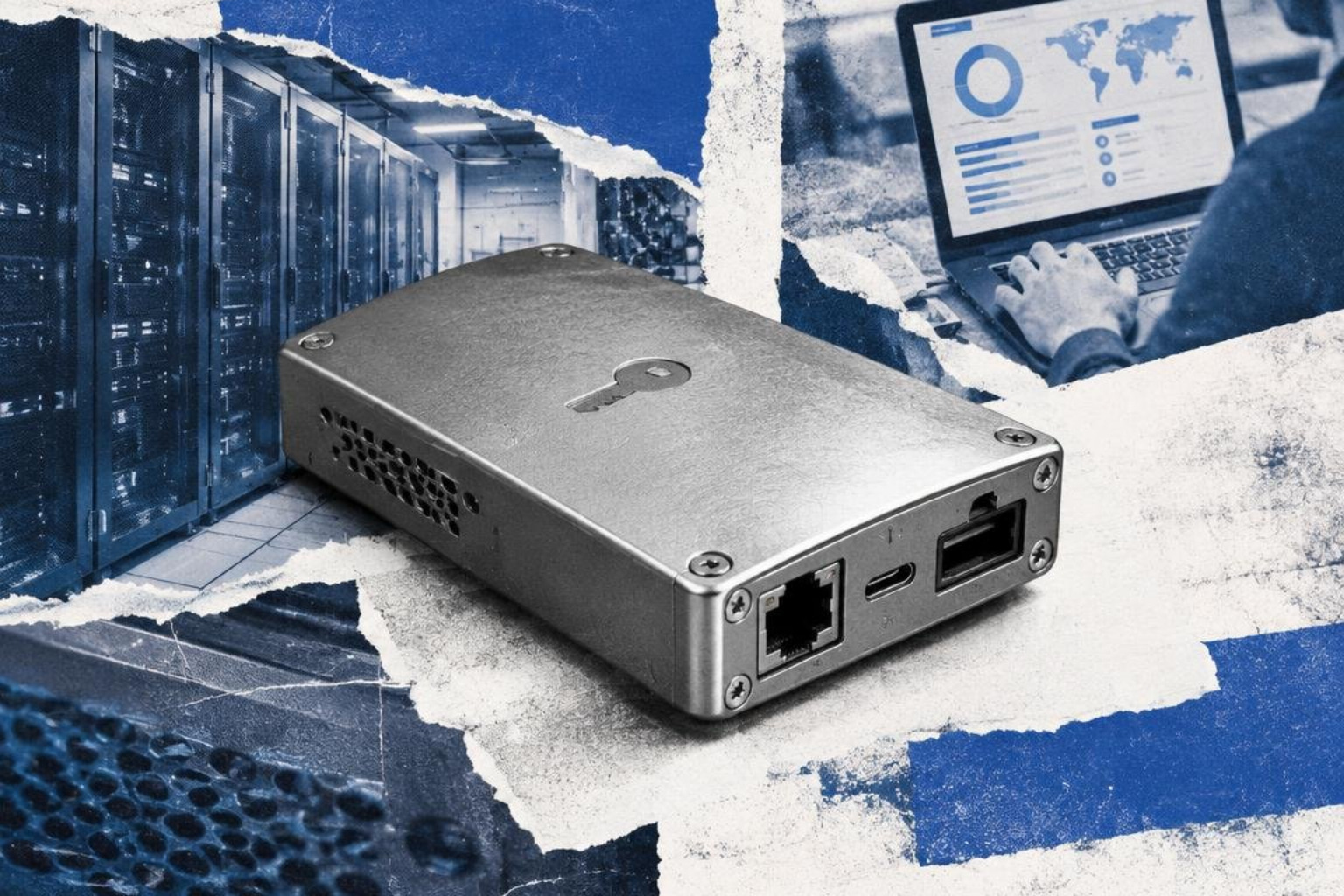
The Enterprise Guide to Managed HSM Services and Network Appliances

Choosing a General Purpose HSM for Enterprise Security
A General purpose HSM is tamper-resistant hardware that generates, protects, and uses cryptographic keys. Choose one for workloads such as certificate issuance, code signing, and data encryption. Start by checking the module's FIPS validation, the interfaces your applications need, and whether a network appliance, PCIe card, or managed cloud service fits your operations.
NIST's published post-quantum standards, including FIPS 203 and FIPS 204, add another buying question: can the HSM support new algorithms as your systems change? This guide covers that decision alongside key isolation, deployment, and cost.
General purpose HSM helpful reading:
- Hardware authentication
- Hardware security key for two factor authentication
- Modern authentication protocols
Architectural Foundations of the General Purpose HSM
A General Purpose Hardware Security Module (GP HSM) delivers a physical and logical root of trust for enterprise computing environments. Unlike standard servers that execute cryptographic calculations inside commodity operating system memory—leaving private keys vulnerable to side-channel attacks, memory dumps, and hypervisor breakouts—an HSM processes all cryptographic operations within an isolated, hardened physical enclosure.
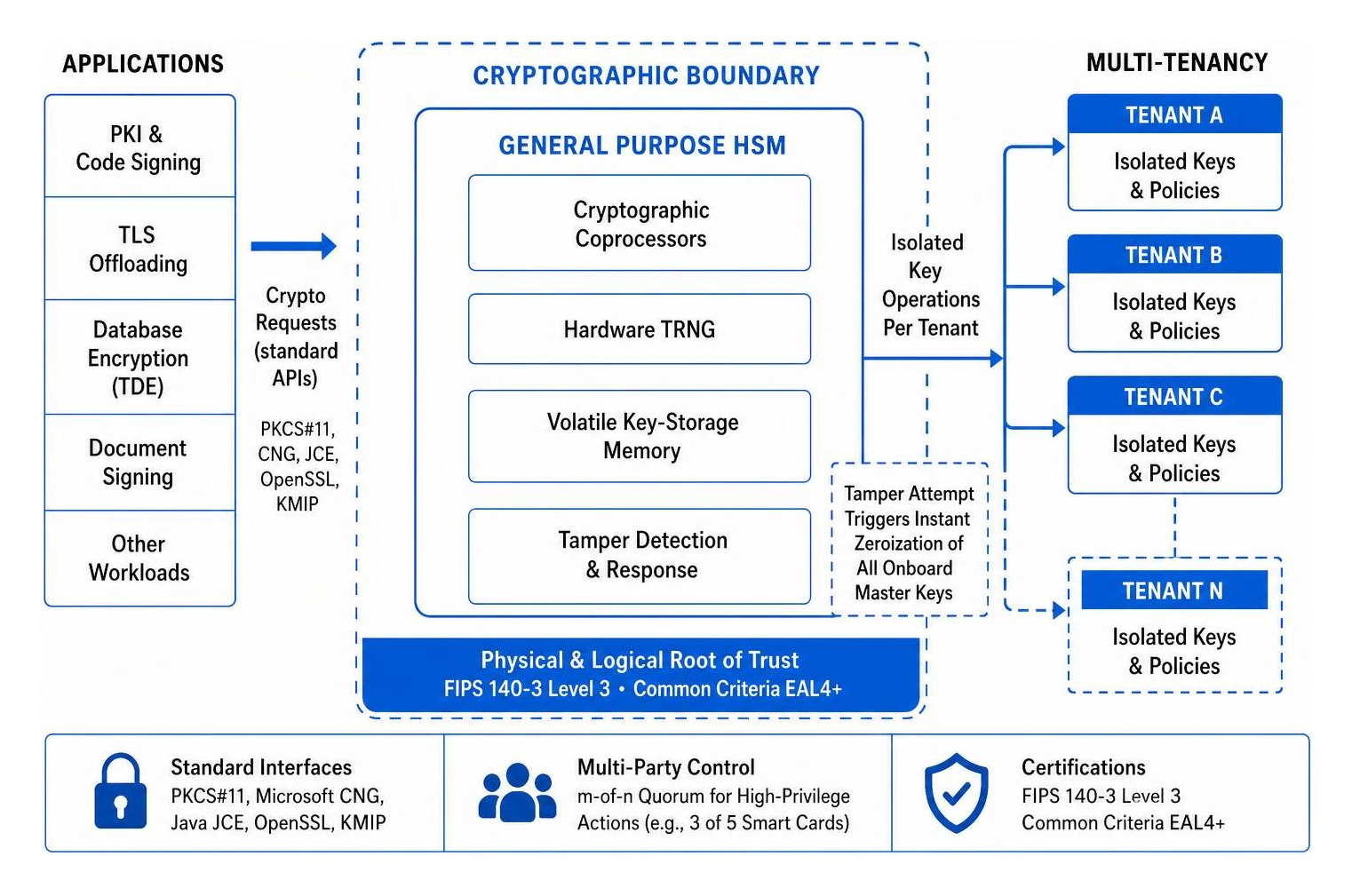
The core of every enterprise HSM consists of dedicated cryptographic coprocessors, a hardware True Random Number Generator (TRNG), volatile key-storage memory, and a physical tamper-reactive barrier. If an attacker attempts physical intrusion—such as drilling through the casing, altering voltage thresholds, or subjecting the silicon to extreme temperatures—the tamper-detection circuitry instantly zeroizes all onboard master keys, wiping unencrypted key material within nanoseconds. Understanding these physical protections aligns directly with fundamental cryptographic authentication methods that underpin Zero Trust architectures.
| Architectural Dimension | General Purpose HSM | Payment / Financial HSM |
|---|---|---|
| Primary Workloads | PKI, Code Signing, TLS Offloading, Database Encryption (TDE), Document Signing | Point-of-Sale (POS) PIN translation, EMV transaction processing, Card issuance, 3DS |
| Standard Interfaces | PKCS#11, Microsoft CNG / CryptoAPI, Java JCE, OpenSSL, REST / KMIP | Proprietary financial host commands, AS2805, ISO 8583 message formatting |
| Key Custody Models | m-of-n administrative quorums, X.509 certificate chains, symmetric DEK/KEK | Strict dual control, Split-knowledge PINs, ANSI X9.24 Key Blocks (TR-31) |
| Target Compliance | FIPS 140-3 Level 3, Common Criteria EAL4+ (EN 419 221-5), eIDAS, GDPR | PCI PTS HSM v3/v4, PCI DSS, PCI 3DS, PCI SPoC/CPoC, EMVCo |
| Algorithmic Focus | RSA, ECC (NIST/Brainpool/Ed25519), AES-GCM, Post-Quantum (ML-KEM, ML-DSA) | Triple-DES, AES-DUKPT, PIN verification keys (PVK), Card verification keys (CVK) |
Modern enterprise security architectures rely on general purpose modules to protect diverse data workflows without forcing administrators into inflexible, payment-specific command sets. You can explore standard capabilities through Utimaco security solutions and vendor-agnostic technical profiles to evaluate how physical cryptographic boundaries serve broader enterprise use cases.
Comparing General Purpose HSM vs Payment HSM Architecture
While both device types provide hardware-enforced protection, they address distinct threat models and operational demands. A General Purpose HSM acts as an open, programmable cryptographic engine. Applications communicate with it using standardized vendor-neutral APIs such as PKCS#11, Microsoft Cryptography Next Generation (CNG), and the Java Cryptography Extension (JCE).
In contrast, a Payment HSM operates on fixed, specialized transaction macros. It is engineered specifically to validate credit card PINs, translate encrypted PIN blocks under ANSI X9.24 guidelines, manage Derived Unique Key Per Transaction (DUKPT) schemes, and personalize EMV chip profiles. Because Payment HSMs must satisfy PCI PTS HSM requirements, their firmware intentionally restricts generic cryptographic functions to prevent payment-specific keys from being manipulated outside defined payment schemes. For an in-depth breakdown of transaction-specific key custody, review this overview of hardware security module architectures.
Security Certifications: FIPS 140-3 Level 3 and Common Criteria
When vetting hardware security devices, certifications confirm that independent, accredited laboratories have tested the device's physical tamper resistance, algorithmic correctness, and lifecycle security:
- NIST FIPS 140-3 Level 3: The benchmark standard across North American government and enterprise deployments. Level 3 requires physical tamper detection and response mechanisms that zeroize plaintext Critical Security Parameters (CSPs) upon physical access attempts. It mandates identity-based authentication and strong logical separation between administrative roles and data-plane operations.
- Common Criteria EAL4+ / EN 419 221-5: The primary European standard for Trust Service Providers (TSPs) under eIDAS regulations. Protection Profile EN 419 221-5 certifies the HSM as a Qualified Signature Creation Device (QSCD), ensuring non-repudiation for legally binding digital signatures and timestamps.
- Operational Dual Control and Quorum Policies: Enterprise HSMs enforce multi-party authorization using m-of-n secret sharing schemes. High-privilege tasks—such as modifying root CA keys, upgrading firmware, or restoring master key backups—require an administrator quorum (for example, 3 out of 5 smart card holders) to authenticate simultaneously.
Core Enterprise Workloads and Cryptographic Integration
Deploying an HSM transforms distributed software cryptography into a centralized, hardware-protected architecture. By keeping cryptographic root keys inside the hardware boundary, applications request cryptographic operations over secure remote channels rather than handling plaintext key material directly.

Enterprise Workloads Driven by a General Purpose HSM
- Public Key Infrastructure (PKI): Hardware protection is essential for enterprise root and intermediate Certificate Authorities (CAs). The private signing keys that anchor your corporate identity are generated directly within the HSM and never leave the crypto boundary in plaintext. This foundation is crucial when managing scalable certificate-based authentication infrastructure across hybrid directories.
- Automated CI/CD Code Signing: DevSecOps pipelines integrate HSMs using PKCS#11 or native tool wrappers to sign binaries, firmware, container images, and software updates automatically, securing the software supply chain against code tampering.
- Database and File Encryption (TDE / KMIP): Enterprise databases such as Microsoft SQL Server and Oracle rely on the HSM via Microsoft SQL Extensible Key Management (SQLEKM) or Oracle Transparent Data Encryption (TDE). The HSM stores the Master Encryption Key (MEK), which in turn encrypts transient Data Encryption Keys (DEKs) used for real-time record and tablespace protection.
- 5G and Telecommunications Security: Telecom operators use high-assurance HSMs to run 5G-AKA authentication vector generation, Home Network Public Key (HNPE) storage, and Subscriber Concealed Identifier (SUCI) de-concealment at network scale.
- Document Signing and Legal Non-Repudiation: Automated signature engines use HSM-stored X.509 signing certificates and hardware timestamping modules to seal commercial contracts, invoices, and audit trails in compliance with eIDAS and Adobe Approved Trust List (AATL) frameworks.
High-Throughput Performance Benchmarks and Cryptographic Acceleration
Cryptographic throughput varies significantly across hardware tiers. Performance requirements depend on whether the workload involves bulk symmetric throughput (such as file and database encryption) or high-volume asymmetric signing (such as Web PKI, mTLS termination, and microservice authentication).
Modern enterprise modules—such as high-end configurations of the Utimaco u.trust GP HSM Se-Series or the Futurex general purpose hardware architecture—can process up to 40,000 RSA-2048 signing transactions per second (TPS). In mid-range enterprise architectures, appliances like the Entrust nShield Connect 6000 handle up to 6,000 signing TPS with RSA 1,024-bit keys and 3,000 TPS with RSA 2,048-bit keys while servicing up to 100 simultaneous application clients.
For bulk symmetric data protection, dedicated crypto engines deliver AES-256 GCM throughput ranging from 37 MiB/s on entry-level models to well over 127 MiB/s on dedicated acceleration engines, offloading mathematical bottlenecks from primary database servers.
Deployment Models: Network Appliances, PCIe, and Managed Cloud HSMaaS
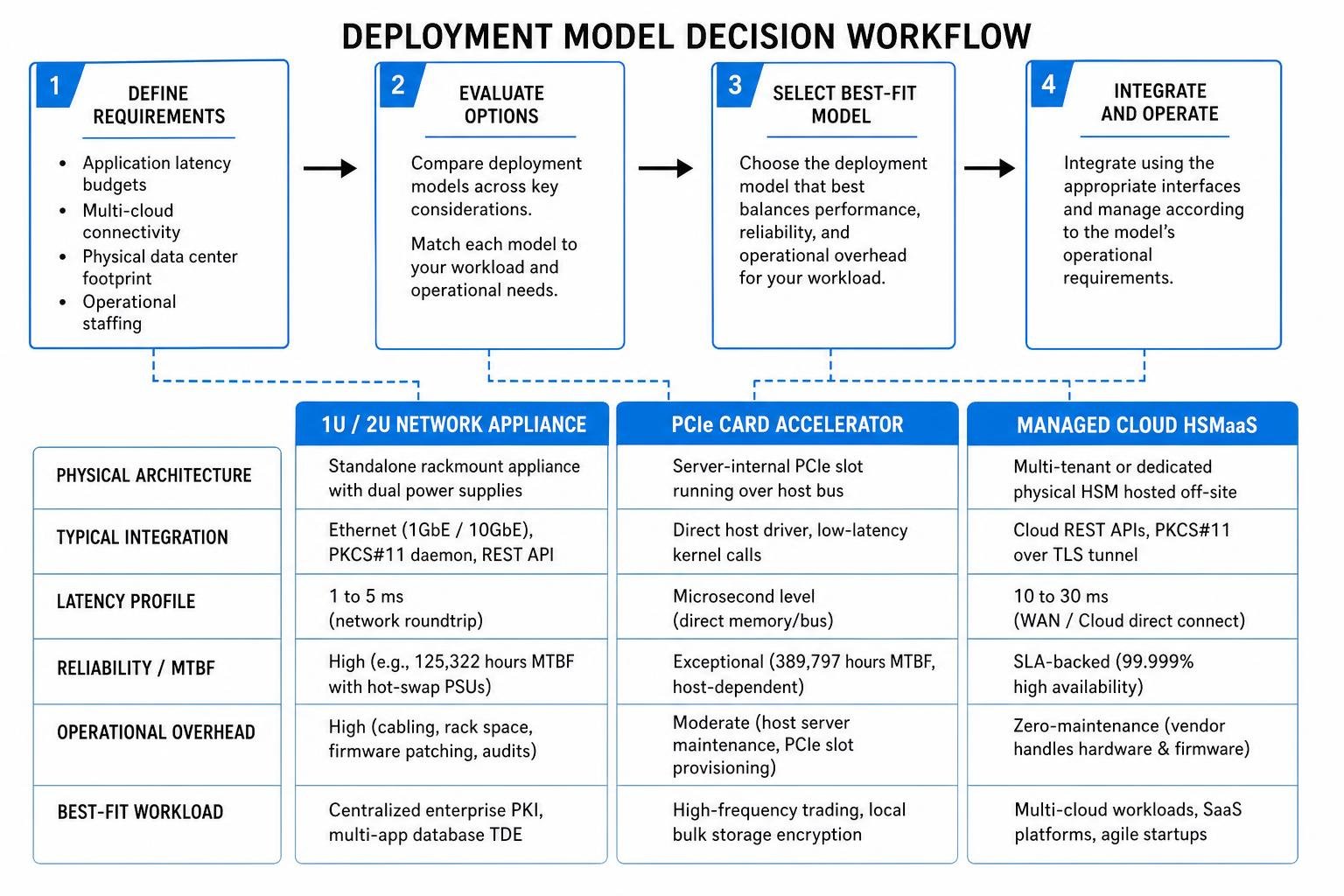
Selecting the right hardware form factor depends on application latency budgets, multi-cloud connectivity, physical data center footprint, and operational staffing.
| Consideration | 1U / 2U Network Appliance | PCIe Card Accelerator | Managed Cloud HSMaaS |
|---|---|---|---|
| Physical Architecture | Standalone rackmount appliance with dual power supplies | Server-internal PCIe slot running over host bus | Multi-tenant or dedicated physical HSM hosted off-site |
| Typical Integration | Ethernet (1GbE / 10GbE), PKCS#11 daemon, REST API | Direct host driver, low-latency kernel calls | Cloud REST APIs, PKCS#11 over TLS tunnel |
| Latency Profile | 1 to 5 ms (network roundtrip) | Microsecond level (direct memory/bus) | 10 to 30 ms (WAN / Cloud direct connect) |
| Reliability / MTBF | High (e.g., 125,322 hours MTBF with hot-swap PSUs) | Exceptional (389,797 hours MTBF, host-dependent) | SLA-backed (99.999% high availability) |
| Operational Overhead | High (cabling, rack space, firmware patching, audits) | Moderate (host server maintenance, PCIe slot provisioning) | Zero-maintenance (vendor handles hardware & firmware) |
| Best-Fit Workload | Centralized enterprise PKI, multi-app database TDE | High-frequency trading, local bulk storage encryption | Multi-cloud workloads, SaaS platforms, agile startups |
Explore specialized hardware configurations and appliances to compare how physical network appliances and embedded PCIe cards integrate into enterprise data centers.
Virtual HSM Multi-Tenancy and Containerized Isolation
Historically, deploying an HSM meant dedicating a physical box to a single enterprise application. Modern appliances eliminate this inefficiency by using firmware-level virtualization and micro-containerization:
- Virtual HSM Instances: High-density platforms can host up to 75 fully isolated virtual HSMs on a single physical chassis. Each virtual HSM maintains its own distinct Security Officer (SO) role, independent master keys, dedicated cryptographic engine allocation, and isolated audit logging.
- Application Partitioning: Each virtual HSM can be further divided into up to 250 isolated application partitions. This allows organizations to establish granular cryptographic separation across different departments, regional entities, or external clients sharing common physical infrastructure.
- Containerized Workload Isolation: Modern appliances, like the u.trust General Purpose HSM Se-Series, support up to 31 distinct containerized partitions. This setup enables security teams to run dedicated custom firmware scripts, double-key encryption containers, or isolated key spaces within dedicated hardware envelopes.
Key Lifecycle Management and Cryptographic Interoperability
An HSM is only as effective as the policy governing its cryptographic lifecycle. Key management capabilities must oversee every stage of key existence:
- Generation: Generated on-device using a hardware TRNG compliant with NIST SP 800-90A/B/C.
- Distribution and Interoperability: Keys are transferred to consuming enterprise applications using standard protocols such as the Key Management Interoperability Protocol (KMIP), or wrapped securely using asymmetric envelope keys (PKCS#8 / RFC 5958).
- Bring Your Own Key (BYOK): Enterprises encrypt cloud keys on-premises inside the HSM, securely projecting them into cloud providers (AWS KMS, Azure Key Vault, Google Cloud KMS) without exposing plaintext key material to the cloud vendor.
- Key Rotation and Archival: Automated rotation policies retire active operational keys after defined cryptoperiods, moving older keys to secure archive states to allow historical decryption while preventing new signatures.
- Offline Root Isolation: For highest-assurance root keys, enterprises combine HSM protection with strict cold storage offline root key isolation to prevent any remote electronic exfiltration.
When operational agility is paramount, organizations increasingly adopt cloud-delivered HSMaaS capabilities, avoiding the upfront capital expense and physical maintenance of on-premises hardware while maintaining single-tenant logical isolation and 99.999% availability SLAs.
Crypto-Agility and Post-Quantum Cryptography Migration
The release of finalized post-quantum standards by NIST—specifically FIPS 203 (ML-KEM) for key encapsulation and FIPS 204 (ML-DSA) for digital signatures—has established a new operational requirement: crypto-agility.

Quantum computers using Shor's algorithm will eventually break standard asymmetric cryptographic schemes, including RSA-2048, RSA-4096, and all standard Elliptic Curve Cryptography (ECDSA, Ed25519). Transitioning enterprise roots of trust to quantum-resistant cryptographic algorithms requires HSM hardware with firmware-upgradable cryptographic libraries and sufficient onboard memory to handle larger public keys and signature envelopes.
Modern general purpose HSMs support hybrid cryptographic workflows, issuing hybrid X.509 certificates that combine classical RSA/ECC signatures with post-quantum algorithms (such as ML-DSA or stateful hash-based signatures like LMS and XMSS under RFC 8554 and RFC 8391). Choosing an HSM with in-field crypto-agile firmware updates ensures you can deploy post-quantum algorithms without needing a disruptive, full hardware replacement cycle.
Frequently Asked Questions about Hardware Security Modules
How does a General Purpose HSM differ from a Payment HSM?
A General Purpose HSM provides flexible cryptographic operations for enterprise workloads (PKI, code signing, database encryption, TLS offloading) through open APIs like PKCS#11, Microsoft CNG, and Java JCE. A Payment HSM is specialized and restricted to payment ecosystem functions—such as PIN translation, EMV authorization, and card personalization—operating under strict PCI PTS standards and specialized banking host commands.
What is the maximum throughput achievable on modern General Purpose HSM hardware?
High-end general purpose HSM appliances process up to 40,000 RSA-2048 digital signatures per second, while mid-tier network appliances handle between 3,000 and 6,000 RSA-2048 operations per second. Symmetric performance for bulk data encryption (such as AES-256 GCM) regularly exceeds 120 MiB/s per hardware accelerator card.
How does multi-tenancy operate without compromising cryptographic boundaries?
Multi-tenancy uses firmware-enforced virtualization and isolated storage containers. Each virtual HSM maintains its own independent master key hierarchy, administrative roles, cryptographic coprocessor allocations, and non-exportable audit logs. Even if a tenant's partition administrator credentials are fully compromised, lateral movement across the physical hardware boundary into an adjacent tenant partition remains cryptographically impossible.
Conclusion
Securing an enterprise cryptographic footprint requires moving beyond ad-hoc, software-based key management toward a centralized, hardware-enforced root of trust. As regulatory requirements tighten and the industry navigates post-quantum algorithm migrations, adopting high-assurance hardware platforms becomes essential for maintaining data integrity and regulatory compliance.
To protect administrative access into high-assurance cryptographic appliances and enterprise management consoles, organizations must implement robust hardware authentication strategies for 2026 and beyond. Integrating strong hardware-backed authenticators with independent educational platforms like Unlocked ensures that administrative privileges, quorum activations, and data access points stay protected against phishing, credential theft, and unauthorized access.
For security engineering teams looking to modernize their physical and digital authentication infrastructure, EveryKey is a small wireless key. Your computer unlocks when you walk up and locks the moment you walk away, and it works alongside your HSM-backed key management and existing security stack.