
IEEE 802.1X Explained: Guarding the Gates of Your Local Network
Any open switch port is an invitation to attackers. IEEE 802.1X locks those ports down with port-based network access control, authenticating every device before it touches your network.

What IEEE 802.1X Actually Does — and Why Your Network Needs It
IEEE 802.1X is a network access control standard that blocks any device from using your network until it proves its identity — working at the port level, before an IP address is ever assigned.
Quick answer for anyone searching for IEEE 802.1X:
| Question | Answer |
|---|---|
| What is it? | An IEEE standard for port-based network access control (PNAC) |
| What does it do? | Blocks unauthorized devices from accessing a LAN or Wi-Fi network at the port level |
| How does it work? | A three-party model: supplicant (device), authenticator (switch/AP), and authentication server (RADIUS) |
| Where is it used? | Wired enterprise LANs, corporate Wi-Fi, eduroam, industrial networks |
| What protocol carries it? | EAP (Extensible Authentication Protocol) over LAN, known as EAPOL |
Here's the core problem: most networks trust the wire. If a device is physically plugged in — or within range of a Wi-Fi access point — it gets access. That assumption was already risky a decade ago. In 2026, with hybrid work, contractor laptops, IoT proliferation, and increasingly sophisticated insider threats, it's a liability.
IEEE 802.1X solves this by treating every port as a locked gate. Nothing gets through until authentication succeeds. The standard defines exactly how that negotiation happens — who initiates it, how credentials or certificates are exchanged, and what happens when a session ends.
This guide covers the full picture: the architecture, how authentication flows from initiation to termination, how 802.1X integrates with MACsec encryption and device identity certificates, where modern deployments are heading, and — critically — where the standard's own weaknesses can be exploited if it's misconfigured or deployed without supporting controls.
Quick ieee 802.1 x definitions:
What is the IEEE 802.1X Standard and Why Does It Matter?
At its core, IEEE 802.1X is a protocol designed to implement port-based network access control (PNAC). It acts as a gatekeeper for local area networks (LANs) and wireless networks, ensuring that no rogue devices can slip through the cracks of your physical infrastructure. Without this gatekeeper, physical switch ports in conference rooms, waiting areas, or empty desks are open invitations to attackers.
Implementing robust access control is no longer just a best practice; it is a foundational pillar of modern enterprise defense. In the past, security teams relied heavily on perimeter firewalls to keep threats out. However, if an adversary manages to walk into a building and connect directly to a wall jack, they bypass those perimeter defenses entirely. The IEEE 802.1X standard neutralizes this vector by requiring identity verification at the very edge of the network.
The Core Problem Solved by IEEE 802.1X
The fundamental issue with traditional Ethernet networks is their inherent trust of physical connections. If a port is active, it will forward frames. This design choice dates back to the early days of networking when physical security was assumed to be absolute.
In modern environments, we face hardware addition attacks, where attackers plant small, low-cost "drop boxes" (such as a configured Raspberry Pi or a pocket-sized router) behind IP phones or printer desks. These rogue devices establish remote tunnels back to the attacker’s command-and-control server, granting them persistent, internal network access.
Insider threats also exploit this physical trust. Disgruntled employees, contractors with excessive permissions, or visiting guests can plug unauthorized laptops directly into corporate switch ports. By enforcing IEEE 802.1X, the network switch immediately isolates any newly connected port, preventing the device from sending or receiving general network traffic until the device's identity is verified via the Official IEEE 802.1X Page.
The Evolution of Port-Based Network Access Control
To understand how IEEE 802.1X works, we must look at how it evolved. Originally, standard network bridges (defined under IEEE 802.1D) forwarded frames indiscriminately based on MAC address tables. There was no mechanism built into the Logical Link Control (LLC) sublayer of the OSI model to challenge a device's identity.
This changed with the release of the Early 802.1X-2001 Standard. This initial specification introduced the concept of logical ports on top of physical ports. It allowed a single physical port to be split into a "controlled" state and an "uncontrolled" state, providing a standardized mechanism to pass authentication traffic while blocking all other user data. Over the years, the standard has been updated to handle complex enterprise needs, including wireless roaming, cryptographic binding, and software-defined segmentation.
The Architecture of Port-Based Network Access Control (PNAC)
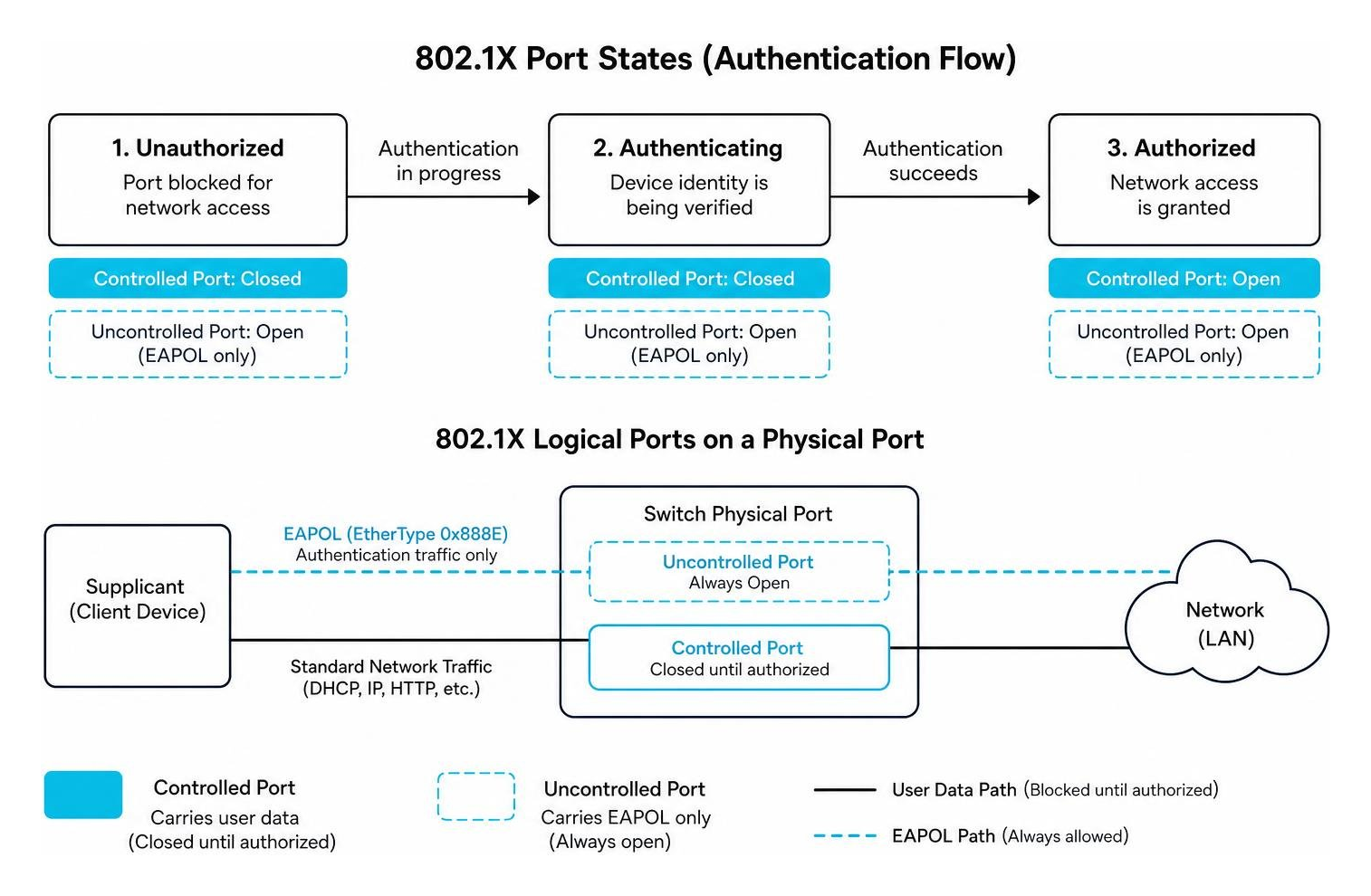
The magic of IEEE 802.1X relies on separating a single physical network port into two distinct logical pathways:
- The Uncontrolled Port: This pathway is always open, but it only allows one type of traffic to pass through: Extensible Authentication Protocol over LAN (EAPOL) frames. These frames use the specific EtherType 0x888E. No IP addresses, DNS queries, or web traffic can use this path.
- The Controlled Port: This pathway carries standard network traffic (DHCP, IP, HTTP, etc.). It remains strictly closed and inactive until the authentication process is completed successfully. Once the server verifies the device's identity, the switch virtualizes the port state to "authorized," opening the gate.
The Three-Party Authentication Model in IEEE 802.1X
The IEEE 802.1X architecture is built around three distinct components. Understanding who is who is critical to troubleshooting and designing secure networks:
- The Supplicant: This is the client device (such as a laptop, smartphone, IP phone, or IoT device) that wishes to join the network. The supplicant runs software designed to respond to identity challenges and send credentials or certificates.
- The Authenticator: This is the edge network device, typically a physical network switch or a wireless access point (AP). The authenticator does not actually decide if the supplicant's credentials are valid. Instead, it acts as an intermediary, translating EAPOL frames from the client into RADIUS packets destined for the authentication server.
- The Authentication Server: This is the brains of the operation, usually a Remote Authentication Dial-In User Service (RADIUS) server. Common examples include Cisco Identity Services Engine (ISE), Aruba ClearPass, or open-source solutions like FreeRADIUS. The server verifies the credentials against an identity store (like Active Directory or an LDAP directory) and instructs the authenticator to open or close the port.
For a deeper dive into how these protocols carry credentials securely across the wire, check out our Guide to Authentication Protocols.
The Authentication Lifecycle: From Initiation to Termination
An IEEE 802.1X session follows a highly structured lifecycle. Here is how a connection is established, maintained, and closed:
- Initiation: When a link state changes to active (e.g., a network cable is plugged in), the authenticator detects the physical connection and sends an
EAP-Request/Identityframe. Alternatively, the supplicant can initiate the process by broadcasting anEAPOL-Startframe. - Authentication: The supplicant responds with an
EAP-Response/Identityframe containing its username, machine name, or certificate. The authenticator wraps this response inside a RADIUS packet and forwards it to the authentication server. The server and supplicant then negotiate an EAP method (such as EAP-TLS or PEAP) and exchange credentials securely. - Authorization: If the credentials are valid, the authentication server sends a RADIUS
Access-Acceptmessage to the authenticator. This message can also contain attributes like VLAN assignments or Access Control Lists (ACLs). The authenticator then transitions the logical controlled port to the "authorized" state, allowing normal network traffic to flow. - Accounting: Once authorized, the authenticator can send RADIUS accounting packets to the server to track session duration, bandwidth usage, and connection events.
- Termination: When the device disconnects, it sends an
EAPOL-Logoffframe. The authenticator immediately moves the controlled port back to the "unauthorized" state, blocking any remaining traffic. If a device is unplugged abruptly, the switch detects the loss of physical link and tears down the session automatically.
Technical Evolution: Comparing IEEE 802.1X-2010 and IEEE 802.1X-2020
As network speeds accelerated and security threats mutated, the standard had to adapt. The original 2001 and 2004 versions of the standard lacked built-in mechanisms to protect data after authentication occurred. This led to a series of substantial revisions, culminating in the 802.1X-2010 and 802.1X-2020 standards.
The 2010 revision introduced support for MACsec (IEEE 802.1AE) and the MACsec Key Agreement (MKA) protocol. This ensured that once a device authenticated, all subsequent frames sent over the wire were encrypted and cryptographically signed.
The 2020 revision, which you can review in detail via the IEEE Std 802.1X-2020 PDF, consolidated previous amendments like 802.1Xbx-2014 (which added support for intelligent query interfaces) and 802.1Xck-2018 (which added YANG data models for network management).
| Feature / Capability | IEEE 802.1X-2010 | IEEE 802.1X-2020 |
|---|---|---|
| Primary Focus | Introduction of MACsec integration and MKA | Modernization, YANG models, and protocol maintenance |
| Data Encryption Support | MACsec (802.1AE) dynamic key exchange | Enhanced MACsec alignment, including extended packet numbering |
| Device Identity Integration | Basic hardware identity support | Native integration with 802.1AR (Secure Device Identity) |
| Management Interface | Traditional SNMP MIBs | YANG Data Modeling for programmatic Netconf/Restconf control |
| Cipher Suite Support | AES-128 and basic GCM | AES-256, GCM, and modern Elliptic Curve Cryptography (ECC) |
Cryptographic Integration: MACsec (802.1AE) and Secure Device Identity (802.1AR)
While IEEE 802.1X does an excellent job of verifying who is at the door, it historically did nothing to stop an attacker from splicing into the cable after the door was opened. This is where MACsec (IEEE 802.1AE) comes in.
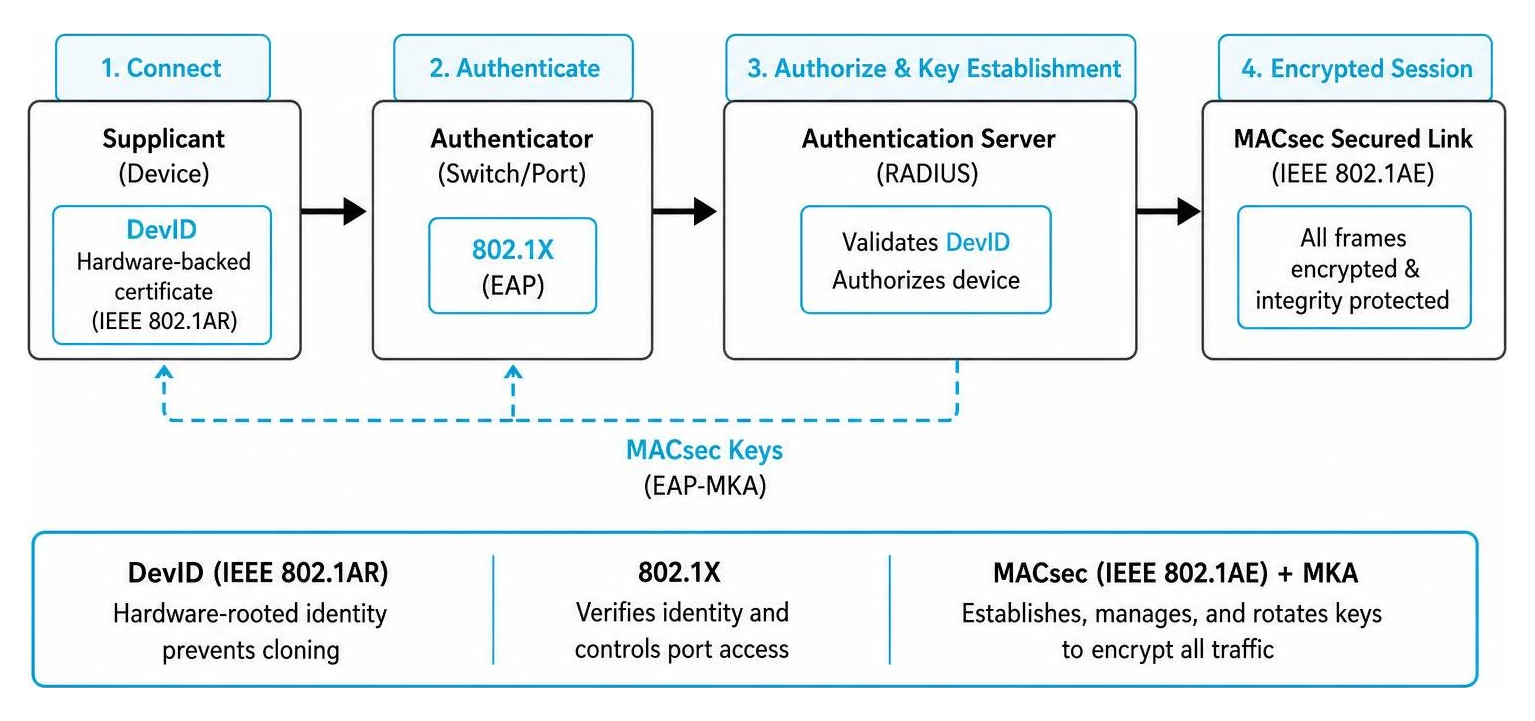
MACsec provides line-rate, hardware-based encryption at Layer 2. By combining 802.1X with MACsec, the authentication server can distribute cryptographic keys to the supplicant and authenticator during the initial 802.1X handshake. The devices then use the MACsec Key Agreement (MKA) protocol to rotate keys and encrypt all subsequent frames.
Furthermore, modern secure deployments leverage IEEE 802.1AR (Secure Device Identity or DevID). A DevID is a cryptographic certificate permanently burned into a device's hardware (usually in a Trusted Platform Module or TPM) during manufacturing.
When a device plugs into an 802.1X-enabled network, it presents this hardware-backed DevID. This eliminates the risk of software credential theft, making it virtually impossible for an attacker to clone a corporate device's identity.
To learn more about how public key infrastructure (PKI) and cryptographic techniques protect these identities, see our guide on Understanding Cryptographic Authentication.
Modern Deployment Scenarios, YANG Models, and Active Projects
Implementing IEEE 802.1X in 2026 is no longer limited to standard username/password combinations. Modern deployments rely heavily on certificate-based authentication (EAP-TLS), which provides the strongest defense against credential harvesting. You can read more about this in our deep dive into Certificate-Based Authentication Explained.
Beyond enterprise Wi-Fi and wired networks, 802.1X is the backbone of eduroam (education roaming), a secure, world-wide roaming access service developed for the international research and education community. Eduroam allows students and researchers to obtain internet connectivity across thousands of participating institutions using their home credentials, routed securely via a global hierarchy of RADIUS servers.
On the management side, modern software-defined networks (SDN) rely on YANG data models (introduced in the 802.1Xck amendment and consolidated in the 802.1X-2020 standard). YANG allows network administrators to programmatically configure, monitor, and troubleshoot 802.1X states across thousands of switches simultaneously using APIs, rather than relying on legacy command-line interfaces (CLI) or SNMP.
Active IEEE projects continue to refine these standards, including:
- P802.1AEef: An active project extending MACsec to support advanced key agreement protocols in highly distributed environments.
- P802.1AReg: Ongoing revisions to the Secure Device Identity standard to accommodate newer, quantum-resistant cryptographic algorithms.
Implementation Challenges and Security Vulnerabilities of IEEE 802.1X
While IEEE 802.1X is highly secure in theory, its real-world implementation is often plagued by configuration shortcuts that introduce significant vulnerabilities.
The most notable vulnerability involves shared media and hub-based bypasses. If an attacker inserts a passive network hub or a managed switch configured with port mirroring between an authorized IP phone (the supplicant) and the wall jack (the authenticator), they can perform a man-in-the-middle (MitM) attack.
Once the legitimate IP phone completes its 802.1X authentication, the switch opens the port. The attacker can then clone the IP phone’s MAC and IP addresses and inject malicious traffic directly into the network. Because the switch only authenticated the port at the start of the session, it happily forwards the attacker's frames.

Another common issue is EAPOL-Logoff spoofing. If an attacker broadcasts a spoofed EAPOL-Logoff frame containing the target device's MAC address, they can trick the authenticator into immediately closing the logical port, causing a denial of service (DoS) for the legitimate user.
To mitigate these risks, organizations must move away from simple port-based authentication and embrace a Zero Trust Authentication Guide framework, combining 802.1X with continuous device monitoring, MACsec encryption, and endpoint compliance scanning.
Frequently Asked Questions about IEEE 802.1X
What is the difference between 802.1X and MACsec?
IEEE 802.1X is strictly an authentication and access control protocol. It verifies the identity of a device and determines whether to open or close a network port. Once authentication is complete, 802.1X's job is done.
MACsec (IEEE 802.1AE), on the other hand, is an encryption standard. It works alongside 802.1X, using the keys exchanged during the 802.1X handshake to encrypt and sign every single packet sent across the wire, ensuring data confidentiality and integrity.
Can 802.1X be bypassed, and what is MAC Authentication Bypass (MAB)?
Yes, 802.1X can be bypassed using a fallback mechanism known as MAC Authentication Bypass (MAB). Many legacy devices, such as network printers, building thermostats, and older IP cameras, do not support 802.1X supplicants.
To keep these devices connected, network administrators configure the switch to fall back to MAB if 802.1X fails or times out. The switch then checks the device's MAC address against a whitelist on the RADIUS server.
Because MAC addresses are incredibly easy to spoof, MAB is a significant security risk and should only be used in combination with strict network segmentation and traffic profiling.
How does 802.1X fit into a modern Zero Trust architecture?
In a Zero Trust framework, we assume the network is hostile and never trust a connection based on its physical location. IEEE 802.1X serves as the initial "gatekeeper" in this architecture, enforcing the principle of least privilege at the physical layer.
However, 802.1X alone is not enough for Zero Trust. It must be paired with continuous verification, device health checks, and micro-segmentation to ensure that a device remains safe after it has been granted access. For a broader look at this concept, see our guide on Modern Authentication and Zero Trust.
Conclusion
Securing the physical layer is one of the most frequently overlooked aspects of enterprise security, yet it remains one of the most critical. By enforcing IEEE 802.1X, you effectively turn your local network into a secure, zero-trust-ready environment where rogue hardware and unauthorized devices are neutralized before they can even request an IP address.
To build a truly resilient security posture, organizations must integrate physical port security with comprehensive identity and access management (IAM) strategies. Solutions like EveryKey can help bridge these gaps by providing seamless, secure authentication workflows across endpoints, ensuring that only verified users and devices can access critical operational resources.
Ready to take your network security to the next level? Explore our Essential Guide to Auth Protocols to discover how to align your local access controls with modern global identity standards.