
A $10,000 Fine for 15 Million Exposed Records: The MMG Fusion Case Every Healthcare Vendor Should Read
HHS's Office for Civil Rights settled with software vendor MMG Fusion after a breach exposed the health data of roughly 15 million people — and the tiny fine hides the real lesson for every practice that trusts a third party with patient information.

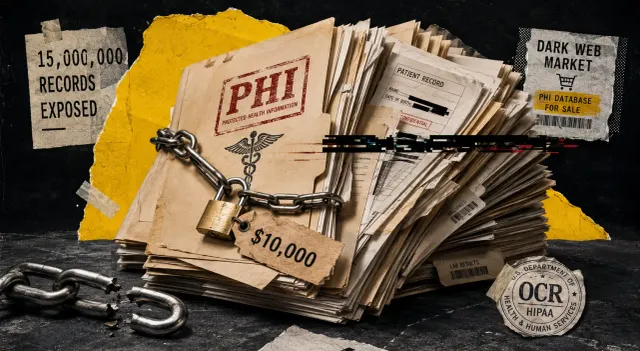
The Department of Health and Human Services' Office for Civil Rights (OCR) has settled a HIPAA investigation with MMG Fusion, LLC, a Maryland software company whose breach exposed the protected health information (PHI) of approximately 15 million individuals. The financial penalty was $10,000. The gap between those two numbers is the whole story — and it points straight at the weakest link in healthcare's data-protection chain: the third-party vendors, or "business associates," that quietly handle patient data on providers' behalf.
What happened
According to OCR, an unauthorized actor infiltrated MMG's systems in December 2020 and accessed PHI including patients' names, phone numbers, mailing and email addresses, dates of birth, and the dates and times of their medical appointments. That data later appeared for sale on the dark web. Critically, OCR did not hear about the incident from MMG. It opened its investigation in March 2023 only after receiving a complaint about an unreported security incident.
OCR ultimately found that MMG had potentially violated the HIPAA Privacy, Security, and Breach Notification Rules in three ways: impermissibly disclosing the PHI of roughly 15 million people, failing to conduct an accurate and thorough risk analysis of the electronic PHI it held, and failing to notify the covered entities affected by the breach so those providers could in turn notify their patients.
Why the fine was so small — and why that's not the point
A $10,000 settlement for a breach of this size looks almost absurd. But OCR calibrates penalties to an organization's size and ability to pay, and a small software vendor is not a national insurer. The more consequential part of the deal is the corrective action plan that OCR will monitor for three years, requiring MMG to finally conduct a proper risk analysis, build a risk-management plan, overhaul its policies, train staff, and provide the breach notifications it never sent. The money is symbolic; the multi-year federal oversight is the real cost of staying silent.
The business-associate blind spot
The mechanics here — an intruder reaching PHI and exfiltrating it undetected — are the mechanics behind most healthcare breaches, and they're fundamentally an identity and access problem. The organizations that get burned are usually the ones that never had a clear picture of who and what could reach sensitive data. That is exactly why HIPAA's under-appreciated risk-analysis requirement matters: you cannot protect data whose exposure you can't even map. The disciplines involved — mapping accounts to data, enforcing least privilege, and reviewing access continuously — are the foundation of any defensible program, and they're covered in Everykey's identity and access management guide and its primer on what identity governance actually involves.
Healthcare's third-party exposure is neither rare nor hypothetical. The same period produced other massive downstream incidents, including the DentaQuest breach affecting more than 23 million people covered by The CyberSignal. In each case, patients are harmed by a vendor most of them have never heard of.
What providers and vendors should take away
For covered entities, the lesson is that a signed business associate agreement is a contract, not proof of security. Ask your vendors for evidence of a current risk assessment, confirm that breach-notification timelines are spelled out in writing, and treat a vendor that cannot explain who can access PHI as the red flag it is. Notification duties increasingly overlap with state privacy law, too — a good starting point for mapping those obligations is Everykey's privacy compliance checklist.
For business associates, MMG is a warning that the Breach Notification Rule has teeth even when the fine is small. Silence doesn't make a breach disappear — it converts a security incident into a compliance failure regulators will supervise for years. HIPAA doesn't just ask organizations to protect data; it asks them to know their own risk and to speak up when that data is exposed. MMG Fusion did neither, and 15 million people paid for a $10,000 lesson.
We go deeper on this settlement — including the "Golden SAML"-style identity attacks now targeting healthcare and a full defensive checklist for vendors — in a companion analysis, "The $10,000 Fine Behind a 15-Million-Record Breach," publishing on HackerNoon.
Sources and further reading: HHS OCR resolution announcement; HIPAA Journal coverage; DataBreaches.net report.