

The Ultimate Guide to AI Compliance Monitoring and Risk Management
Generative and agentic AI have outpaced traditional GRC tools. AI compliance monitoring shifts governance from annual audits to continuous, API-native oversight that helps enterprises avoid penalties and protect data.

AI Compliance Monitoring Is No Longer Optional — Here's What You Need to Know
AI compliance monitoring is the practice of continuously tracking, testing, and documenting AI systems to ensure they stay aligned with applicable laws, internal policies, and regulatory frameworks — across their entire operational lifecycle, not just at deployment.
Quick answer for busy practitioners:
| What it covers | Why it matters right now |
|---|---|
| Real-time behavioral monitoring of AI models and agents | EU AI Act full enforcement hits August 2026 |
| Automated regulatory change tracking | SEC has issued over $1.3B in penalties in the past year |
| Audit trail generation for AI decisions | 1,558 US enforcement actions in the past 30 days alone |
| Multi-jurisdiction risk classification | US Code of Federal Regulations spans nearly 200,000 pages |
| Human-in-the-loop oversight for high-risk outputs | 63% of orgs lack adequate AI data management practices (Gartner) |
Here's the uncomfortable truth: most organizations are still treating AI governance like they treated cybersecurity in 2005 — as a checklist you run through once a year and file away.
That approach is already failing.
AI systems aren't static. They drift. They update silently. A model that was compliant in March can generate new legal exposure by June — without anyone changing a single line of configuration. Autonomous agents make decisions in milliseconds that traditional GRC frameworks were never designed to govern.
Meanwhile, regulators aren't waiting. The EU AI Act imposes penalties of up to €35 million or 7% of global annual revenue for serious violations. The FTC's "Operation AI Comply" enforcement actions signal that US regulators are moving fast too. And the SEC has already made clear it has little patience for "AI washing" — overstating AI capabilities in disclosures.
The organizations that will navigate this well aren't the ones with the thickest compliance binders. They're the ones embedding governance directly into how they build, deploy, and monitor AI — treating compliance not as a review gate, but as operational infrastructure.
This guide breaks down exactly how to do that.
What is AI Compliance Monitoring and How Does It Differ From Traditional GRC?
To understand why traditional Governance, Risk, and Compliance (GRC) tools fail when applied to artificial intelligence, we have to look at how compliance was historically managed.
For decades, cybersecurity compliance relied on predictable, deterministic systems. If you configured a firewall rule, that rule remained identical until a human administrator changed it. Compliance teams could track obligations using static spreadsheets, conduct point-in-time checklists, and rest easy knowing that their systems wouldn't spontaneously rewrite their own operational logic.
AI changes this completely. AI systems are probabilistic, meaning they do not produce the exact same output for every input. Instead, they reason through probabilities. This introduces the phenomenon of probabilistic systems drift, where a model's behavior shifts over time due to changes in user prompts, retrieval index updates, silent upstream model adjustments, or evolving data distributions.
Furthermore, the rise of autonomous agents and Non-Human Identities (NHIs) means that AI systems are no longer just passive tools; they are active, independent decision-makers. They draft financial journal entries, process medical logs, and query customer databases. Because they bypass traditional human-centric segregation of duties, they can collapse access boundaries in milliseconds. A point-in-time checklist simply cannot capture this dynamic behavior.
The Shift to Continuous AI Compliance Monitoring
Managing AI risk requires moving away from static, annual audits toward continuous, API-native governance. Instead of reviewing a system after it has been built, organizations must implement real-time guardrails and telemetry.
One of the most effective ways to achieve this is through Reasoning Context Vectors (RCVs). An RCV is a cryptographic, structured record of the exact factors that drove an AI agent's decision—including the model parameters, the data inputs, the specific system constraints applied during deliberation, and the counterfactuals considered.
By capturing this telemetry, compliance teams can perform intent tracing rather than simple log aggregation. When combined with real-time prompt and response guardrails, organizations can run continuous testing with LuminosAI Monitors to detect and block non-compliant outputs before they ever leave the system.
Real-World Applications of AI Compliance Monitoring
Continuous compliance monitoring is already transforming how highly regulated industries operate:
- Financial Services: Banks use real-time transaction monitoring to detect money laundering (AML) and suspicious activities. Traditional systems suffer from high false-positive rates, drowning analysts in noise. AI compliance tools analyze behavioral context to distinguish genuine risks from anomalies, significantly reducing alert fatigue.
- Healthcare: Hospitals deploy monitoring tools to inspect AI-driven billing records and EHR access logs to maintain strict HIPAA compliance, ensuring patient data is never exposed to unauthorized models.
- Manufacturing & Energy: Industrial systems use continuous compliance to verify that plant-level operations, equipment inspections, and emissions data align with environmental and safety standards.
To streamline this overhead, organizations are increasingly automating policy updates with Gruve AI Compliance Agent, which dynamically maps external regulatory updates to internal controls. This continuous visibility ensures that whether you are scaling operations or preparing for an audit, your systems are always structured to support The Complete Guide to SOC 2 Compliance.
Navigating the Challenges of AI Compliance: Privacy, Explainability, and Regulatory Uncertainty
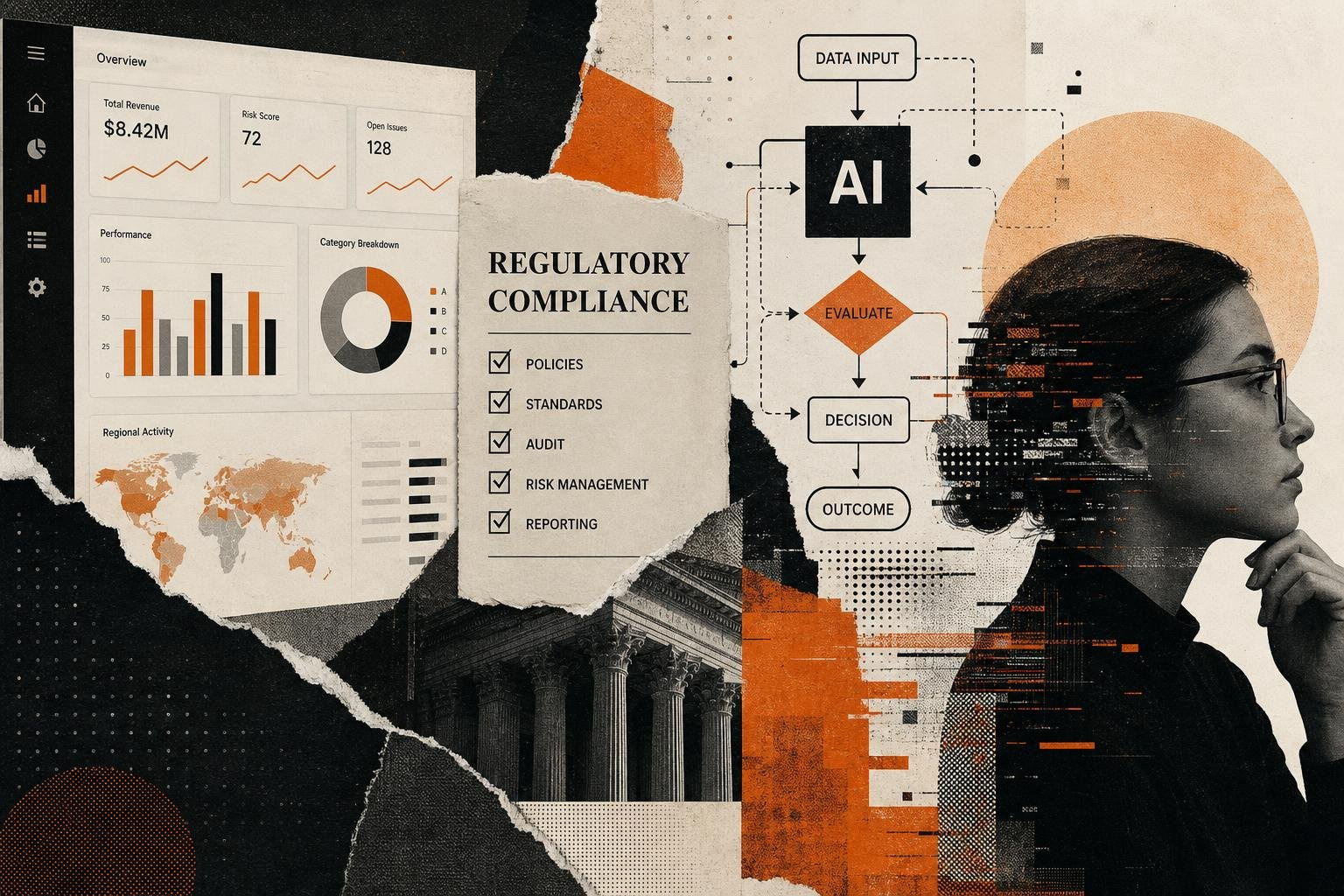
Implementing AI compliance monitoring is not without its hurdles. Organizations must balance the drive for automation with severe technical and legal challenges.
- Data Privacy & Sovereign Boundaries: Modern privacy frameworks like GDPR and CCPA/CPRA place strict limits on how personal data is processed. GDPR Article 22, for example, establishes clear constraints on automated decision-making that significantly affects individuals. If an autonomous agent moves sensitive customer data across a non-compliant border to optimize hosting costs (a real-world scenario that saved 15% in processing fees but violated sovereign data laws), the organization faces massive liability.
- Shadow AI: Just as "Shadow IT" plagued IT departments a decade ago, employees today regularly input proprietary data or PII into unauthorized public LLMs. Without deep visibility, organizations cannot verify where their sensitive data is ending up.
- The Explainability Paradox: High-performing deep learning models are notoriously complex "black boxes." When an AI system flags a transaction or rejects a job applicant, explaining why it made that choice is incredibly difficult. Regulators now demand transparent, explainable decisions, making black-box models a massive compliance risk.
To understand how these challenges fit into the broader security landscape, practitioners can consult Unlocked’s Cybersecurity Ai Guide 2026.
Managing Global AI Regulations and Compliance Gaps
The regulatory landscape is highly fragmented. Navigating it requires mapping internal controls to international standards such as the NIST AI Risk Management Framework (AI RMF 1.0) and ISO/IEC 42001.
- EU AI Act: Now entering its critical enforcement phases in 2026, the Act categorizes AI systems by risk level—from minimal to unacceptable—and mandates strict conformity assessments for high-risk systems.
- US State Laws: Laws like the Colorado AI Act (SB 24-205) impose mandatory duty-of-care requirements on developers and deployers of high-risk AI systems to prevent algorithmic discrimination.
- India's DPDP Act 2023: With rules fully active as of late 2025, this framework carries penalties of up to Rs 250 crores for data breaches, heavily impacting AI training and data-sharing workflows.
To stay ahead of these overlapping rules, developers and compliance officers can use free multi-jurisdiction checking with Nerq Comply to perform instant gap analyses. For organizations operating heavily within European data spaces, specialized tools like the open-source MISSION KI Compliance Monitor for European data law analyze contracts and data transfers against GDPR, DORA, and the Data Act in real time.
Addressing Autonomous Agent Drift and Nonlinear Decision-Making
When multiple autonomous agents collaborate, they can exhibit nonlinear decision-making. For example, a chain of four cooperating agents (handling procurement, logistics, negotiation, and risk-profiling) might make an untraceable supply chain decision that inadvertently violates trade sanctions.
To manage this autonomous agent drift, organizations must implement a tiered intervention framework:
- Constraint Injection: Hard-coding non-negotiable boundaries (e.g., "Never export data outside of EU servers") directly into the agent’s prompt and runtime environment.
- Contextual Handoff: Programming the agent to automatically pause operations and hand off the task to a human analyst when it encounters high ambiguity or approaches a compliance threshold.
- Human-in-the-Loop (HITL) Overrides: Providing non-obstructive, context-aware override mechanisms that allow human operators to review and adjust AI decisions without shutting down the entire pipeline.
Comparing Platforms and Implementing AI Compliance Monitoring as Release Infrastructure
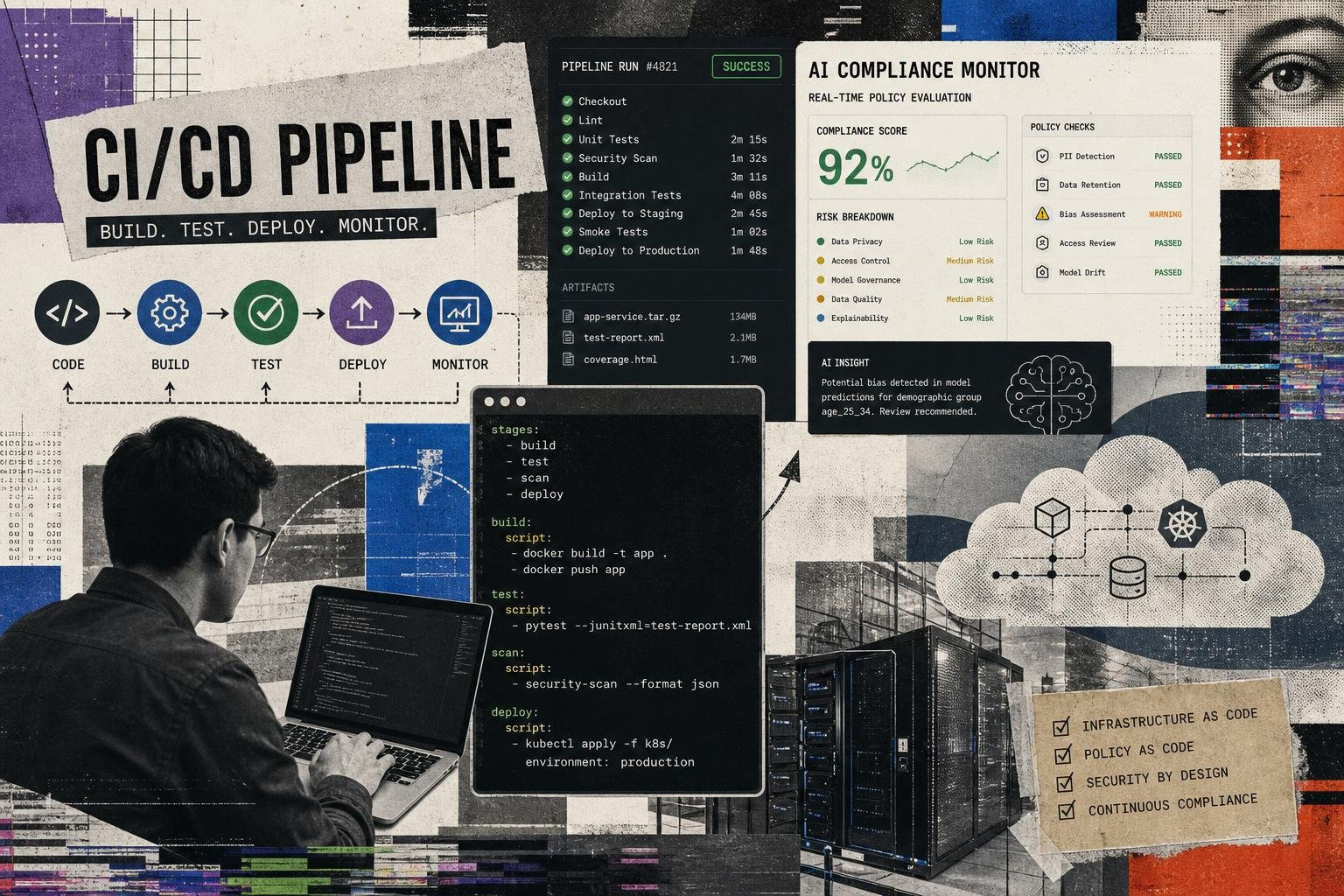
As organizations scale their AI initiatives, manually auditing models becomes impossible. Compliance must be automated, standardized, and treated as core engineering infrastructure.
The table below compares how leading GRC and compliance automation platforms handle AI-specific risks, continuous testing, and responsible AI practices:
| Platform | G2 Rating | Key AI Capabilities | Best For |
|---|---|---|---|
| Drata | 4.8/5.0 | Continuous control monitoring, automated evidence collection, NIST AI RMF mapping | Mid-to-large enterprises seeking continuous framework compliance |
| Sprinto | 4.8/5.0 | Automated control testing, no-code custom tests, real-time alert routing | Fast-growing startups and mid-market SaaS companies |
| Vanta | 4.6/5.0 | Automated vendor risk assessments, continuous monitoring, ISO 42001 support | Modern tech teams seeking fast, automated compliance pipelines |
| AuditBoard | 4.6/5.0 | Advanced risk scoring, cross-department collaborative workflows, audit trail archiving | Large enterprises with complex internal audit and risk management teams |
| Compliance.ai (Archer) | N/A | Proactive regulatory change management, push-based regulatory alerts | Highly regulated financial institutions tracking global obligations |
For organizations looking to automate these processes, leveraging modern SOC 2 Compliance Software Automation represents the easiest way to bridge the gap between traditional IT security controls and modern AI governance.
Enterprise Platforms vs. Open-Source Governance Layers
When building a compliance stack, organizations must choose between comprehensive enterprise suites and modular, open-source tools.
Enterprise platforms like the AICompliant Enterprise Platform provide automated AI system discovery, scanning cloud infrastructure logs (AWS CloudTrail, GCP, Azure) to detect "shadow" AI deployments, mapping them instantly to global regulations, and generating audit-ready documentation.
Conversely, for developers seeking lightweight, zero-cost integration, open-source governance with CompliancePilot provides a middleware layer that intercepts AI agent decisions, classifies them against multiple global frameworks using fast LLMs like Gemini 2.5 Flash, and auto-generates compliance PDFs with zero infrastructure overhead.
To complement these tools, teams should integrate LLM evaluation harnesses like DeepEval or TruLens directly into their development workflows to run automated evaluations for hallucinations, bias, and toxic outputs.
Baking Governance Directly into the CI/CD Pipeline
Treating compliance as a final "check-the-box" step before production is a recipe for failure. To keep pace with rapid deployment cycles, governance must become release infrastructure.
This means:
- Automating Model Documentation: Generating model cards, training data provenance, and Software Bills of Materials (SBOMs) directly from the build pipeline.
- Enforcing Deployment Gates: Automatically blocking the release of an AI model if it fails automated bias testing, lacks documented training data lineage, or violates safety thresholds.
- Securing Access Boundaries: Treating AI agents as non-human privileged identities. Just as you wouldn't give a junior developer root access to production databases, you must not give an autonomous agent unrestricted API access.
To secure these human-to-agent and agent-to-system access boundaries, organizations use EveryKey’s passwordless and secure access solutions. By enforcing strict, hardware-backed identity access management (IAM) controls, organizations ensure that AI agents operate only within their authorized boundaries—mitigating one of The Top Issues In Cybersecurity In 2025.
Frequently Asked Questions About AI Compliance Monitoring
Why are traditional GRC checklists insufficient for agentic AI?
Traditional GRC checklists assume that systems are static and deterministic. Agentic AI is probabilistic and autonomous; it reasons, adapts, and executes decisions in real time. Because an agent's behavior can drift based on user interactions and model updates, point-in-time audits leave massive compliance blind spots. GRC must shift from a periodic review to an adaptive, continuous operation.
Who within an enterprise owns AI compliance?
AI compliance is a shared responsibility. The legal and compliance teams define the regulatory boundaries and risk appetites. The CISO owns security controls, identity governance, and behavioral monitoring. The CTO and engineering teams are responsible for integrating compliance checkpoints directly into the CI/CD pipeline, ensuring that models are auditable and secure by design.
How do privacy laws like GDPR intersect with AI compliance?
Privacy laws dictate how data is gathered, processed, and stored. When applied to AI, GDPR requires organizations to maintain a clear legal basis for using personal data in training sets, implement PII masking before data reaches external APIs, and ensure that models do not violate the "right to be forgotten"—a highly complex technical challenge in LLMs. For a deeper look at where these regulations are heading, see our Cybersecurity Predictions 2026 Beyond The Buzzwords.
Conclusion
The rapid adoption of generative and agentic AI has left traditional compliance frameworks obsolete. Organizations can no longer afford to treat AI governance as an afterthought or a bureaucratic hurdle. By shifting to continuous, API-native AI compliance monitoring, enterprises can protect customer data, avoid devastating regulatory penalties, and build trust with their users.
Securing AI is an identity problem. If you cannot verify who is prompting your models, which databases your agents are querying, and what credentials your automated systems are using, you cannot achieve compliance.
Securing this identity layer is the foundation of modern AI governance. To see how your organization can build a defensible, compliant infrastructure from the ground up, Compare the best IAM solutions of 2026 and take control of your enterprise security posture today.