The Definitive Guide to Comparing Biometric Authentication Methods
Physical and behavioral biometrics compared side by side, with practical guidance on liveness detection, multimodal fusion, template protection, fallback controls, and regulatory alignment.

Why Biometrics for Authentication Are Replacing Passwords in 2026
Biometrics for authentication is the use of unique physical traits — fingerprints, iris patterns, facial geometry, vascular maps — or behavioral signals to verify who someone is before granting access to systems, data, or facilities.
Quick answer: what you need to know
- Biometric authentication replaces or supplements passwords by verifying what you are, not what you know or carry
- It works by capturing a live sample and comparing it against a stored mathematical template — not a raw image
- Modern systems run this comparison locally on a hardware chip (secure enclave), so raw biometric data rarely touches a network
- It is not foolproof — deepfakes, presentation attacks, and irrecoverable template breaches are real risks
- Best practice in 2026 is biometrics as part of a multi-factor or passwordless architecture, not as a standalone control
The pressure to move away from passwords is no longer theoretical. The global average cost of a data breach has reached $4.99 million, and stolen credentials remain one of the most consistent entry points attackers exploit. AI-driven attacks surged 56% in the most recent reporting period, with generative AI making credential phishing and voice spoofing significantly cheaper to execute at scale.
The authentication problem is getting harder, not easier. And passwords — even strong, well-managed ones — are a deterministic secret that can be guessed, phished, reused, or simply bought on a dark web market.
Biometrics shift the model. Your fingerprint cannot be phished over email. Your iris pattern cannot be reused across 14 breached sites. But the tradeoffs are real and worth understanding carefully: a stolen password can be reset in seconds; a stolen biometric template is yours for life.
This guide compares every major biometric modality, walks through how these systems actually work under the hood, and gives you a practical decision framework — whether you're a CISO evaluating enterprise deployment or an IT administrator figuring out where to start.
Fundamentals of Biometrics for Authentication vs Traditional Credentials
To understand why biometrics for authentication behave fundamentally differently from legacy credentials, security teams must recognize the mathematical divide between deterministic and probabilistic systems.
Passwords, personal identification numbers (PINs), and cryptographic tokens operate deterministically. The input either matches the stored secret byte-for-byte or it fails. There is no middle ground. Biometric systems, in contrast, operate probabilistically. Because human tissue changes with age, hydration, lighting, and sensor position, a biometric sensor never captures the exact same raw data twice.
Instead of matching strings, biometric processing extracts discrete topological features — such as fingerprint minutiae or facial landmark distances — and converts them into encrypted mathematical templates. During access requests, feature extraction algorithms convert live samples into a feature vector and compute a matching score against stored reference templates.
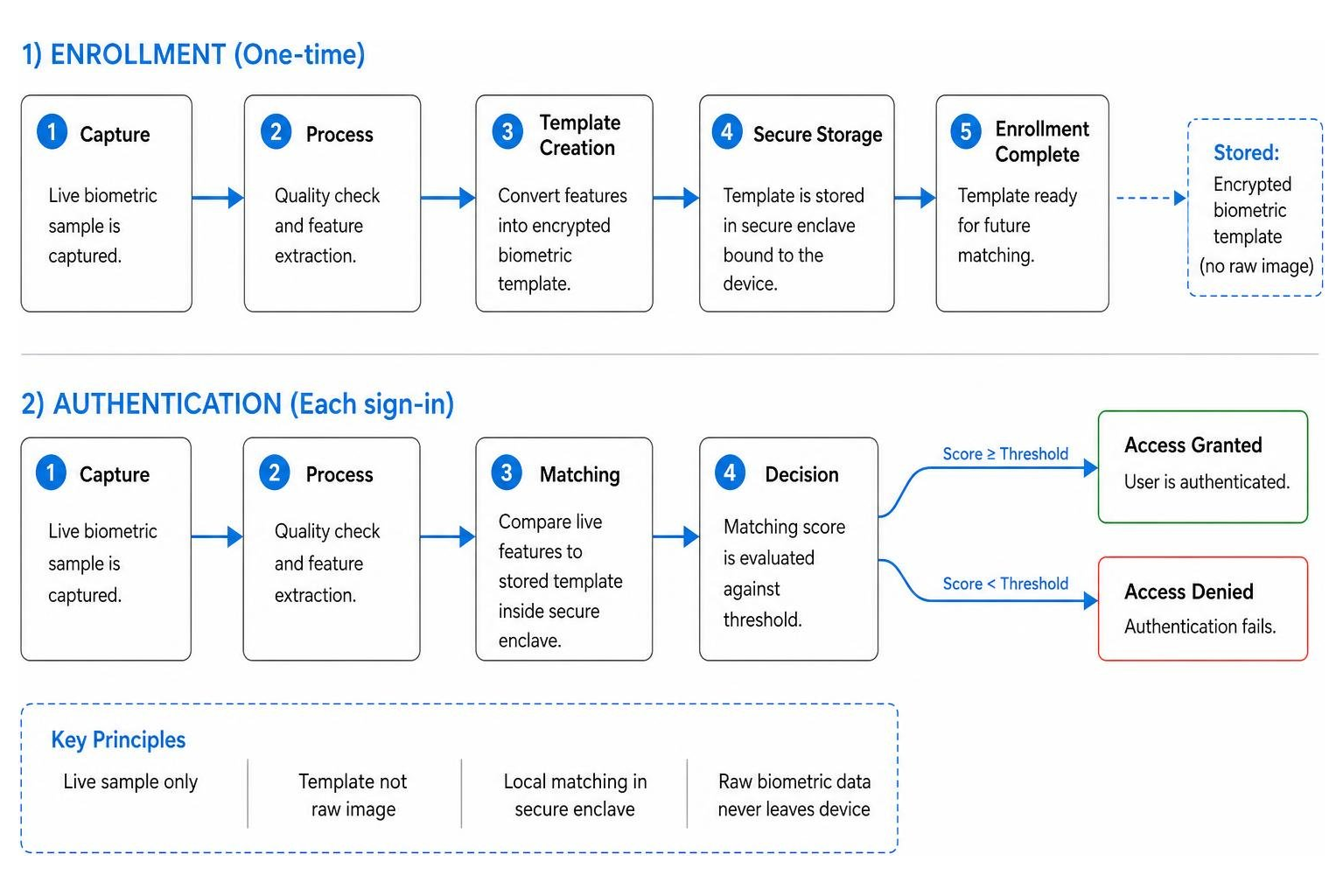
As highlighted in the CISA Identity Security Threat Intelligence Advisory issued in January 2026, adversary shift toward automated session hijacking makes local hardware binding essential. High-assurance systems enforce 1:1 local verification rather than central 1:N searching, binding biometric templates directly to local hardware security modules (HSM), TPMs, or mobile secure enclaves. Modern enterprise frameworks adopt best authentication methods of 2026 mfa biometrics passkeys more by leveraging WebAuthn and FIDO2 standards. When a user presents a biometric, the local secure element authenticates the user locally and unlocks a hardware-bound private key to sign a cryptographic challenge sent by the relying party server.
Standardization guidelines like the BSI TR-03166 Technical Guideline for Biometric Authentication Systems and NIST Special Publication 800-76-2 - Biometric Specifications for Personal Identity Verification mandate strict operational separation between Layer 1 device unlocking and Layer 2 application access. This architecture ensures raw biometric images are never exposed over network transit, transforming biological traits into hardware-gated access triggers. For a broader analysis on this architectural transformation, explore biometrics for authentication how biometric systems are transforming secure identity verification.
| Attribute | Traditional Credentials (Passwords/Tokens) | Biometric Authentication Methods |
|---|---|---|
| Authentication Logic | Deterministic (Exact string match) | Probabilistic (Similarity threshold matching) |
| Phishing Resistance | Low to Moderate (Vulnerable to Social Engineering) | High (Requires physical presence or live sample) |
| Revocability | High (Instantly revocable and reset) | Zero (Physical traits cannot be altered) |
| Storage Architecture | Salted central hashes or vault secrets | Hardware-isolated cryptographic templates |
| Primary Failure Metrics | Credential reuse, brute force | False Accept Rate (FAR), False Reject Rate (FRR) |
Evaluating Biometric Authentication Modalities: Physical vs Behavioral
Physical Inherence Traits: Fingerprints, Iris Scans, and Vascular Patterns
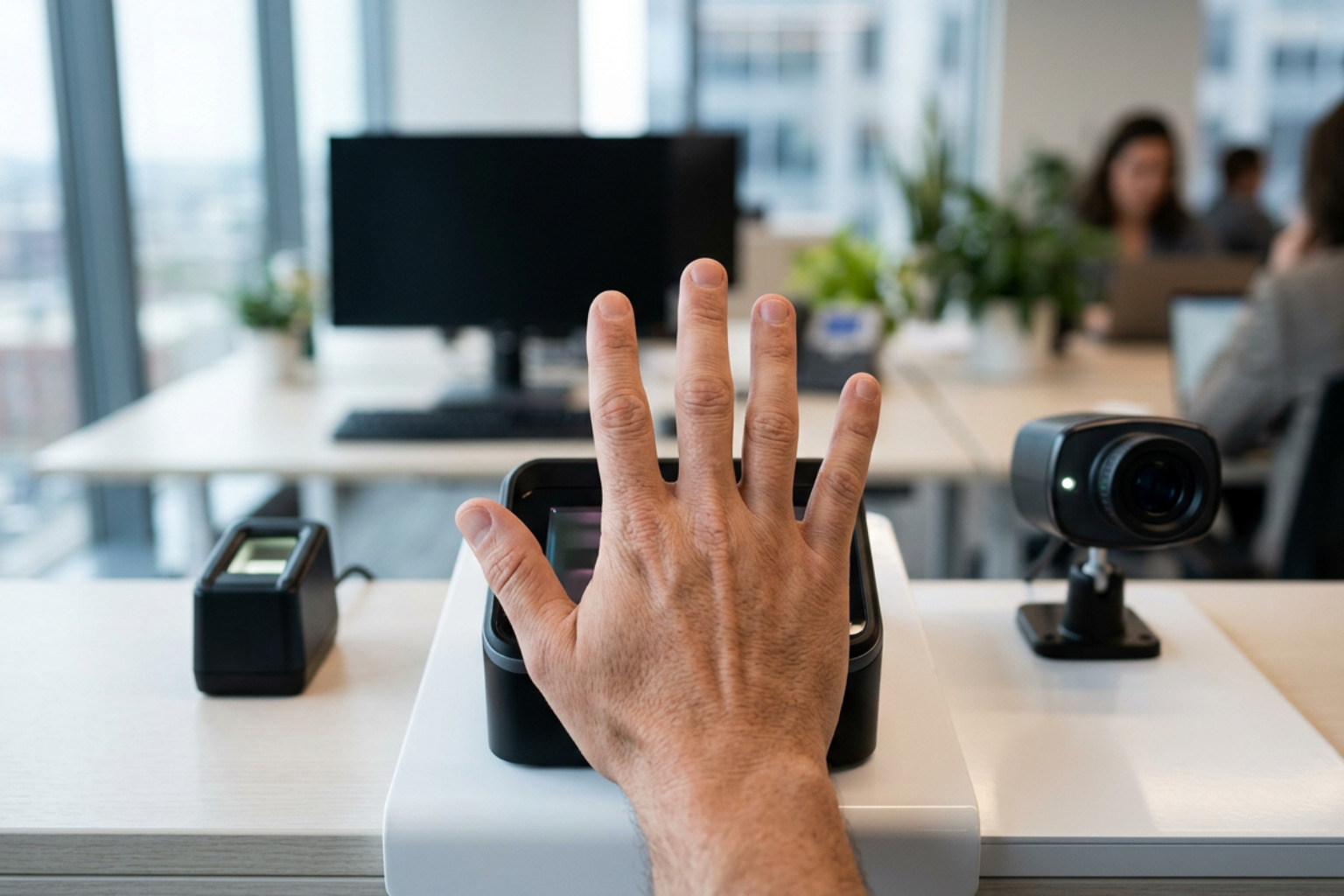
Physical inherence factors rely on static, biological structures. Among these, fingerprint recognition remains the most widely deployed. Statistical research indicates that the probability of finding two identical fingerprints in the general population is approximately 1 in 64 billion. However, surface-level fingerprint sensors suffer from environmental degradation caused by moisture, dirt, or grease, leading to high Failure to Capture (FTC) rates in industrial environments.
Facial recognition has achieved rapid adoption due to smartphone integration. Modern 3D structured-light and time-of-flight cameras deliver impressive False Acceptance Rates (FAR), with platforms like Apple Face ID maintaining a random unlock probability of less than 1 in 1,000,000 under baseline conditions. However, performance degrades under extreme lighting, and static 2D cameras remain susceptible to presentation attacks without active infrared depth analysis.
Iris scanning offers exceptional accuracy. The human iris stabilizes between ages 1 and 2 and contains intricate visual patterns that yield binary templates suitable for rapid, highly scalable searching. According to the World Bank's Biometric data | Identification for Development initiative, iris matching algorithms are computationally efficient, achieving near-zero false match rates. For detailed technical mechanics on ocular verification, see our analysis on iris scanner technology explained how iris recognition systems improve identity verification.
Vascular pattern recognition — specifically sub-dermal palm and finger vein scanning — captures near-infrared light absorbed by deoxygenated hemoglobin in blood vessels. Because vascular structures lie beneath the skin surface, vein patterns cannot be captured passively in public or scraped from social media photos. While equipment costs for vein recognition remain 2x to 4x higher than standard optical fingerprint readers, its immunity to surface contamination makes it an elite choice for shared clinical and industrial workstations.
Behavioral Factors and Continuous Signals
Behavioral biometrics measure dynamic human interaction habits rather than physical features. Systems analyze keystroke dynamics (typing speed, flight time between keys, dwell time on individual keycaps), mouse movement vectors, scroll acceleration, and gait patterns captured via smartphone accelerometers.
Unlike static physical factors that authenticate identity at a single point in time, behavioral biometrics enable continuous authentication. A user might log in using a local passkey, but behavioral analytics continuously compute a confidence score in the background. If an unauthorized actor steps in while the workstation is unlocked, anomalous typing cadences trigger automated step-up authentication or session termination.
Recent academic advances detailed in A PRISMA-based systematic review on advances in identity recognition and authentication using human biometric signals (2018–2023) | BioMedical Engineering OnLine | Springer Nature Link highlight emerging physiological biosignals. Modalities such as continuous Electrocardiogram (ECG) and Photoplethysmogram (PPG) readings derived from smartwatches achieve pooled authentication accuracies exceeding 98.6%. Biosignals provide built-in liveness confirmation, as live cardiac activity cannot be replicated with static photos.
Conversely, legacy voice recognition has suffered severe degradation as a reliable security control. Generative AI voice cloning tools can now replicate individual voice patterns using brief audio samples scraped from public calls or video media. Security teams should treat voice as an unverified user identifier rather than a secure authentication factor, as detailed in our guide on why your voice is not a password the deepfake assault on biometrics.
Threat Vectors, Liveness Detection, and Multimodal Defense
Defeating Deepfakes and Presentation Attacks
As biometrics for authentication become standard enterprise controls, adversaries have escalated presentation attacks (PAs). Attackers attempt to bypass sensors using spoofed physical artifacts, including high-resolution printed photos, 3D silicone masks, latent fingerprint reactivations, and real-time AI video injection streams.
To counter these vectors, ISO/IEC 30107-standardized Presentation Attack Detection (PAD) mechanisms operate across active and passive layers:
- Active Liveness Detection: Prompts the user to complete randomized actions during capture, such as blinking, smiling, turning the head, or speaking dynamic passphrases.
- Passive Liveness Detection: Evaluates subtle physical properties transparently during sample acquisition without requiring user interaction. This includes tracking pupil constriction in response to screen light changes, analyzing sub-dermal blood flow via micro-color variations (photoplethysmography), and detecting surface specular reflection differences between human skin and synthetic silicone masks.
- Camera Injection Attack Prevention: Enforces hardware root-of-trust signatures on camera frame feeds to prevent adversaries from substituting software-generated deepfake video streams directly into browser API hooks.
Failures in liveness controls lead directly to systemic identity leaks, a structural issue analyzed further in biometrics backlash what happens when your face leaks.
Multimodal Biometric Fusion Architecture
Unimodal biometric systems rely on a single physical or behavioral trait. They are inherently vulnerable to single points of failure, such as sensor noise, physical disability, or targeted spoofing. Multimodal biometric fusion mitigates these weaknesses by combining two or more distinct modalities into a unified verification decision.
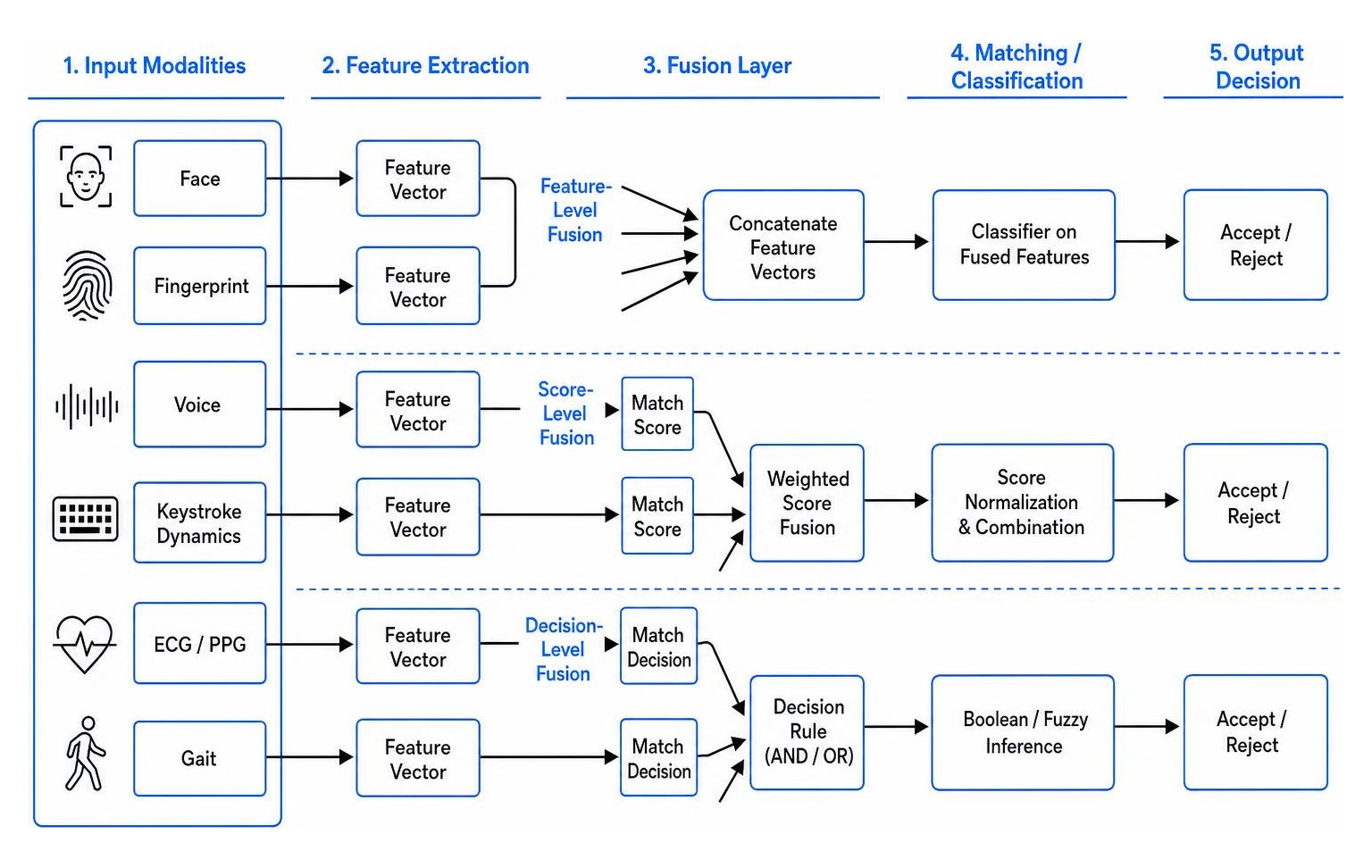
As established in published research on Multimodal biometric authentication: A review - Swimpy Pahuja, Navdeep Goel, 2024, fusion can occur at multiple stages within the processing pipeline:
- Feature-Level Fusion: Raw feature vectors from different modalities (e.g., facial geometry landmark points fused with finger-vein vectors) are concatenated into a single joint vector before classification.
- Score-Level Fusion: Individual match scores are calculated independently for each trait, normalized, and combined using weighted fusion algorithms to generate a cumulative confidence score.
- Decision-Level Fusion: Independent classifiers execute separate accept/reject decisions, which are evaluated using Boolean logic rules (e.g., AND/OR configurations) or fuzzy inference engines.
Fusing complementary physical traits (such as palm vein) with continuous behavioral dynamics (such as keystroke dynamics) lowers Equal Error Rates (EER) below 0.001%, rendering brute-force presentation attacks mathematically impractically expensive for adversaries.
Enterprise Implementation, Risk Mitigation, and Regulatory Compliance
Managing Template Security, Key Invalidation, and Fallback Controls
Deploying biometrics for authentication across an enterprise network requires strict engineering controls to safeguard template data and manage operational edge cases. Because biological features are permanent, compromised raw templates represent an unfixable security liability.
To securely deploy biometric capabilities, enterprise security teams must apply the following core practices:
- Enforce Template Protection Schemes: Transform raw minutiae into non-reversible mathematical structures using fuzzy vaults, cancelable biometrics, or zero-knowledge cryptographic representations so stored files cannot be reverse-engineered into original images.
- Isolate Storage to Local Hardware: Utilize local device enclaves (such as Apple Secure Enclave or Android Keystore) to handle template extraction and comparison locally, preventing centralized template database accumulation.
- Handle OS Key Invalidations: Implement error handling for hardware key invalidations. On Android and iOS, keys bound to the current set of enrolled biometrics are invalidated when fingerprints are added or changed, so a newly enrolled biometric cannot unlock existing credentials.
- Enforce Strong Fallback Policies: Configure Mobile Device Management (MDM) profiles to enforce complex multi-character alphanumeric passcodes when biometric verification limits are exceeded, preventing weak 4-digit PIN fallbacks from compromising device integrity.
For a deeper dive into mitigating exposure risks, review our analysis on why when they steal a fingerprint you cant reset it and how to deploy advanced biometric template protection.
Sector Use Cases and Global Regulatory Alignment
Biometric controls serve specific security goals across major industry sectors:
- Financial Services: Digital customer onboarding workflows combine facial recognition with active liveness checks to satisfy Know Your Customer (KYC) and Anti-Money Laundering (AML) mandates, preventing fraudulent account creation.
- Healthcare: Workstation SSO leverages contact-free palm vein or iris scanners to grant clinical staff instantaneous access to Electronic Health Records (EHR) while wearing surgical gloves, ensuring HIPAA compliance.
- Border Control and Public Safety: International transit hubs utilize microchipped e-Passports containing standardized ISO/IEC 19794 biometric data matched against live automated gate scans to streamline border clearance.
From a regulatory standpoint, biometric data is classified as Sensitive Personal Information (SPI) under Article 9 of the EU General Data Protection Regulation (GDPR). GDPR enforces strict explicit consent mandates, proportional necessity assessments, and mandatory Data Protection Impact Assessments (DPIAs) prior to deployment.
In the United States, state-level statutes like the Illinois Biometric Information Privacy Act (BIPA) and the California Consumer Privacy Act (CCPA) impose strict statutory damages for unauthorized collection, storage, or disclosure of biometric identifiers without prior written consent. Systems that utilize passwordless architectures, such as a passwordless authenticator best passwordless authentication methods for 2026, minimize compliance liability by performing local biometric verification that keeps PII bounded entirely within individual user hardware.
Actionable Takeaways and Decision Framework for Biometric Deployment
For security leaders establishing enterprise authentication strategies, the following phased roadmap balances threat reduction, regulatory compliance, and operational cost:
- Conduct Modality Risk Mapping: Match biometric factors to environment constraints. Select touchless vein or iris modalities for high-hygiene or industrial environments, and deploy hardware-backed facial/fingerprint passkeys for corporate remote endpoints.
- Mandate FIDO2 / WebAuthn Standards: Eliminate vendor lock-in and centralized template liability by requiring all enterprise authenticators to leverage public-key cryptography where biometrics merely unlock local hardware private keys.
- Establish Exception and Fallback Workflows: Define administrative identity-proofing processes for employees who experience Failure to Enroll (FTE) due to physical conditions, ensuring secondary fallback mechanisms match primary biometric security levels.
- Implement Continuous Risk-Based Layering: Layer initial local biometric entry prompts with background behavioral monitoring (IP reputation, device health metrics, typing dynamics) to enforce Zero Trust access policies across sensitive cloud resources.
Organizations looking to implement modern passwordless frameworks alongside hardware keys and local biometrics can explore hardware-backed identity solutions provided by EveryKey, which pair bluetooth proximity signals with local biometric prompts to enforce seamless, multi-factor zero trust access across physical and logical endpoints.
Frequently Asked Questions About Biometrics
How does biometric authentication differ from biometric identification?
Biometric authentication is a 1:1 (one-to-one) matching process. The user claims an identity (e.g., entering a username or presenting a hardware token), and the system captures a biometric sample to compare exclusively against that single user's pre-registered template to answer: "Is this person who they claim to be?"
Biometric identification is a 1:N (one-to-many) searching process. The system captures a sample from an unknown individual and compares it against an entire database of stored templates to answer: "Who is this person?" Identification requires vastly higher computational power and central database storage, whereas 1:1 authentication can execute locally inside isolated hardware enclaves in milliseconds.
What happens if an organization's biometric template database is breached?
If an unencrypted central database storing raw biometric images or standard feature minutiae is compromised, the stolen data is permanently exposed because biological features cannot be changed or reset.
Modern architectures prevent this catastrophic exposure by utilizing cancelable biometrics and zero-knowledge mathematical transformations. Instead of raw samples, systems store non-invertible hashes. If a template hash is leaked, security administrators simply alter the transformation algorithm parameter, generating a completely new, mathematically distinct template vector from the same physical finger or face without invalidating the user's physical trait.
Why are multimodal biometric systems replacing single-factor voice and facial scans?
Single-factor voice and 2D facial recognition systems have experienced significant security degradation due to commodity generative AI, dynamic voice synthesis tools, and high-resolution video injection software.
Multimodal biometric architectures eliminate single-point vulnerabilities by fusing two or more factors — such as combining a local 3D facial scan with continuous keystroke behavioral analytics or sub-dermal vein mapping. By requiring verification across distinct biological or behavioral dimensions simultaneously, multimodal systems drive spoofing costs to levels that effectively neutralize automated cyberattacks.
Deploying Biometrics as One Layer, Not the Only One
Biometric authentication has evolved from an enterprise luxury into a foundational component of modern Identity and Access Management (IAM). As passwords continue to yield to automated phishing kits, dark web credential markets, and AI-assisted attacks, biological and behavioral factors offer a compelling path toward passwordless zero-trust environments.
However, biometrics must not be viewed as a silver bullet. Because biological traits are immutable, improper implementation — such as storing unencrypted raw templates in cloud databases or relying on unverified voice audio — creates systemic liability. High-assurance security depends on proper cryptographic architecture: performing 1:1 matching inside hardware secure enclaves, enforcing active liveness detection, and leveraging open standards like FIDO2 and WebAuthn.
The Unlocked platform delivers independent technical analysis, threat intelligence, and architectural guides to help CISOs, system administrators, and security engineers navigate identity security decisions. By integrating local biometric verification into broader multi-factor frameworks — alongside options like modern passwordless security keys and hardware authenticators such as EveryKey — organizations can achieve low-friction access control while enforcing robust defense against credential breaches.