
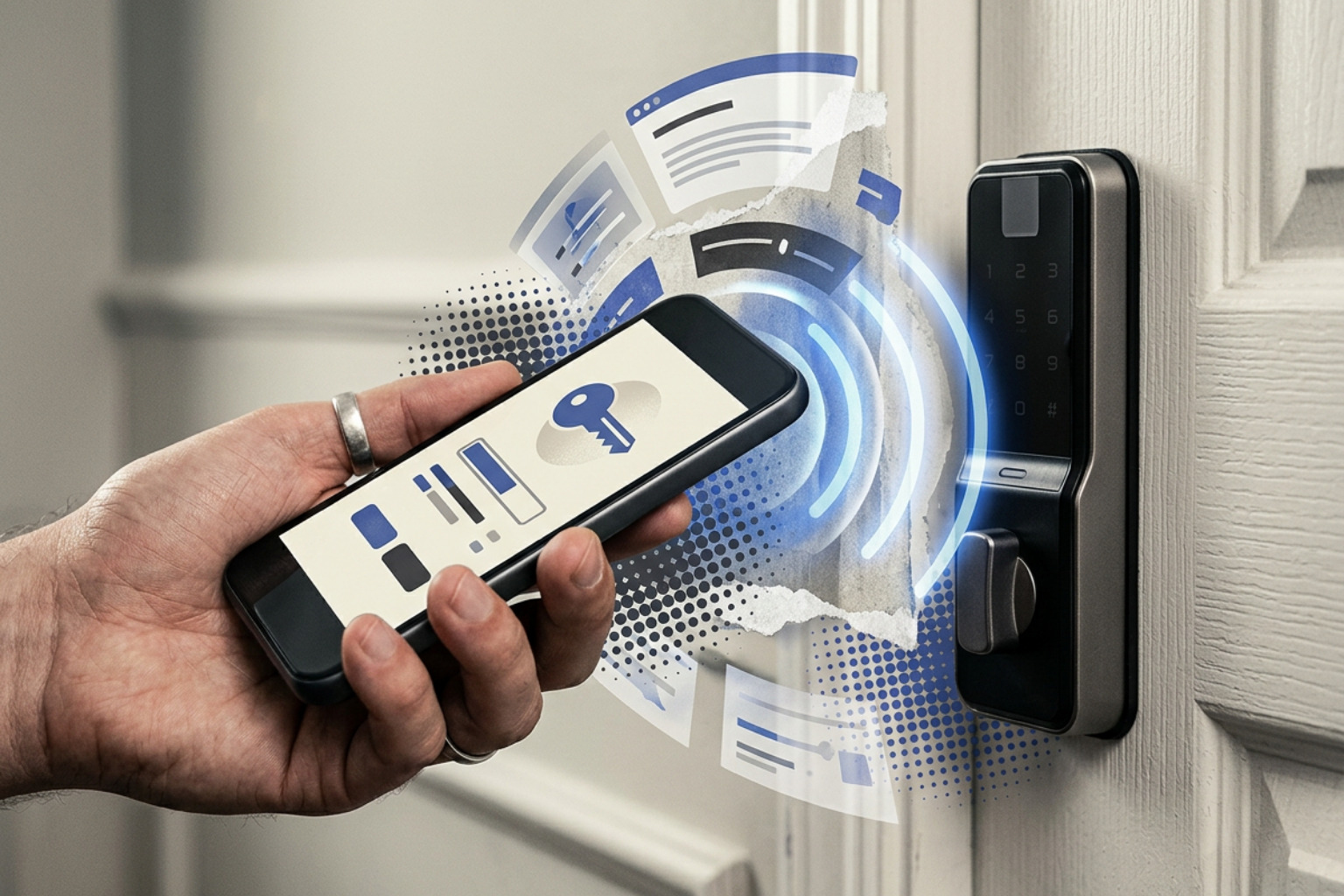
All About Proximity-Based IoT Device Authentication

Why Proximity Based IoT Device Authentication Is Now a Critical Security Control
Proximity based IoT device authentication is the practice of verifying that a device is physically present in a specific location before granting it access to a network or paired device — using signals like Wi-Fi, Ultra-Wideband (UWB), or RF fading as proof of physical closeness rather than relying on passwords or pre-shared keys.
Quick answer — how it works:
- Both devices scan their local radio environment (Wi-Fi beacon frames, UWB ranging signals, or ambient RF)
- They compare what they "hear" — if the signals match closely enough, they're in the same physical space
- Proximity is confirmed, and a secure channel is established without manual credential entry
Here's the uncomfortable reality: billions of IoT devices ship with no screen, no keyboard, and no practical way for a user to enter a password. Security researchers have demonstrated that many popular commercial smart home devices encrypt their Wi-Fi setup credentials using keys derived from nothing more unique than a MAC address and device ID — meaning cracking one device from a product line compromises all of them. In one documented case, researchers extracted a global decryption key from a smart plug using a $10 USB flash reader and a few soldered wires.
That's not a fringe vulnerability. It's a structural problem.
The attack surface is enormous and growing fast. IoT devices roughly doubled from 15 billion in 2015 to 31 billion by 2020, with projections reaching 60 billion by 2024. In parallel, cyber-attacks on IoT devices surged 600% in a single year — from roughly 6,000 reported incidents in 2016 to 50,000 in 2017. And with over 80 different authentication schemes currently proposed or implemented across the industry, there is no dominant standard to rally behind.
The result is a fragmented, under-secured ecosystem where the onboarding moment — the instant a new device joins a network — is often the most exposed point in the entire device lifecycle.
Proximity-based authentication directly addresses this gap. Instead of asking "does this device know the right secret?", it asks a harder-to-fake question: "Is this device physically here, right now?"
The Vulnerability of Headless Onboarding and the Need for Proximity
The term "headless" refers to any IoT device that lacks a traditional user interface (UI) — think of smart environmental sensors, industrial actuators, security cameras, and smart plugs. Because these devices cannot support interactive login screens, their initial onboarding (or "bootstrapping") phase is notoriously weak.
To get these devices onto a local network, manufacturers often design them to broadcast a temporary, unencrypted Wi-Fi Access Point (AP) or Bluetooth beacon during setup. A smartphone app connects to this temporary AP and transmits the local Wi-Fi credentials. If an attacker is within radio range during this brief window, they can intercept these credentials in plain text or easily spoof the setup SSID to execute a Man-in-the-Middle (MITM) attack.
Furthermore, once a device is deployed, its physical security remains a major concern. If an attacker gains physical access to a headless device, they can perform SPI flash extraction — physically reading the firmware off the circuit board to steal embedded cryptographic keys. If those keys are shared across the product line, every other deployed unit becomes vulnerable. This means that a single compromised device can serve as a gateway to the rest of your enterprise network, as discussed in IoT and Smart Devices: Your Office Printer Might Be a Hacker's Gateway.
Proximity-based authentication mitigates these risks by binding cryptographic trust to physical co-location. An attacker sitting a block away cannot complete the handshake, even if they have intercepted the device's static firmware keys, because they cannot replicate the unique physical environment of the pairing zone.
Why Traditional Methods Fail in Proximity Based IoT Device Authentication
When engineers look for ways to verify proximity, they often turn to familiar technologies like GPS or Bluetooth. However, in the context of enterprise IoT, these traditional methods fall short:
- GPS Limitations: GPS is highly unreliable indoors. Concrete, steel, and multi-story building layouts attenuate satellite signals, often resulting in position errors of tens of meters — or a complete lack of signal. This makes GPS useless for verifying that a smart sensor is in the same room as its gateway.
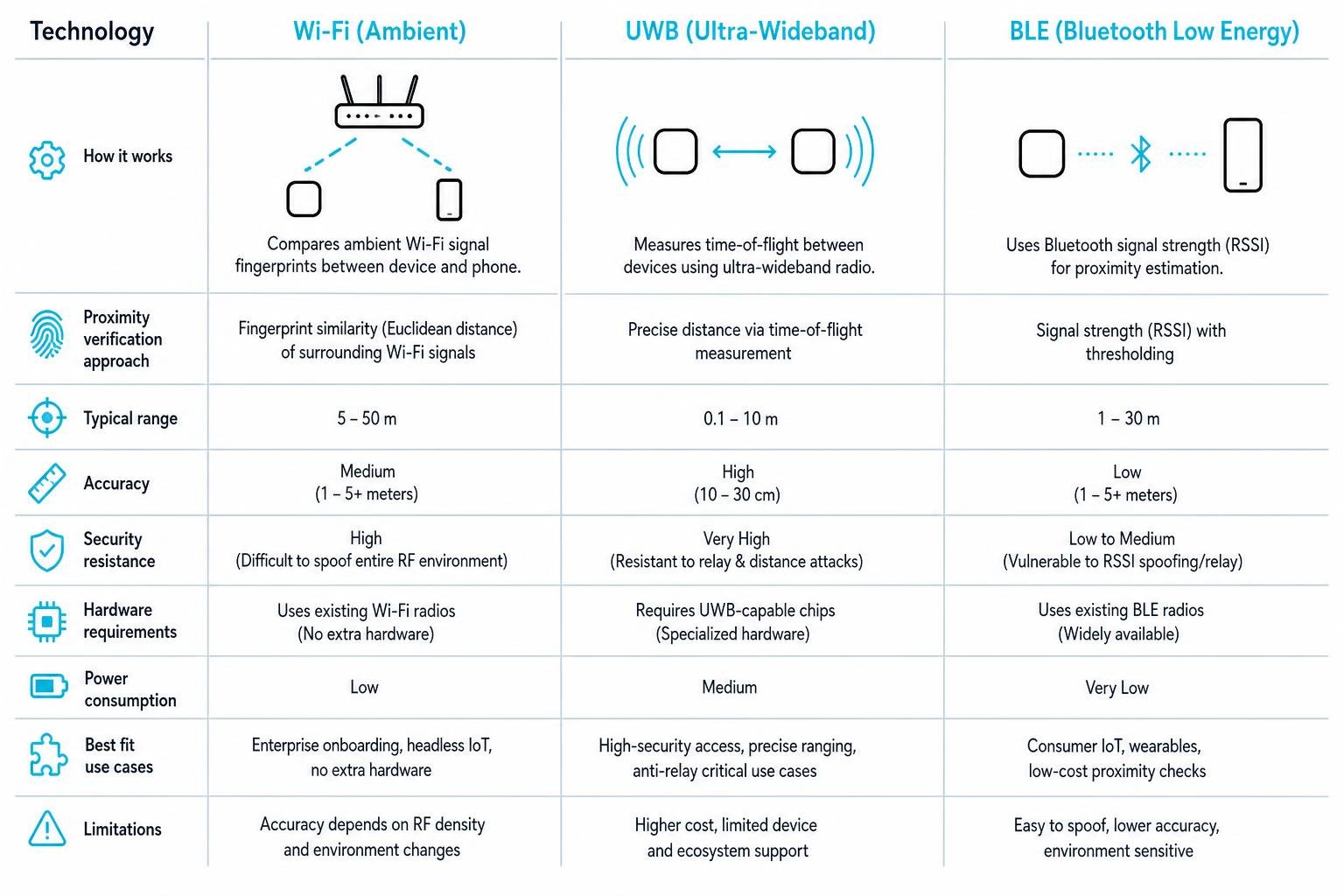
- Bluetooth Constraints: While Bluetooth is widely used, it has inherent security and architectural limitations. Bluetooth operates on a relatively simple signal strength metric (RSSI) that can be easily spoofed by an attacker using high-gain directional antennas or signal amplifiers. Furthermore, Bluetooth mesh and peer-to-peer setups require specialized chips and software stacks that are not universally present in all legacy or highly constrained IoT hardware.
- Pre-Shared Key (PSK) Vulnerabilities: Relying on static, pre-shared keys printed on device stickers or stored in databases creates a massive logistical headache. These keys are frequently leaked, lost, or compromised, completely undermining the trust model analyzed in Device Authentication: Building Trust in Every Connection.
Core Technologies for Proximity Based IoT Device Authentication
To build a secure, zero-hardware-overhead proximity verification system, we must look to the physical properties of the wireless signals already present in modern enterprise environments.
Ambient Wi-Fi Footprinting and Euclidean Distance Calculations
One of the most elegant approaches to proximity verification is using the existing IEEE 802.11 (Wi-Fi) infrastructure. Every modern building is flooded with Wi-Fi signals from multiple access points. Each of these APs periodically broadcasts beacon frames containing unique identifiers (SSID and BSSID) alongside a measurable Received Signal Strength Indicator (RSSI).
Together, these signals form a unique "ambient Wi-Fi footprint" or "fingerprint" for any specific coordinate in space. Because radio waves degrade and reflect off walls, furniture, and human bodies, two devices placed close to each other will "hear" the surrounding Wi-Fi APs with highly correlated signal strengths. A device located even a few meters away, or in a different room, will perceive a significantly different footprint.
To authenticate a new device, the pairing process follows a mathematical approach:
- Scan Phase: The authenticated gateway (Node A) and the joining device (Node B) simultaneously scan the local environment to collect matching (BSSID, RSSI) tuples.
- Transmission Phase: Node B transmits its scanned tuple to Node A over a temporary channel.
- Calculation Phase: Node A calculates the Euclidean distance between the two RSSI datasets. In plain terms, for every access point that both devices can hear, Node A takes the difference between the two signal strength readings, squares each difference, adds all of those squared values together, and then takes the square root of the total. A smaller result means the two devices are hearing the Wi-Fi environment more similarly.
If the calculated Euclidean distance falls below a pre-calibrated threshold, Node A confirms that Node B is in close physical proximity. In real-world physical experiments using two Raspberry Pi devices, this method achieved an initial authentication accuracy of 87.9%. When researchers applied a 20% tolerance margin to the Euclidean threshold, the accuracy rose to 94.5%. In larger multi-node computer simulations, the scheme maintained a reliable 90% authentication accuracy, proving its viability for ad hoc network deployments.
For highly secure, low-latency deployments, these ambient checks can be paired with physical layer security (PLS) primitives, such as the zero-round-trip-time multi-factor handshakes detailed in A Physical Layer, Zero-Round-Trip-Time, Multifactor Authentication Protocol.
Ultra-Wideband (UWB) and Fast Authentication Modes
Where Wi-Fi footprinting leverages existing infrastructure, Ultra-Wideband (UWB) technology provides dedicated, highly precise distance measurement. UWB operates by transmitting ultra-short radio pulses across a wide spectrum (typically between 3.1 and 10.6 GHz). By measuring the exact Time-of-Flight (ToF) of these pulses, UWB systems can calculate the distance between two devices with centimeter-level accuracy.
The Fine Ranging (FiRa) Consortium has standardized UWB communication and security protocols to enable secure hands-free access control, such as digital car keys and smart door locks. However, the standard FiRa specification requires establishing a secure cryptographic channel via a complex GENERAL AUTHENTICATE command sequence before ranging can begin. This handshake is computationally heavy and slow, often taking more than a second to complete — a major bottleneck for seamless user experiences.
To solve this, advanced implementations utilize a "secure channel unused mode" (or fast authentication mode) detailed in recent industry patents, such as the AUTHENTICATION METHOD BETWEEN TERMINALS HAVING PROXIMITY COMMUNICATION FUNCTION AND TERMINALS IMPLEMENTING THE SAME METHOD - Patent Application.
In this fast mode, a pre-shared authentication key is stored securely within an embedded Secure Element (eSE) in a specific field of the Application Dedicated File (ADF). When a device approaches:
- The controller generates basic session information containing a dynamically generated random value (a nonce).
- This random value is sent to the approaching device.
- Both devices independently derive a session key using the pre-shared key and the random value, completely bypassing the slow secure channel setup.
- The devices immediately perform secure UWB ranging using the derived session key, completing the entire authentication and distance verification process in under a second.
Physical Layer Security and Gesture-Based Verification
If an active attacker is highly sophisticated, they might attempt to spoof signal strengths or replicate ambient Wi-Fi footprints. To defend against these advanced threats, security protocols can incorporate Physical Layer Security (PLS) and user-mediated gestures.
Move2Auth: Correlating Physical Gestures with Signal Variations
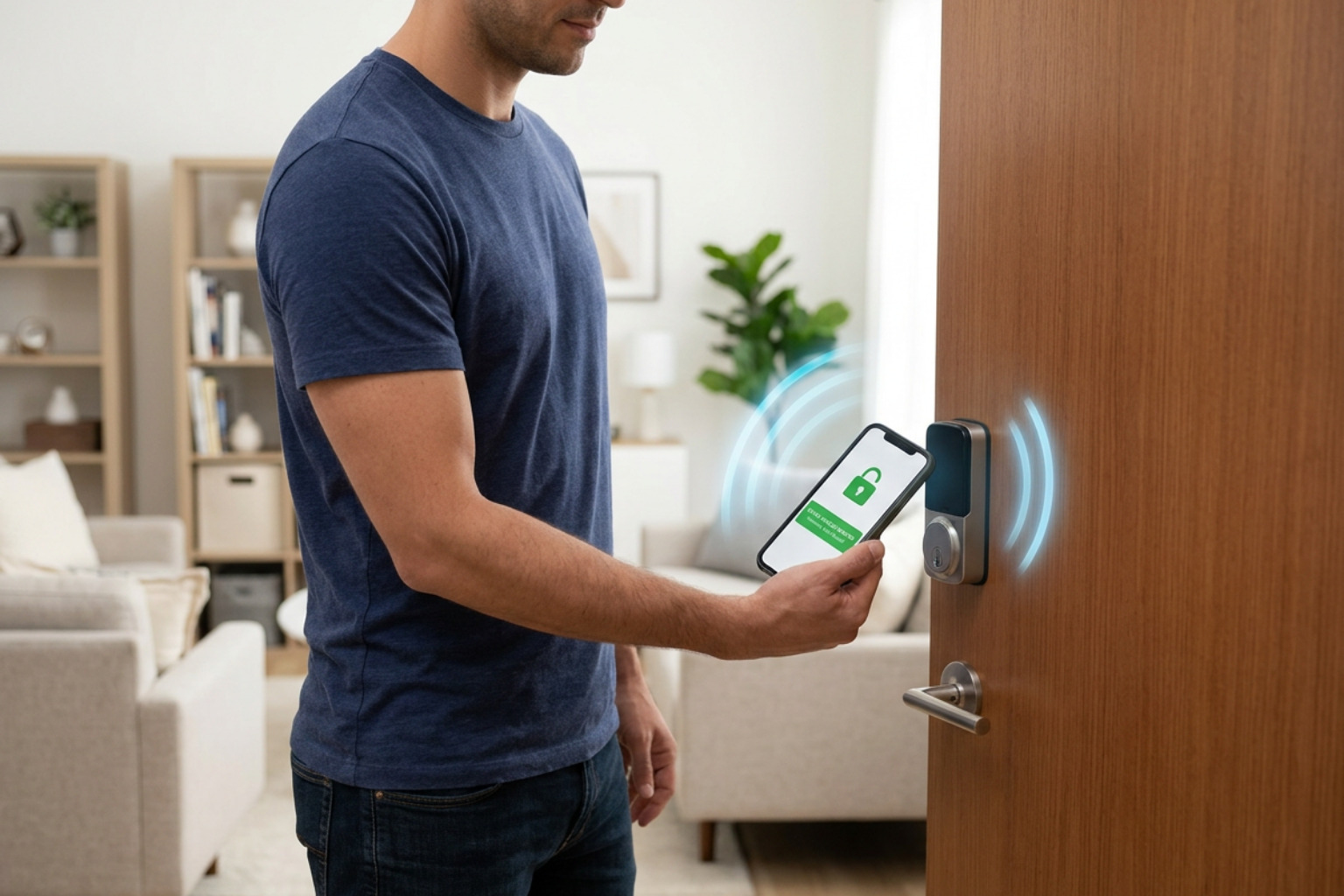
The Move2Auth protocol leverages the natural physics of wireless antennas to authenticate headless devices. When a user holds a smartphone and performs a simple physical gesture — such as moving the phone toward and away from an IoT device, or rotating it 180 degrees — they introduce highly predictable variations in the Received Signal Strength (RSS).
This technique relies on two core physical concepts:
- Antenna Polarization (Malus's Law): Wireless antennas are polarized. When a user rotates a smartphone by 180° directly in front of an IoT device, the change in polarization alignment causes a deep, predictable signal drop of 12 to 15 dB in the near field.
- Near-Field vs. Far-Field Fading: In the near field (very close to the device), physical movement of just 20 cm causes massive RSS variations of more than 15 dB. In the far field (where a remote attacker is located), multi-path reflections and atmospheric scattering smooth out these variations. The attacker only perceives a flat, low-entropy signal variation of around 5 dB, making it mathematically impossible for them to replicate the user's gesture trace.
By correlating the smartphone's internal inertial sensors (accelerometer and gyroscope) with the RSS variations recorded by the IoT device, the system can verify proximity. In Move2Auth trials, this gesture-matching approach achieved:
- A false-positive rate (FPR) of less than 0.5% against active attackers attempting to spoof the signal by tuning their transmission power or replaying historical gesture traces.
- A false-negative rate (FNR) of exactly 0% when the smartphone and IoT device were held in close physical proximity (within 20 cm).
- A total gesture time of just 3 seconds, requiring a movement of only 20 cm.
To explore how these physical interactions fit into broader security architectures, see ProxiMate: Proximity-based Secure Pairing using Ambient.
Ambient RF Fading and Key Extraction
For devices that cannot perform physical gestures, proximity can still be verified through small-scale fading of ambient RF signals (such as local FM radio, digital TV, or Wi-Fi broadcasts).
The physical boundary for secure key correlation is half a wavelength of the ambient signal. Legitimate devices placed closer than one-tenth of a wavelength to each other perceive almost identical fading patterns from ambient sources, while an adversary located further than four-tenths of a wavelength away experiences completely uncorrelated fading.
For perspective, the physical distances vary based on the signal frequency:
- 100 MHz FM Radio: Wavelength is about 3 meters. Legitimate pairing zone (one-tenth of a wavelength) is within 30 cm; the attacker boundary (four-tenths of a wavelength) is beyond 120 cm.
- 584 MHz TV Signal: Wavelength is about 51 cm. Legitimate pairing zone is within 5 cm; attacker boundary is beyond 20 cm.
- 2.4 GHz Wi-Fi: Wavelength is about 12.5 cm. Legitimate pairing zone is within 1.2 cm; attacker boundary is beyond 5 cm.
By sampling these ambient signals and applying list-encoding (mapping the relative peaks and drops of the signal amplitude to binary bits), co-located devices can extract identical cryptographic keys directly from the air, completely eliminating the need for a Diffie-Hellman key exchange.
Balancing Security Strength and Energy Constraints
While proximity-based authentication provides exceptional security, it introduces computational and transmission overhead. For a battery-powered sensor running on a tiny 64MHz ARM processor with only 1MB of flash RAM, every radio scan and cryptographic handshake directly impacts operational lifespan.
To optimize these protocols, developers must carefully calibrate the packet transmission count during the pairing phase. Sending too few packets reduces authentication accuracy; sending too many drains the battery.
| Packet Count | Correlation Threshold | False Alarm Rate | Detection Rate | Energy Consumed (Joules) |
|---|---|---|---|---|
| 20 | 0.62 | < 5% | > 95% | 21.25 J |
| 50 | 0.65 | < 3% | > 97% | 28.70 J |
| 100 | 0.70 | < 1% | > 98% | 36.15 J |
| 200 | 0.75 | < 0.5% | > 99% | 51.92 J |
As shown above, setting the packet count to 20 with a correlation threshold of 0.62 represents an optimal sweet spot for resource-constrained hardware, cutting energy consumption by more than half compared to a packet count of 200 while still maintaining a robust security posture.
Cryptographic Optimization: ECC vs RSA in Proximity Based IoT Device Authentication
Beyond packet counts, the choice of cryptographic algorithms is a primary factor in energy efficiency. Traditional public-key cryptosystems like RSA are computationally heavy, requiring large key sizes (e.g., 2048 or 4096 bits) and intensive mathematical operations that quickly exhaust low-power IoT microcontrollers.
By contrast, Elliptic Curve Cryptography (ECC) offers equivalent security with significantly smaller keys (e.g., a 256-bit ECC key provides the same security as a 3072-bit RSA key).
Using an ECC-based hybrid cryptosystem — such as Elliptic Curve Diffie-Hellman (ECDH) combined with AES-GCM symmetric encryption — reduces the energy consumed during the cryptographic handshake by approximately 90% compared to RSA-based alternatives. This dramatic reduction in computational overhead is essential for maintaining the multi-year battery life required by enterprise IoT deployments, as detailed in the Hardware Authentication Guide 2026.
Threat Mitigation and Continuous Authentication
Implementing proximity authentication at the initial pairing step is a massive step forward, but it is not a silver bullet. Security teams must also account for post-pairing threats:
- Environment Simulation Attacks: An attacker might record the Wi-Fi or RF footprint of a secure facility and play it back to a remote device to trick it into thinking it is still inside the secure perimeter. This can be mitigated by binding the proximity check to unique, hardware-level identifiers like Physical Unclonable Functions (PUFs) or IMEI numbers.
- Physical Relocation / Insider Threats: A device could be paired securely inside a server room, but later physically stolen or moved outside the secure boundary to be tampered with.
- Session Hijacking: An attacker might wait for a device to complete its initial handshake, then inject malicious packets to hijack the active session.
These vulnerabilities are why modern security architectures are moving away from one-time "perimeter" checks and embracing the zero-trust models outlined in Continuous Authentication in Practice: A Modern Approach to Secure Access.
Implementing Continuous Proximity Verification
Continuous authentication ensures that a device remains in its authorized physical location throughout its entire operational session. Instead of authenticating once and trusting the connection indefinitely, the gateway and the IoT device perform periodic, low-overhead background scans of the ambient Wi-Fi or RF environment.
Because raw RSSI measurements are highly volatile due to temporary environmental noise (like people walking past or doors opening), systems apply a fast Kalman filter to the signal data. This filter reduces the complex multi-variable signal matrices down to simple, stable scalar values with linear computational complexity, meaning the processing time grows at the same rate as the number of data points.
By filtering out fast-fading noise, the system isolates the stable, large-scale path loss trend. If a device is physically moved away, the Kalman-filtered RSSI trend will deviate from the gateway's baseline, prompting the system to automatically terminate the session, as discussed in Context-Aware Access: Smarter, Safer Control for the Modern Enterprise.
Securing the Relay in 5G and Ad Hoc Networks
In large-scale industrial settings or remote field deployments, IoT devices often cannot connect directly to a central base station. Instead, they rely on nearby peer devices to act as relays to bridge their connection to the wider network. This introduces a major risk: how does a remote device know it can trust a peer relay, and how does the network prevent unauthorized devices from exploiting these relays?
To secure these ad hoc connections, modern 5G architectures utilize AKMA (Authentication and Key Management for Applications) alongside a Proximity Based Service Function (PBSF), as detailed in recent 3GPP security patents like SYSTEMS AND METHODS FOR AUTHORIZATION OF PROXIMITY BASED SERVICES - Patent Application.
The protocol operates through a secure, multi-step verification process:
- The network's PBSF and the remote device independently generate a validation token using a shared anchor key and an encrypted freshness parameter (such as a dynamic nonce).
- The PBSF transmits this validation token to the relay node.
- The remote device sends its local token to the relay node.
- The relay node matches the two tokens. If they match, mutual trust is established, and the relay authorizes network access.
Because the freshness parameter is encrypted and unique to each session, this protocol completely neutralizes replay attacks, preventing adversaries from hijacking relay sessions or launching distributed denial-of-service (DDoS) attacks against edge gateways.
Frequently Asked Questions about Proximity-Based IoT Authentication
Why are GPS and Bluetooth suboptimal for indoor IoT proximity authentication?
GPS signals are heavily attenuated by building materials like concrete and steel, resulting in poor indoor accuracy or a complete loss of signal. Bluetooth, while useful for general connectivity, relies on a simple Received Signal Strength Indicator (RSSI) that can be easily bypassed by attackers using high-gain directional antennas. Additionally, Bluetooth often requires specialized hardware and pairing steps that are impractical for headless, highly constrained IoT sensors.
How does Euclidean distance calculation of Wi-Fi RSSI verify device proximity?
Both the gateway and the joining device scan the local environment to collect matching Wi-Fi access point identifiers (BSSIDs) and their corresponding signal strengths (RSSI). Because physical structures and obstacles shape how radio waves propagate, two devices in the same room will observe highly correlated signal strengths. By calculating the mathematical Euclidean distance between these two sets of RSSI values, the system can verify if the devices are physically close. Applying a 20% tolerance margin to this threshold has been shown to improve authentication accuracy to 94.5%.
What is continuous authentication and why is it important for IoT?
Continuous authentication is a security model where devices periodically re-verify their identity and physical proximity at set intervals throughout an active session, rather than just once during the initial login. This is critical for IoT because it prevents session hijacking, protects against physical relocation attacks (where an authorized device is stolen and moved to an untrusted area), and ensures that the connection is immediately severed if the physical environment changes.
Conclusion
As the enterprise IoT landscape expands toward tens of billions of connected endpoints, traditional password-based security models are proving entirely inadequate. Headless devices, resource-constrained hardware, and the disappearance of the traditional network perimeter require a fundamental shift in how we establish trust.
Proximity-based authentication offers a practical, highly secure, and often zero-hardware-overhead solution to this challenge. By binding cryptographic trust to the physical reality of the wireless medium — whether through ambient Wi-Fi footprinting, precise UWB ranging, or gesture-based signal correlation — organizations can ensure that only devices physically present in the room are granted access to the network.
For organizations looking to deploy robust, user-friendly proximity controls, the landscape is evolving rapidly. EveryKey is a small wireless key. Your computer unlocks when you walk up and locks the moment you walk away, and it works alongside your existing MFA and identity tools.
To see how modern proximity-based access controls can secure your enterprise, explore A New Chapter for Access: Meet the New EveryKey.