
A Comprehensive Guide to OAuth Client Credential Flow

Why the OAuth Client Credential Flow Matters for Machine Identities
The OAuth client credential flow lets a confidential, server-side application prove its own identity and get an access token without a user signing in. It is the right choice for machine-to-machine work: a daemon, scheduled job, CI/CD pipeline, CLI, or backend service calling a protected API.
In practice, the service sends grant_type=client_credentials plus its client authentication to the authorization server. It receives a short-lived, scoped access token, then calls the API with Authorization: Bearer <token>. Use it only where the application can protect its credentials. Browser apps and mobile apps cannot safely do that.
Defined in RFC 6749, Section 4.4, this is often called two-legged OAuth because no user-consent or browser redirect step is involved.
Machine identities deserve the same controls as human accounts. CISA's guidance on protecting cloud identities reinforces a key point: leaked or over-permissioned application credentials can give attackers persistent, unattended access. The goal is not just to issue tokens, but to limit permissions, protect credentials, validate tokens, and continuously monitor how non-human identities use them.
OAuth client credential flow further reading:
Fundamentals of the OAuth Client Credential Flow
The OAuth 2.0 framework introduces distinct authorization models tailored to different client architectures. Understanding these foundations ensures that automated services interact securely without relying on shared static passwords or unmanaged service accounts. For security engineers evaluating modern enterprise standards, reviewing modern authentication protocols provides valuable context on how machine identity governance fits into broader zero-trust initiatives.
What Is Two-Legged OAuth and Machine-to-Machine Communication?
In traditional user-delegated authentication, three distinct parties interact: the end-user (resource owner), the client application, and the authorization server. This three-legged model relies on interactive consent prompts, session cookies, and browser redirects to delegate permissions.
By contrast, the client credentials grant operates as a two-legged authorization exchange. Only two primary entities participate in the transaction: the confidential client application and the authorization server. The client does not act on behalf of a human operator; it acts entirely on its own behalf. The application itself is the entity being authenticated, and it exercises permissions granted directly to its machine identity.
Common operational scenarios for two-legged OAuth include:
- Background daemons and cron utilities synchronizing database tables during off-peak hours.
- Distributed microservices communicating across internal service meshes.
- Automated CI/CD deployment runners provisioning cloud infrastructure.
- Administrative command-line interface (CLI) tools fetching system telemetry.
As detailed in the OAuth2 Client Credentials Flow: Machine-to-Machine | knowledgelib.io architectural pattern, bypassing human interaction requires strict enforcement of confidential client status. Public clients—such as Single-Page Applications (SPAs) executing in web browsers or native mobile binaries—cannot safeguard cryptographic secrets and must never utilize this grant type.
Client Credentials vs. User-Delegated Flows
Selecting the appropriate OAuth 2.0 grant type depends primarily on whether an interactive end-user is present during execution. Misapplying machine-to-machine patterns to user-facing applications introduces critical authentication bypass risks.
| Protocol Characteristic | OAuth 2.0 Client Credentials Grant | Authorization Code Flow with PKCE |
|---|---|---|
| Primary Use Case | Machine-to-machine (M2M) backend automation | Interactive user applications (SPAs, mobile, web) |
| Participant Roles | 2-legged (Client and Authorization Server) | 3-legged (User, Client, Authorization Server) |
| Client Type Requirement | Confidential clients exclusively | Public and confidential clients |
| User Interaction | None (Fully autonomous execution) | Mandatory (Interactive login and consent screens) |
| Permission Model | Direct application roles / ACL scopes | Delegated user scopes (act-as-user) |
| Refresh Token Support | Not supported (Client re-authenticates directly) | Supported (Long-lived session maintenance) |
| Governing Standard | RFC 6749 - The OAuth 2.0 Authorization Framework | RFC 7636 / RFC 6749 |
When an application requires interactive end-user delegation or executes within an untrusted client environment, organizations should implement the OAuth 2.0 PKCE Flow rather than attempting to embed backend credentials into client-side code.
Token Acquisition Protocols and Implementation
Acquiring an access token through the client credentials grant requires constructing a conformant HTTP POST request to the identity provider's token endpoint. Adhering to rigorous API Authentication Best Practices prevents credential exposure during transmission and ensures predictable token validation downstream.
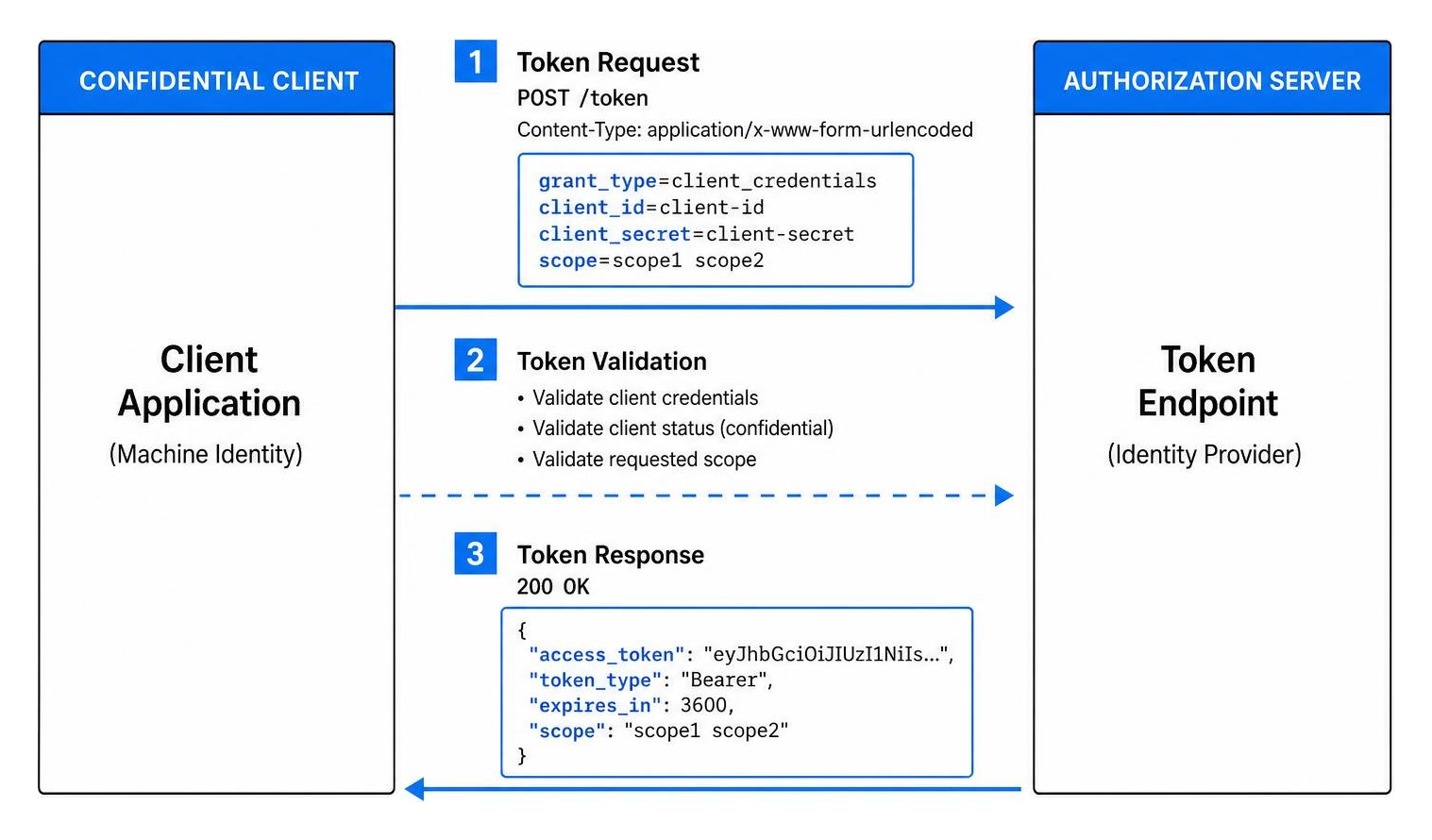
Anatomy of an OAuth Client Credential Flow Request
The client initiates the exchange by sending an HTTP POST request formatted as application/x-www-form-urlencoded. Sending credentials as a JSON payload or via HTTP GET queries violates the standard and can lead to sensitive tokens leaking into intermediate proxy access logs.
A standard token request contains the following parameters:
grant_type: Must be set explicitly toclient_credentials.client_id: The unique public identifier assigned to the application registration.client_secret: The confidential shared secret (when using secret-based authentication).scope: The requested permission boundary. Depending on the identity platform, this may be a space-separated list of scopes or a resource identifier (such as the/.defaultsyntax used in Microsoft environments).
Upon successful validation, the authorization server returns an HTTP 200 OK response containing a JSON payload:
Modern software libraries, such as the standard Go implementation found in clientcredentials/clientcredentials.go at 696f7b31 · golang/oauth2, encapsulate this wire protocol into reusable HTTP client wrappers that handle serialization, payload parsing, and automated token attachment transparently.
Shared Secrets vs. Private Key JWT and Workload Identity Federation
While shared secrets are straightforward to configure during initial development, enterprise production environments increasingly favor asymmetric and federated credentials to mitigate secret sprawl. Exploring Understanding Cryptographic Authentication Methods and Best Practices provides deeper insight into establishing robust key hierarchies.
As documented in the v2-oauth2-client-creds-grant-flow reference, private key assertions replace the static client_secret parameter with client_assertion_type=urn:ietf:params:oauth:client-assertion-type:jwt-bearer and a cryptographically signed client_assertion. This ensures that even if an attacker intercepts a single request, they cannot forge subsequent requests without access to the underlying private key.
Authorization Architectures and Access Governance
Authenticating a machine identity is only the initial step; the resource server hosting the protected API must enforce strict authorization boundaries. The distinction between establishing identity and evaluating access privileges is detailed in Identification Authentication and Authorization in Cybersecurity.
Application Roles vs. Direct Access Control Lists (ACLs)
Resource servers typically evaluate authorization for machine clients through one of two architectural patterns:
- Application Roles (App Roles / Role Claims): The authorization server centrally manages permissions. When an administrator assigns a role (e.g.,
Reports.ReadWrite.All) to a client, the identity provider injects that assignment directly into therolesclaim of the resulting JSON Web Token (JWT). The resource server inspects the claims array within the validated token to authorize specific API endpoints. - Resource-Level Access Control Lists (ACLs): The resource server maintains an internal allowlist of permitted client identifiers. The identity provider issues a baseline token containing the client's public identifier (
client_idorappidclaim) and issuer (issclaim). The target API inspects these claims against its internal database or configuration file to determine access rights, as illustrated in the Client Credentials Grant Type implementation guide.
Scope Governance and Administrative Consent Workflows
In delegated user flows, end-users consent to permissions on the fly. In client credential flows, granting machine permissions often exposes broad, tenant-wide data. Consequently, directory administrator consent is mandatory before an application can acquire tokens containing high-privilege application permissions.
According to platform implementation documentation like docs/identity-platform/v2-oauth2-client-creds-grant-flow.md, requesting scopes in enterprise environments often requires declaring static permissions during registration and utilizing the target resource's default scope parameter (.default). Directory administrators then review and approve the requested permissions through dedicated admin consent workflows or infrastructure-as-code deployment pipelines, preventing unprivileged developers from granting arbitrary access to automated daemons.
Token Lifecycle Management and Operational Resilience
Effective client design requires robust token lifecycle management. Failing to implement caching or improperly handling transient network failures can degrade service performance and trigger identity provider rate limits.
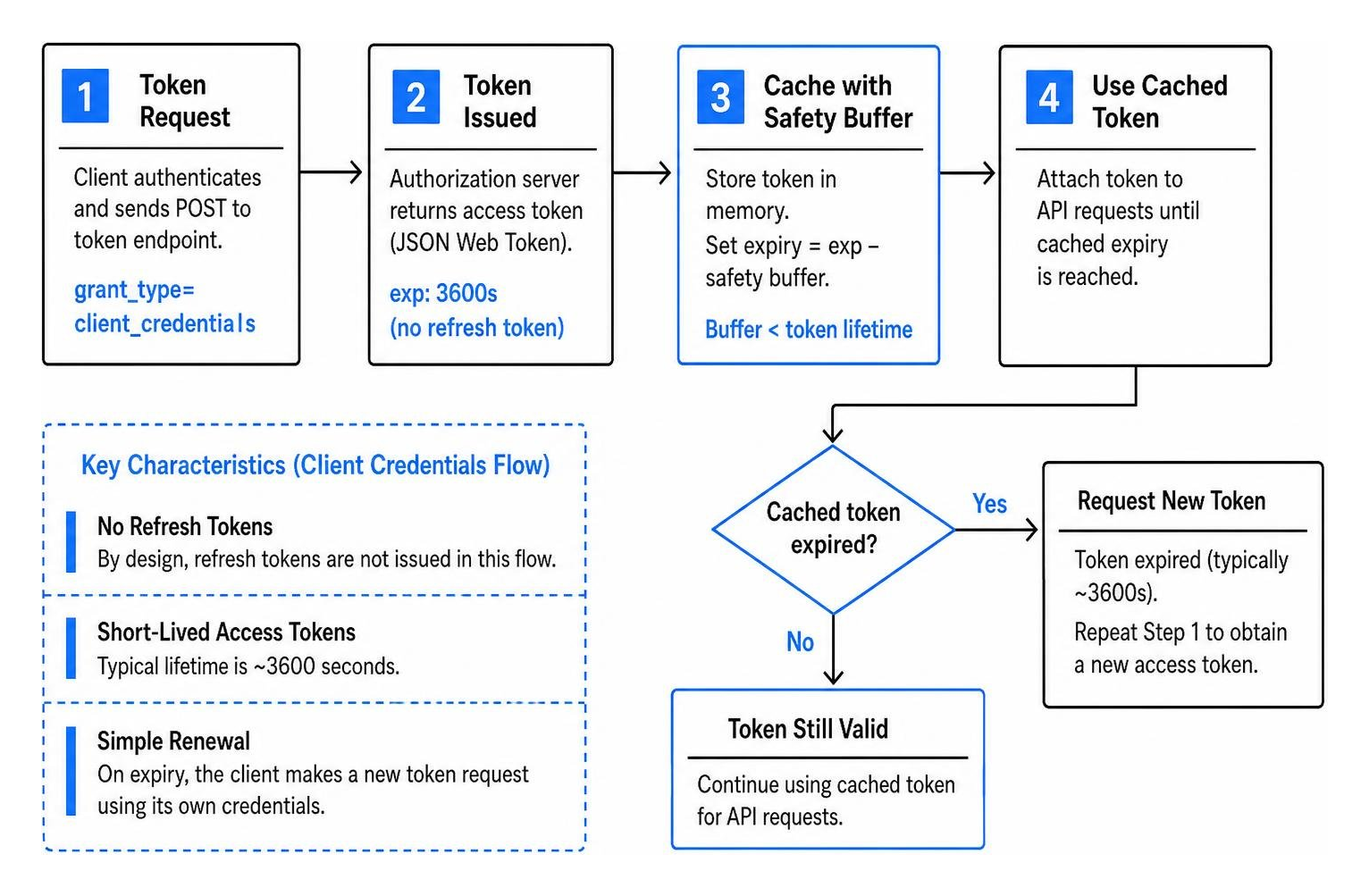
Handling Token Expiration Without Refresh Tokens
A foundational characteristic of the client credentials grant under RFC 6749 is the deliberate absence of refresh tokens. Because the confidential client maintains custody of its own credentials (whether a shared secret, certificate, or workload trust relationship), issuing a refresh token introduces unnecessary architectural overhead and an extra credential attack surface.
When an access token expires (typically after 3,599 to 3,600 seconds), the client application simply executes a new HTTP POST request directly against the token endpoint. Attempting to request or process a refresh token in this flow violates standard specifications and will result in protocol errors.
In-Memory Caching and Concurrency Strategies
Making an HTTP call to the token endpoint before every single API request introduces significant latency and will quickly exceed identity provider rate limits—such as standard multi-tenant thresholds of 1,000 requests per minute. Applications must cache access tokens in memory and implement resilient renewal routines:
- Enforce Thread-Safe In-Memory Caching: Store access tokens in an in-memory cache protected by double-checked locking mechanisms or concurrent primitives to prevent race conditions during high-throughput parallel execution.
- Implement Safety Expiration Buffers: Calculate the local cache expiration time by subtracting a safety margin (e.g.,
expires_in - 60 seconds) from the total lifetime. This ensures background workers do not initiate an API call with a token that expires mid-transit. - Handle 401 Unauthorized Responses Dynamically: If a resource server rejects a cached token due to mid-session key rotation or clock skew, invalidate the local cache immediately, fetch a fresh access token from the token endpoint, and retry the downstream request once.
- Adopt Exponential Backoff and Retries: When token endpoint requests encounter transient network timeouts or HTTP 429 (Too Many Requests) responses, execute retries with randomized exponential backoff intervals (e.g., 1s, 2s, 4s).
- Execute Zero-Downtime Secret Rotation: When utilizing shared secrets, provision dual concurrent secrets within the identity provider. Update client infrastructure to consume the secondary secret before decommissioning the deprecated primary credential.
Enterprise Security Hardening and Threat Mitigation
Securing machine-to-machine integrations requires shifting beyond basic network perimeter defenses toward rigorous Zero Trust Authentication Securing Access in a Borderless World architectures.
Security Vulnerabilities in the OAuth Client Credential Flow
Machine identities frequently present wider attack surfaces than human accounts because they lack multi-factor authentication (MFA) challenges and often run with elevated, 24/7 permissions. Key vulnerabilities include:
- Hardcoded Credentials in Version Control: Embedding client IDs and secrets in configuration files or code repositories exposes credentials to unauthorized internal personnel and automated external scraping bots.
- Deployment in Public Client Environments: Distributing client credentials inside native desktop applications, mobile apps, or frontend web scripts allows adversaries to extract secrets via simple reverse engineering or browser debugging tools.
- Over-Permissioned Application Scopes: Granting global write permissions to a service that only requires read access to a specific sub-resource exponentially increases the blast radius if the credential is leaked.
- Bearer Token Interception: Unconstrained bearer tokens can be used by any party that intercepts them. Implementing Mutual TLS (mTLS) profile for OAuth 2.0 (RFC 8705) binds access tokens directly to the client's TLS certificate, rendering stolen tokens unusable on unauthorized connections.
Detecting Client ID Spoofing and Credential Spraying
Threat intelligence published by CISA and major cloud security providers has highlighted continuous threat actor campaigns targeting automated OAuth endpoints. In typical non-human identity credential spraying operations, attackers execute high-volume automated requests against token endpoints to validate harvested enterprise credentials.
In platforms like Microsoft Entra ID, error code AADSTS700016 indicates that the requested application (client) ID was not found in the tenant. Threat actors mutate client IDs across thousands of permutations to evade volume-based rate limiting on a single application ID. Security Operations Centers (SOCs) must track client ID cardinality rather than static request counts alone, allowing detection engineers to uncover coordinated credential validation campaigns before unauthorized data access occurs.
Frequently Asked Questions about Client Credentials
Why are refresh tokens not issued in the Client Credentials flow?
Under RFC 6749, refresh tokens are designed to allow clients to maintain access without repeatedly prompting an interactive end-user for credentials. Because a confidential machine client already possesses its own authentication credentials (such as a private key or client secret), it can authenticate directly against the token endpoint at any time. Issuing refresh tokens would introduce redundant credential storage requirements without providing any security benefit.
Can single-page applications or mobile apps use the Client Credentials grant?
No. The client credentials grant requires a confidential client capable of strictly safeguarding credentials. Browser-based single-page applications, mobile apps, and distributed IoT firmware are public clients; their source code and runtime environments can be inspected by end-users and attackers. Public applications must use interactive authorization flows, such as Authorization Code with PKCE.
How does workload identity federation replace static client secrets?
Workload identity federation leverages asymmetric OpenID Connect (OIDC) trust relationships between platforms. An application running in an external compute environment (such as a Kubernetes pod or external cloud instance) obtains an ephemeral, signed identity token from its local platform. The application presents this external token to the target identity provider as a client assertion. The authorization server validates the external signature and exchanges it for a native access token, completely eliminating the need to generate, store, or rotate static client secrets.
Conclusion
Managing modern enterprise infrastructure requires treating machine identities with the same architectural rigor applied to human users. The OAuth client credential flow provides a standardized, robust framework for securing server-to-server communication, provided organizations implement least-privilege permissions, transition away from static shared secrets toward cryptographic assertions, and enforce disciplined token caching.
As organizations modernize their identity fabrics, platforms like Unlocked—backed by EveryKey's cybersecurity research—deliver the technical intelligence and operational guides required to navigate evolving zero-trust requirements. For a broader overview of access frameworks and protocol architectures, explore the Essential Guide to Auth Protocols Types and Security Best Practices to harden your enterprise authentication ecosystem.