

The Ultimate Guide to Finding Credible Cybersecurity Newsletters

Why You Need a Dedicated Cybersecurity Newsletter in 2026
To find credible cybersecurity newsletters, build a multi-tiered feed that separates real-time operational alerts, executive briefings, and domain-specific technical digests. Start with one daily vulnerability source for the SOC, one semi-weekly practitioner summary for security leadership, and one niche publication for your primary infrastructure. This structure filters raw disclosure volume into actionable triage without drowning teams in alert fatigue.
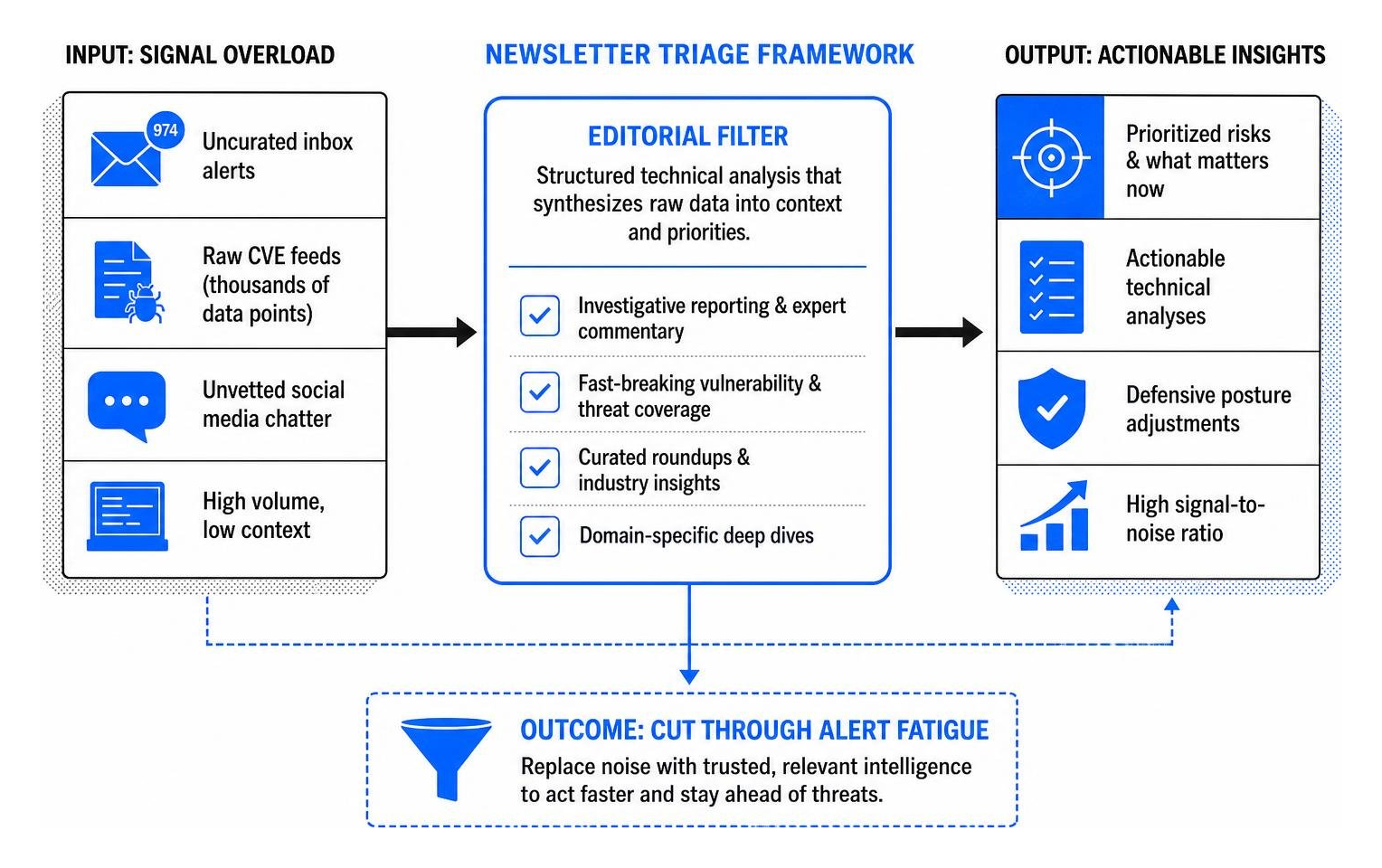
The volume and velocity of vulnerability disclosures have outpaced the capacity of uncurated inbox alerts. In September 2026, Microsoft addressed a historic batch of 974 security flaws in a single Patch Tuesday update—including 113 classified as critical. Relying purely on raw Common Vulnerabilities and Exposures (CVE) feeds leaves security operations center (SOC) teams buried under thousands of data points without actionable context.
Attackers are shrinking the window between disclosure and weaponization. Development workflows also face novel exposure points, including secrets leaking into code repositories. Navigating these risks requires preparing for emerging cybersecurity trends through sources that synthesize raw data into defensive posture adjustments.
A focused cybersecurity newsletter functions as an editorial filter. It replaces unvetted social media chatter and unprioritized vulnerability feeds with structured technical analyses, helping practitioners cut through alert fatigue to maintain a high signal-to-noise ratio. For broader context on how curated intelligence fits into a mature security program, the NIST Cybersecurity Framework provides a useful reference model for aligning detection, response, and recovery activities.
Top General and Investigative Cybersecurity Publications
Balancing high-level strategic awareness with tactical threat hunting requires understanding how leading publications approach coverage. Different publications serve distinct operational tiers:
| Publication | Primary Audience | Frequency | Depth & Primary Focus | Pros | Cons |
|---|---|---|---|---|---|
| Krebs on Security | Security Leaders, Investigators, Fraud Analysts | Irregular / Event-Driven | Deep-dive investigative journalism; threat actor tracking, data broker litigation, cybercrime rings | Unmatched investigative depth; uncovers root infrastructure and legal filings | Not a daily operational patch feed; irregular cadence |
| SANS NewsBites | CISOs, Security Managers, Enterprise IT | Semi-Weekly | Executive summaries of major news paired with subject-matter expert commentary | Highly authoritative practitioner context; concise executive format | High-level focus; lacks raw packet-level or low-level exploit walkthroughs |
| The Hacker News | SOC Analysts, DevSecOps, Sysadmins | Daily / Real-Time Feed | Fast-breaking vulnerability announcements, campaigns, exploit chains | Rapid coverage of active exploitation and malware releases | High volume can induce cognitive fatigue; varying technical depth across articles |
| This Week in Security | General Practitioners, IT Staff | Weekly | Curated roundup of major headlines, missed stories, and industry culture | Highly scannable; excellent balance of serious security and accessible commentary | Weekly cadence means zero-day operational alerts may arrive late |
Investigative Deep Dives and Executive Briefings
For security executives and digital forensics professionals, understanding the business and regulatory ecosystem behind an attack is as vital as the exploit payload itself. Krebs on Security specializes in investigative exposés, dissecting complex threat networks such as the Nexus dark-web market (which indexed over 153 million driver's license records) and tracking high-stakes data broker litigation under privacy frameworks like New Jersey's Daniel's Law. Brian Krebs’ reporting focuses on attribution, unmasking threat actors, and mapping illicit financial networks back to operational command-and-control infrastructure.
For enterprise decision-makers needing concise oversight, SANS NewsBites provides a semi-weekly executive summary. Its defining feature is the inclusion of practitioner-led commentary following each news item, translating abstract vulnerability reports into specific governance, risk, and compliance priorities. Each entry features direct analysis from industry veterans, giving CISOs actionable perspectives on board reporting and compliance postures under evolving frameworks like NIS2 and SEC cyber disclosure rules.
Fast-Paced Aggregators and Community Digests
When tactical speed is required to triage zero-day attacks and widespread campaigns, aggregators deliver rapid-response awareness. The Hacker News offers continuous reporting on emerging exploit vectors—such as the recent ClickFix social engineering framework, which bypasses conventional email gateways by tricking users into pasting malicious scripts directly into local terminal prompts. It provides the initial breadcrumbs that incident response teams need to start threat hunting across endpoint telemetry.
For a digestible weekly overview, This Week in Security—curated by journalist Zack Whittaker—delivers an accessible digest covering both mainstream disclosures and overlooked edge cases. Whittaker aggregates critical policy decisions, patch updates, and security research into scannable summaries that don't overwhelm engineers. Leveraging these publications alongside actionable defense strategies for security pros ensures technical teams patch critical infrastructure before proof-of-concept exploits circulate widely.
Specialized Technical Publications for Complex Threat Vectors
Broad industry roundups frequently miss domain-specific operational challenges. Modern enterprise defense requires incorporating niche publications focused on distinct attack surfaces.
Finding a Niche Domain-Specific Cybersecurity Newsletter
Specialized operational environments—such as cloud platforms or industrial control systems (ICS)—operate under distinct constraints where standard IT remediation workflows do not apply.
- Operational Technology & Critical Infrastructure: Look to Look to specialist OT newslettersspecialist OT newsletters for coverage of ICS/SCADA and operational technology (OT). for coverage of ICS/SCADA and operational technology (OT). Standard IT advisories often fail to address the reality of air-gapped or legacy programmable logic controllers (PLCs), so look for coverage that maps threat actor tactics to the MITRE ATT&CK for ICS framework and offers compensating controls when immediate patching is impossible.
- Cloud & Infrastructure-as-Code (IaC): Dedicated publications track threats targeting modern deployment pipelines, such as malicious Terraform modules distributed through registry poisoning or compromised dependencies in containerized ecosystems. These digests explain how misconfigured IAM roles and insecure Kubernetes manifests create privilege escalation paths across AWS, Azure, and GCP environments.
Defenders tracking these specialized vectors benefit from continuously tracking breaking cybersecurity news within their vertical.
Selecting an AI-Driven Cybersecurity Newsletter vs. Human Curation
The rise of automated threat intelligence has introduced platforms like CyberBrief, which deploy multi-agent LLM pipelines to scrape, deduplicate, and summarize security feeds 24/7. These systems monitor GitHub commits, NVD updates, and dark web forums simultaneously to flag newly surfaced vulnerabilities in near real time.
While AI aggregators process vast amounts of vulnerability data rapidly, human-curated publications—such as Chris Hughes' Resilient Cyber—provide qualitative analysis that models cannot replicate. Human curators evaluate the business risk of an exploit, account for historical vendor behavior, and filter out speculative vulnerability claims. A balanced security program uses automated feeds for initial telemetry ingestion and human-edited newsletters for strategic posture evaluation.
How to Evaluate Credibility, Timeliness, and Vendor Bias
Not all security briefings maintain high editorial standards. Distinguishing dependable intelligence from vendor-driven marketing requires a systematic verification process:

- Verify Primary Source Citations: Credible publications link directly to Common Vulnerabilities and Exposures (CVE) entries, National Vulnerability Database (NVD) records, or official vendor advisories. Be skeptical of outlets reporting "critical zero-days" without reproducible details or CVE IDs.
- Cross-Reference Against CISA KEV: Check whether reported vulnerabilities appear in the Cybersecurity and Infrastructure Security Agency (CISA) Known Exploited Vulnerabilities catalog. Publications that distinguish between theoretical vulnerabilities and active exploitation deliver far higher defensive utility.
- Assess Vendor Neutrality: Many commercial security blogs structure news summaries around product pitches. Look for independent editorial teams that evaluate vulnerabilities objectively rather than positioning a specific proprietary platform as the sole remediation tool.
- Evaluate Exploit Reproducibility: Technical reporting should accurately reflect CVSS v3/v4 metrics and specify real attack pre-requisites (e.g., authentication requirements, local network adjacency) rather than relying on hyperbole.
- Review Historical Incident Tracking: High-quality publications maintain transparent post-mortems. Cross-referencing threat reporting against structured analyses, such as Unlocked's monthly breach analysis, helps benchmark how accurately an outlet assesses complex attack chains over time.
Where credential theft, hardware token vulnerabilities, or passwordless access flaws are reported, Unlocked, Everykey's blog, covers these topics. EveryKey is a small wireless key that locks your computer when you walk away and unlocks it when you return, and it works alongside the tools you already use. For additional background on vulnerability scoring and prioritization, the Common Vulnerability Scoring System documentation explains how base, temporal, and environmental metrics inform triage decisions.
Frequently Asked Questions About Cybersecurity Newsletters
What is the most trusted cybersecurity newsletter for enterprise CISOs?
For executive leadership, SANS NewsBites remains a gold standard due to its semi-weekly cadence, concise executive summaries, and subject-matter expert commentary. Cybersecurity Dive is also widely read by executive teams for its focus on regulatory shifts, cyber insurance developments, and compliance requirements.
How can organizations avoid information overload from security feeds?
Establish a multi-tier subscription framework:
- Tier 1 (SOC/Engineering): 1–2 real-time vulnerability feeds or daily digests (e.g., The Hacker News).
- Tier 2 (IT Management): 1 semi-weekly practitioner summary with strategic context (e.g., SANS NewsBites).
- Tier 3 (Domain Specialists): 1 niche weekly briefing tailored to your architecture (e.g., an OT-focused or cloud-specific digest).
Are automated AI threat intelligence newsletters reliable for zero-day tracking?
Automated AI newsletters excel at gathering disparate data points across disparate forums, but they can occasionally misinterpret proof-of-concept code or inflate severity ratings. Use AI feeds for early telemetry, but confirm technical details against primary vendor advisories or human-curated newsletters before executing configuration changes.
Conclusion
Building a resilient defensive posture requires curating intelligence sources that deliver actionable clarity rather than unverified noise. As demonstrated by the recent surge in automated supply-chain exploits, critical infrastructure targeting, and massive vulnerability batches like the September 2026 Patch Tuesday disclosures, security teams need disciplined intelligence filtering to stay ahead of active adversaries.
By pairing daily operational alerts with investigative journalism and niche domain reporting, IT and security leaders can make informed patch management decisions and protect core infrastructure. For continued analysis of enterprise architecture, threat intelligence frameworks, and identity governance, explore Unlocked's comprehensive digital protection and security strategies to keep your organization resilient against modern threat vectors.