Backing Up Your Biology: Biometric Authentication Disaster Recovery Best Practices
What happens to biometric access when sensors, databases, or power fail in a crisis. Practical guidance on fallback authentication, template escrow, multimodal failover, and recovery targets.

When Your Biology Becomes a Single Point of Failure
Biometric authentication disaster recovery is the practice of maintaining secure, verified access to critical systems when the biometric infrastructure you depend on — sensors, databases, matching engines — is damaged, offline, or compromised during a crisis.
Here's what a solid biometric DR plan covers:
- Backup authentication methods — FIDO2 hardware tokens, PINs, or break-glass accounts that activate when biometric sensors fail
- Biometric data escrow — encrypted, offsite copies of biometric templates that can be restored after a system failure
- Environmental fallback protocols — procedures for when lighting, debris, power loss, or physical damage make sensors unusable
- Multi-modal redundancy — using more than one biometric modality (e.g., fingerprint and facial recognition) so one failure doesn't lock everyone out
- Clear RPO/RTO targets — defined Recovery Point and Recovery Time Objectives specifically for identity and access management systems
Most disaster recovery planning treats authentication as an afterthought. Restore the servers first, worry about who can log in later. That gap is dangerous when biometrics are involved.
Here's why: a forgotten password can be reset in seconds. A compromised fingerprint cannot be reset at all. The 2015 OPM breach exposed the fingerprint records of over 5.6 million US federal employees — those individuals have no recourse, ever. Their biometric credential is permanently burned across every system that uses it.
Now add a disaster scenario on top of that. Power is out. Sensors are physically damaged. Your backup database hasn't replicated in 18 hours. Staff are evacuating a building. Emergency responders need access to patient records, transaction systems, or classified infrastructure — right now.
That's the real problem with biometric authentication disaster recovery. It sits at the intersection of two already-hard problems — biometric security and disaster recovery planning — and inherits the worst complications of both. The stakes are high in calm conditions. In a crisis, they're critical.
This guide walks through every layer of the challenge: architectural vulnerabilities, environmental threats, security risks that spike when systems fail, and the specific protocols that keep identity continuity intact when everything else is falling apart.
The Vulnerability of Biological Credentials in Crisis Scenarios
Biometric authentication relies on two categories of human traits: physiological biometrics (static physical characteristics like fingerprints, irises, and facial geometry) and behavioral biometrics (actions like voice patterns, gait, and keystroke dynamics). Under blue-sky conditions, these traits are highly stable. In a crisis, however, the human body changes.
Biological degradation is a major point of failure during emergencies. First responders and disaster victims are often subjected to intense physical labor, exposure to debris, and extreme stress.
Physical labor can physically wear down or abrade fingerprint ridges, rendering standard capacitive or optical scanners useless. Facial structures can be altered by swelling, cuts, bandages, or even extreme exhaustion.
Similarly, behavioral biometrics suffer heavily under stress. A user's voice cadence and pitch change dramatically during a crisis, or they may have a cold or respiratory irritation from dust, causing voice recognition algorithms to fail.
Even aging and long-term physical changes mean that a backup template captured years ago may no longer match the user today.

Why Traditional Fallbacks Fail During Emergencies
When a primary biometric system fails, many legacy setups default to traditional fallbacks like Knowledge-Based Authentication (KBA) or email-based password resets. In a disaster, this creates a massive security hole.
KBA questions (e.g., "What was the name of your first pet?") rely on static data that has likely already been leaked in data breaches or scraped from social media. During emergencies, attackers capitalize on the chaos to launch credential stuffing and social engineering campaigns.
Moreover, relying on email-based password resets assumes that communication infrastructure is fully functional and that the user has immediate access to their secondary devices.
In reality, disasters break communication lines, creating the great recovery gap why account recovery is the weakest link in security. If your fallback mechanism is weaker than your primary biometric block, attackers will simply target the recovery path to gain unauthorized access.
The Permanent Risk of Compromised Biometric Templates
The fundamental rule of password security is simple: if a password is leaked, you change it. If your biometric data is leaked, you are out of options. You cannot rotate your face, and when they steal a fingerprint you cant reset it.
This permanence makes the secure storage of biometric templates a critical priority. If a disaster recovery site is breached and raw biometric templates are stolen, those credentials are permanently compromised for the victims' lifetimes, leading to a massive biometrics backlash what happens when your face leaks.
To prevent this, modern systems must employ Biometric Template Protection (BTP). BTP ensures that stored biometric data is irreversible (meaning the original image cannot be reconstructed from the template) and unlinkable (meaning templates generated from the same biometric trait across different databases cannot be matched to track the user).
Without robust BTP, a disaster recovery database becomes a high-value target for threat actors looking to harvest lifetime credentials.
Architectural Challenges of Biometric Authentication Disaster Recovery
Implementing biometric authentication disaster recovery requires addressing severe architectural hurdles. Unlike flat text files containing password hashes, biometric databases are computationally heavy, highly sensitive, and require complex matching engines to function.
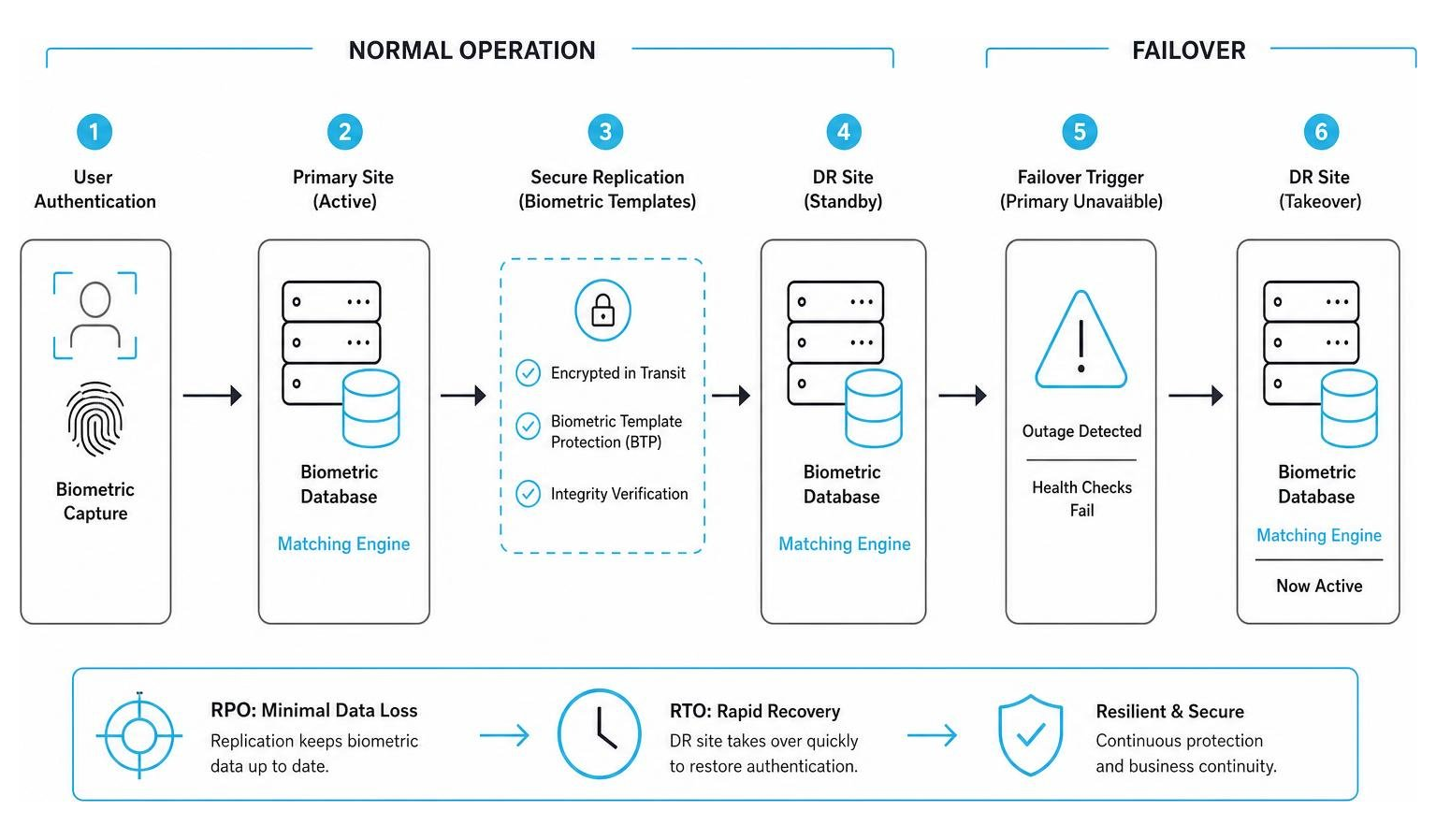
When designing a disaster recovery architecture, organizations must define two key metrics:
- Recovery Point Objective (RPO): The maximum acceptable age of data that can be restored from backup storage when a system failure occurs. For biometric systems, a high RPO means users enrolled right before the crisis will be missing from the backup database, locking them out.
- Recovery Time Objective (RTO): The maximum acceptable duration of downtime before the identity system is restored. In critical environments, the RTO for identity verification must be near-zero.
According to the comprehensive industry whitepaper Identity in Crisis, a critical best practice is isolating your Disaster Recovery Center (DRC) from the primary site.
This prevents localized physical disasters (like floods or power grid failures) from knocking out both systems simultaneously.
Furthermore, the whitepaper emphasizes that system-to-system data transfer must be automated and continuous. Relying on physical media transport (like backup tapes or portable drives) during a crisis introduces massive risks of physical loss, theft, and unacceptable delays.
Environmental and Hardware Degradation in Disaster Zones
In a physical disaster zone, the environment is hostile to sensitive electronics. Biometric sensors are highly sensitive to external conditions:
- Fingerprint Scanners: Dirt, grease, moisture, and debris quickly coat the scanner glass, blocking the sensor. Without regular sensor cleaning using soft, non-chemical microfiber cloths, false rejection rates skyrocket.
- Facial Recognition Cameras: Smoke, dust, poor lighting, or extreme backlighting from fires or emergency flares disrupt the camera's ability to map facial geometry.
- Iris Scanners: Iris recognition requires near-infrared illumination to map complex patterns. Debris in the air or severe physical trauma to the eye can prevent successful reads, though iris scanner technology explained how iris recognition systems improve identity verification shows that iris patterns remain one of the most stable identifiers if the physical hardware is kept clean.
When power outages occur, local biometric terminals lose connection to central verification servers, forcing them to either fail-open (a massive security risk) or fail-closed (blocking emergency operations).
Database Replication and Synchronization Hurdles
To maintain identity continuity, the Automated Biometric Identification System (ABIS) must remain synchronized across all locations. This presents a major synchronization challenge.
Active-passive replication is easier to manage but introduces a delay, meaning the standby database may not have the most recent enrollments when a failover is triggered. Active-active replication provides real-time synchronization but requires massive, low-latency bandwidth, which is often the first thing to degrade during a disaster.
For cloud-hosted biometrics, the challenge is even greater. If the local facility loses internet connectivity, it cannot reach the cloud matching engine.
To mitigate this, organizations must implement essential strategies for managing identity and access management risks, which include deploying localized, lightweight edge-matching containers that can perform cached offline verifications until cloud connectivity is restored.
Designing a Resilient Biometric Disaster Recovery Protocol
A resilient biometric disaster recovery plan must balance security, usability, and speed. When the primary biometric system fails, a clear, pre-defined protocol must dictate how users are authenticated without introducing vulnerabilities.
| Backup Method | Security Level | Usability / Speed | Key DR Consideration |
|---|---|---|---|
| FIDO2 Hardware Tokens | Extremely High (Phishing-Resistant) | High (Requires physical possession) | Must be pre-provisioned and distributed before the crisis. |
| Passkeys (WebAuthn) | High | Very High (On-device biometrics) | Relies on user-owned device availability and cloud sync. |
| Emergency PINs / Patterns | Medium | High | Vulnerable to shoulder surfing and social engineering. |
| Break-Glass Accounts | High (Strictly Audited) | Low (Requires multi-party authorization) | Should only be used for system administrators to restore access. |
To implement these methods effectively, organizations should consult the best authentication methods of 2026 mfa biometrics passkeys more to design a layered multi-factor authentication (MFA) framework that prevents single points of failure.
Establishing a Secure Biometric Template Escrow
A critical component of physical and digital business continuity is a biometric data escrow. This is a highly secure, offsite repository where encrypted biometric templates are stored independently of the primary identity provider.
The escrow system should utilize split-key cryptography, requiring authorization from both the identity owner (or local authority) and the escrow agent to decrypt and restore templates. This ensures that even if the primary database is destroyed, the templates can be safely retrieved and rebuilt without exposing raw data to a single compromised party.
Multi-Modal Biometrics and Cross-Platform Failovers
Relying on a single biometric modality (like fingerprints) is an operational hazard. If a worker injures their hand, they are entirely locked out.
A resilient architecture utilizes multi-modal biometrics, combining fingerprints, facial recognition, and iris scans. If one sensor fail, the system dynamically shifts to another.
Furthermore, during a crisis, dedicated physical scanners may be destroyed. Organizations must plan for cross-platform failovers, allowing mobile biometric enrollment and verification on consumer smartphones.
According to recent research on Securing Face and Fingerprint Templates in Humanitarian Biometric Systems, deploying lightweight, modality-independent protection schemes like PolyProtect combined with EdgeFace allows secure, on-device biometric processing.
This setup secures vulnerable templates on mobile devices even in offline, resource-constrained environments, ensuring that field-deployed smartphones can act as secure authentication terminals.
Security Risks Amplified by Biometric System Failures
When biometric systems fail or degrade during a crisis, the temptation to lower security thresholds is immense. This creates a dangerous window of vulnerability.
In biometric systems, there is an inherent trade-off between the False Acceptance Rate (FAR) — the probability that the system incorrectly authorizes an impostor — and the False Rejection Rate (FRR) — the probability that the system rejects a legitimate user.
During a disaster, high FRR caused by dirty sensors or stressed users leads to operational paralysis. If administrators respond by making matching thresholds more lenient to speed up access, they drastically increase the FAR, opening the door to unauthorized intruders.
This is why a zero trust security building a stronger future with zero trust architecture is non-negotiable.
Even if a biometric check succeeds or fails-over, the system must continuously verify the user's context (device posture, IP address, behavioral patterns) before granting access to critical assets.
Spoofing, Deepfakes, and Presentation Attacks in High-Stress Environments
During a crisis, physical security is often compromised, making systems highly vulnerable to presentation attacks (spoofing). Attackers can use high-resolution photos, 3D masks, or silicone fingerprints left on physical surfaces to bypass degraded scanners.
The threat is amplified by the rise of generative AI. Attackers can deploy digital doppelgangers and deepfake audio to bypass voice recognition portals.
As detailed in your voice is not a password the deepfake assault on biometrics, sophisticated deepfake bypass tools can compromise voice authentication systems with alarming success rates.
To combat this, disaster-resilient biometric systems must enforce hardware-backed liveness detection (such as 3D depth sensing and skin-temperature verification) to ensure the biometric sample is genuine and presented in real time.
The Great Recovery Gap: Account Takeover Vulnerabilities
A major security gap during corporate and municipal disasters involves "unregistered accounts." These are accounts belonging to legitimate users who have not yet enrolled their biometric profiles or set up multi-factor authentication.
When disaster strikes and IT support is overwhelmed, attackers exploit this gap. Using leaked personal data, they register these accounts, set up their own biometric profiles, and complete an account takeover.
This highlights the critical importance of secure identity proofing during disaster recovery, ensuring that any emergency registration is bound to a verified, government-issued ID rather than weak knowledge-based questions.
Failing to secure this path is one of the most prominent identity and access management risks the top security threats defining 2026.
Industry-Specific Best Practices for Biometric Disaster Recovery
Every industry faces unique regulatory and operational hurdles when planning biometric disaster recovery. Organizations must align their DR plans with strict compliance frameworks, including the European Union's General Data Protection Regulation (GDPR), the Health Insurance Portability and Accountability Act (HIPAA), and the Illinois Biometric Information Privacy Act (BIPA).
These regulations mandate strict data minimization, explicit user consent, and immediate notification in the event of a biometric data breach. For a complete blueprint on managing these requirements, security leaders should refer to the complete guide to id verification in the digital age.
Healthcare: Securing Patient Records and Medication Dispensing
In healthcare, patient misidentification during a disaster can be fatal. If a hospital's primary database goes offline during an evacuation, clinicians must still access electronic health records (EHR) and secure automated medication dispensing cabinets.
To maintain security and speed without risking cross-contamination or sensor failure, many modern healthcare facilities deploy vein recognition technology.
While more expensive than standard fingerprint scanners, vein scanners map the unique vascular patterns under the skin, which are unaffected by surface cuts, dirt, or moisture.
By deploying these scanners on shared clinical workstations and backing them up with localized, offline database caches, hospitals ensure continuous, secure access to patient data even when primary network connections are severed.
For more on how these systems integrate, see biometrics for authentication how biometric systems are transforming secure identity verification.
Finance and Government: Maintaining Identity Continuity and Preventing Fraud
Governments and financial institutions must maintain operations during national emergencies to prevent economic collapse and distribute critical aid.
During major crises, such as the aftermath of severe weather events, federal agencies utilize mobile biometric enrollment stations.
For example, as documented in Parsons’ Identity Solutions Help During Hurricane Helene, self-contained, ruggedized biometric "jump kits" can be deployed directly to disaster zones.
These kits allow responders to collect fingerprints, iris scans, and facial photos in the field, facilitating rapid disaster victim identification (DVI) and securing restricted supply zones without relying on local power grids or internet infrastructure.
By using secure, time-bounded cryptographic tokens, forensic and emergency teams can securely read passport chips in the field to verify identities, bypassing the need to access centralized government databases during the initial hours of an emergency response.
Frequently Asked Questions about Biometric Authentication Disaster Recovery
What is biometric authentication disaster recovery and why is it critical?
It is the strategic planning, architectural design, and operational protocols required to maintain secure, continuous identity verification when primary biometric authentication systems fail during a crisis.
It is critical because, unlike traditional passwords, biometric credentials cannot be reset if compromised.
A failure in biometric DR can lead to complete operational lockout or force systems to fail-open, creating massive security vulnerabilities.
Understanding the distinction between these phases is fundamental to identification authentication and authorization in cybersecurity.
What happens when biometric sensors are physically destroyed?
When physical infrastructure is destroyed, organizations must shift to decentralized verification models.
This involves utilizing the built-in biometric sensors of consumer smartphones (such as Apple's Touch ID/Face ID or Android equivalents) as edge-matching terminals.
By pushing cryptographically protected, hashed templates to user devices, organizations can verify identities locally without relying on centralized physical readers.
This approach aligns with the international standards currently being developed under ISO/IEC TS 21421, a technical specification still in draft that will guide the use of biometrics for identity management in major incident response.
What are the best backup methods for biometric authentication failures?
The gold standard for biometric backup is passwordless, phishing-resistant FIDO2 passkeys and physical hardware security tokens.
These methods rely on public-key cryptography, ensuring that even if an attacker intercepts the backup authentication flow, they cannot steal credentials.
Unlike legacy knowledge-based questions or SMS codes, passkeys maintain the highest level of security while offering a seamless user experience during high-stress scenarios.
To learn how to transition your organization to these resilient methods, read the future of authentication embracing passkeys.
Building a Resilient Identity Future
The ultimate goal of disaster recovery is resilience — the ability to withstand a catastrophic event and resume secure operations with minimal friction.
As biometrics continue to replace vulnerable passwords, security leaders must recognize that biological credentials require a completely different class of disaster recovery planning.
You cannot treat a fingerprint like a string of text, and you cannot afford to let your identity infrastructure become a single point of failure when a crisis hits.
For security teams looking to build a resilient, future-proof authentication architecture, the path forward requires a layered, zero-trust approach.
By combining multi-modal biometrics, secure data escrows, and robust FIDO2-backed fallbacks, you can ensure that your organization remains secure, compliant, and operational through any storm.
Explore more in-depth technical guides and industry insights on biometrics for authentication how biometric systems are transforming secure identity verification, and partner with Unlocked to secure your identity landscape against the unexpected.