

Understanding Credential Stuffing: Risks and Effective Prevention Tips
Credential stuffing explained — how bot-driven login attacks exploit reused passwords, and the MFA and detection strategies organizations use to stop them.


Credential stuffing is a type of cyberattack in which a cybercriminal uses stolen usernames and passwords from one organization to access user accounts at another organization. Credential stuffing has become one of the most widespread threats to modern authentication systems. This guide explains what credential stuffing is, how these attacks work, their impact on organizations and individuals, and the most effective prevention strategies. It is intended for IT professionals, security teams, and anyone concerned about online account security. Understanding credential stuffing is crucial because these attacks exploit common user behaviors and weaknesses in authentication systems, leading to significant financial, operational, and reputational damage.
Summary: What Is Credential Stuffing, How Does It Work, and How Can You Prevent It?
Credential stuffing is an automated cyberattack and a type of bot attack where hackers use automated bots to continually attempt to access a website with stolen login credentials. In these attacks, cybercriminals use stolen usernames and passwords from one organization to access user accounts at another organization, taking advantage of password reuse and weak authentication practices. The most effective defense against credential-based attacks reportedly includes Multi-Factor Authentication (MFA), which can stop 99.9% of such attacks. The most effective defenses against credential stuffing attacks include implementing multi-factor authentication (MFA), enforcing strong password policies, and deploying bot detection tools. MFA is highly effective because it requires users to log in with another form of authentication in addition to a username-password combination, making it much harder for attackers to succeed.
However, it remains a significant challenge to stop credential stuffing attacks due to their automated and often patternless nature, making real-time bot management technologies essential for effective prevention.
Credential Stuffing
Credential stuffing is a type of cyberattack in which a cybercriminal uses stolen username and password combinations from one organization to access user accounts at another organization. Credential stuffing occurs when attackers attempt to log into a website using stolen login credentials obtained from previous breaches.

The attack relies on the fact that many users reuse the same password and username combinations across multiple services. When attackers obtain compromised login information, they can test the same usernames with multiple passwords across multiple sites to increase their chances of success.
Credential stuffing is considered a type of brute force cyberattack, but it differs in that it uses known credentials rather than attempting to guess passwords. These attacks can target multiple user accounts across different platforms, exploiting password reuse to gain unauthorized access.
Data breaches are a common source of credentials used in credential stuffing attacks, as attackers often acquire username/password pairs from these incidents. Credential stuffing is a lucrative activity for cybercriminals, as they can sell validated credentials on the dark web for profit. Credential stuffing attacks are one of the most common causes of data breaches because many people reuse the same password on multiple accounts.
With this foundational understanding, let’s explore how credential stuffing attacks are executed at scale.
Credential Stuffing Attacks
Credential stuffing attacks occur at scale and can target millions of accounts simultaneously.
The credential stuffing attack process involves acquiring combo lists of leaked credentials, automating tests against targets, and evading detection through IP rotation. Attackers often use botnets to distribute login attempts across thousands of different IP addresses, making it harder for security systems to detect and block the attacks.
Attackers use sophisticated bots and automated tools that simultaneously attempt login attempts across multiple services. These attacks can lead to account takeovers, where attackers gain unauthorized access to user accounts for malicious purposes.
Credential stuffing attacks can lead to account takeovers, which can result in financial theft, unauthorized purchases, and data breaches. The success rate of credential stuffing attacks is typically low, ranging from 0.1 percent to 2 percent, but the sheer volume of attempts can lead to significant breaches.
Approximately 16.5 percent of traffic on a login page is tied to credential stuffing attacks, which can significantly impact application performance. This bot traffic can be identified and mitigated using techniques like rate-limiting, blocking headless browsers, and filtering non-residential IP sources. These large scale attacks can overwhelm an organization’s IT infrastructure, leading to denial of service situations. The influx of traffic from credential stuffing attacks can lead to increased operational costs for businesses due to the need for enhanced security measures and infrastructure upgrades.
To better understand how credential stuffing compares to other attack types, let’s look at brute force attacks.
Brute Force Attacks
Credential stuffing is often compared with brute force attacks.
Traditional brute force attacks attempt to guess passwords by testing many password combinations until the correct one is found. A brute force attack focuses on guessing passwords for a single account using many password combinations.
Credential stuffing is considered a type of brute force cyberattack, but it differs in that it uses known credentials rather than attempting to guess passwords. Instead of guessing passwords, attackers test those same combinations across multiple accounts and unrelated services. Understanding credential stuffing vs brute force attacks helps security teams implement the right defensive controls.
Next, let's examine how multi-factor authentication can help defend against these attacks.
Multi Factor Authentication
Multi factor authentication is one of the most effective defenses against credential stuffing, and organizations should understand multi-factor authentication as a complete guide to enhanced security. Multi-Factor Authentication (MFA) is a highly effective way to prevent credential stuffing because it requires users to log in with another form of authentication in addition to a username-password combination, illustrating the benefits of multifactor authentication in modern security.
The most effective defense against credential-based attacks reportedly includes MFA, which can stop 99.9 percent of such attacks. When organizations require MFA, attackers cannot gain access to user accounts even if they possess valid usernames and passwords.
Additional authentication factors can include push notifications, biometric authentication, or hardware tokens, which are common options in two-factor verification for strengthening account security.
To further strengthen account security, organizations should consider additional authentication strategies.
Multi Factor Authentication MFA
Multi factor authentication MFA plays a critical role in protecting accounts from automated login attempts.
Protective measures against credential stuffing include using a password manager to ensure unique passwords and enabling factor authentication as the key to modern account security whenever possible.
Passwordless authentication can prevent credential stuffing altogether by verifying a user with something they have or something they are instead of a password.
Continuous authentication systems use factors like biometrics or behavioral patterns to verify a user's identity in real time, making credential stuffing attacks less viable and aligning with Zero Trust security models that continuously verify users and devices.
Modern identity systems also support stronger authentication models that move beyond traditional passwords. For example, EveryKey allows organizations to authenticate users through proximity and device presence, enabling seamless access while continuously verifying identity. In a Zero Trust architecture, identity is continuously confirmed, which reduces the likelihood that stolen credentials can be reused by attackers, reflecting broader identity security strategies for digital safety.
Now, let's look at the consequences of credential stuffing attacks and how they lead to compromised accounts.
Compromised Accounts
Credential stuffing attacks often lead to compromised accounts. When attackers gain access to user accounts, they may steal personal data, initiate unauthorized transactions, or sell access to other criminal groups.
Account takeover incidents frequently lead to identity theft and financial fraud:
- The PayPal data breach impacted 35,000 accounts and was an example of credential stuffing where attackers reused compromised credentials to log into other services.
- Amtrak customers had their Guest Rewards Accounts hijacked in 2024 due to credential stuffing attacks that used credentials from past breaches.
- Credential stuffing attacks on Roku compromised 15,363 customer accounts in the first attack and about 576,000 accounts in the second.
- The Snowflake identity-based attacks in 2024 were a significant incident where attackers accessed millions of individuals' personal and corporate data due to weak authentication practices.
Understanding the sources of stolen credentials is key to preventing future attacks.
Data Breaches
Data breaches are the main source of credentials used in credential stuffing attacks. When a breach occurs, attackers often obtain massive lists of stolen usernames and passwords. These credentials appear on dark web marketplaces where criminals purchase them for use in automated attacks.
The scale of these breaches creates a massive pool of password pairs that attackers can reuse:
- In 2018, the UK's Information Commissioner's Office fined Uber £385,000 for data security flaws that exposed the data of approximately 2.7 million UK customers.
- In 2021, the French Data Protection Authority fined a data controller and its data processor €225,000 for failure to implement adequate security measures against credential stuffing attacks.
These incidents highlight the regulatory consequences organizations face when they fail to protect user accounts.
To combat these attacks, attackers rely on automated tools — let's explore how these tools work.
Automated Tools
Automated tools play a central role in credential stuffing attacks. Attackers deploy malicious bots that can attempt thousands of login attempts in a few hours. These bots rotate IP addresses and simulate legitimate users in order to bypass security systems. Credential stuffing attacks work because attackers can simultaneously attempt authentication across multiple services. Sophisticated bots are designed to mimic legitimate user behavior, making detection more difficult.
Understanding how these attacks work in practice is essential for building effective defenses.
How Credential Stuffing Attacks Work
Understanding how credential stuffing attacks work helps security teams build effective defenses, including adopting Multi-Factor Authentication (MFA) best practices and innovations. Credential stuffing works by testing large lists of stolen login credentials across multiple sites until attackers find successful logins.
The attack typically involves these steps:
- Attackers obtain breached credentials from previous breaches.
- They load credential lists into automated tools.
- Bots attempt login attempts against multiple accounts.
- Successful logins are harvested for fraud or resale.
These attacks can affect business accounts, personal accounts, and enterprise systems. Businesses lose an average of 6 million dollars per year to credential stuffing in the form of application downtime, lost customers, and increased IT costs. The cost associated with credential stuffing attacks can range from 6 million to 54 million dollars annually, realized through fraud related losses, application downtime, and customer churn.
To defend against these attacks, organizations must implement robust bot detection and mitigation strategies.
Bot Detection
Bot detection is essential for defending against credential stuffing.
Bot detection features can identify a bot attempting to authenticate with a high percentage of success, providing protection against credential stuffing attacks. Security features such as Web Application Firewalls, intrusion detection systems, and DDoS protection are essential components of a comprehensive defense. Device fingerprinting collects device specific information to create a profile for each incoming session, which can help identify credential stuffing attacks. Web application firewalls can be deployed to monitor server logs for suspicious activity and create custom security rules to protect against credential stuffing. Anomaly detection involves monitoring traffic to understand when an organization is under attack and taking action to mitigate attacks.
Implementing CAPTCHA can reduce the effectiveness of credential stuffing by requiring users to perform an action to prove they are human, but organizations should also understand multi factor authentication vulnerabilities and best practices to avoid weakening their defenses.
Rate limiting login attempts can help mitigate credential stuffing attacks by enforcing maximum request thresholds and monitoring for spikes in failed logins. Using adaptive rate limiting can help mitigate credential stuffing attacks by triggering limits based on suspicious patterns like multiple login attempts from a single IP.
A multi-layered defense is necessary to protect against credential stuffing, as attackers continue to evolve their tactics.
Why Credential Stuffing Works
Credential stuffing works because many users reuse the same usernames and passwords across multiple services.
Protecting against credential stuffing requires a multi layered defense, as these attacks use valid stolen credentials and automated bots to mimic legitimate users. Organizations should monitor for anomalous login activity and use threat intelligence to identify if user credentials have appeared on the dark web. Breached password protection compares the password a person uses to log in against databases of compromised credentials to prevent credential stuffing in real time. Regularly checking if your email has been leaked using services like Have I Been Pwned is a recommended protective measure.
Security teams should also enforce strong password policies and encourage users to adopt password managers to maintain unique passwords across accounts.
Now, let's examine the broader impact of credential stuffing and how organizations and users can respond.
The Impact of Credential Stuffing
Credential stuffing has emerged as one of the most persistent threats facing organizations today. These automated attacks, where cybercriminals deploy sophisticated tools to test millions of stolen login credentials across multiple platforms, represent a growing menace that exploits fundamental weaknesses in how we approach digital authentication. The scale is staggering — attackers can test thousands of username-password combinations per minute, turning data breaches into keys that unlock accounts across the digital ecosystem.
Financial Impact
The economic impact tells a sobering story. Industry analyses show organizations lose between $4 million and $15 million annually to credential stuffing-related fraud, with costs extending far beyond immediate financial theft. Application downtime during large-scale attacks can cripple business operations, while customer acquisition costs skyrocket when users abandon compromised accounts. Perhaps more damaging is the long-term reputational fallout — customers who experience account takeovers often switch to competitors, creating revenue losses that persist for years beyond the initial incident.
Defense Strategies
Security teams are responding with layered defense strategies that make automated attacks significantly more difficult. Multi-factor authentication has proven particularly effective at stopping these intrusions, since attackers typically lack access to secondary authentication factors like mobile devices or hardware tokens.
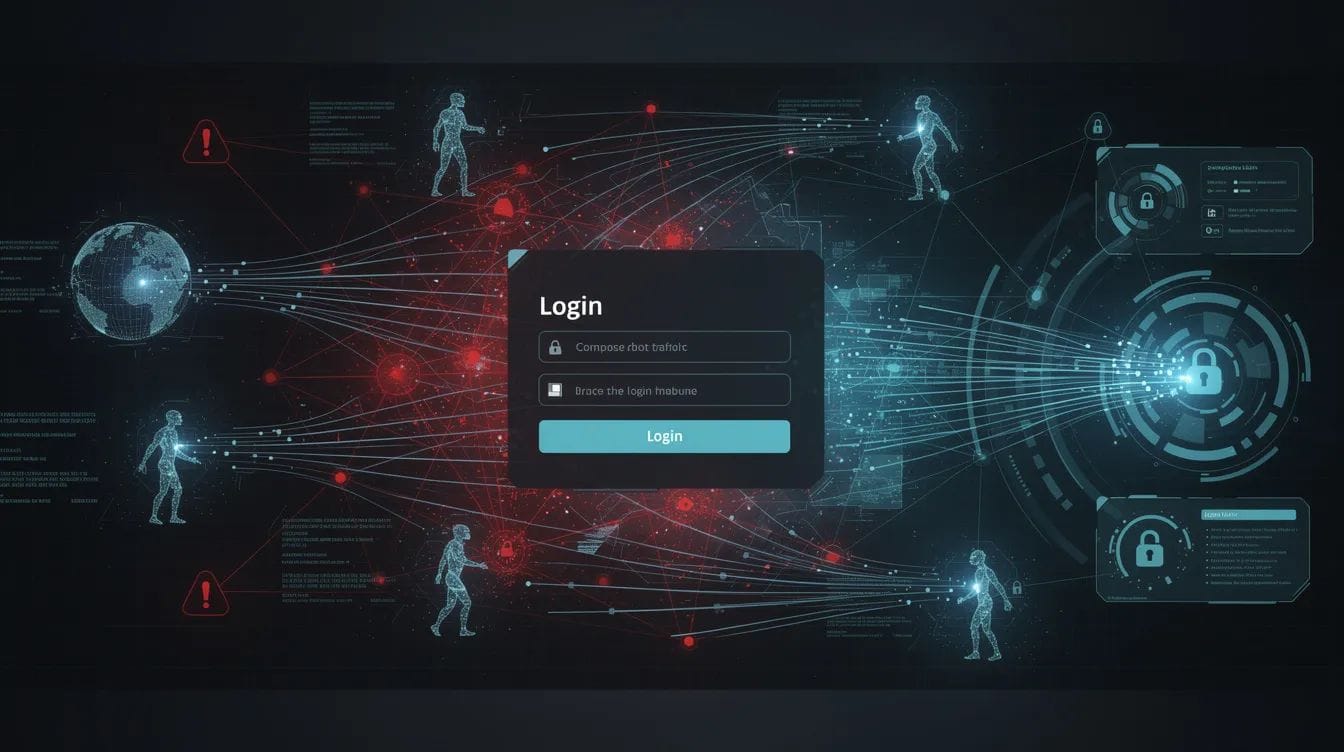
Organizations are also implementing adaptive authentication systems that analyze user behavior patterns, flagging logins that deviate from established norms. Advanced password policies, including mandatory complexity requirements and regular rotation schedules, further complicate attackers' efforts to exploit stolen credentials.
Technology Solutions for Real-Time Protection
Modern bot detection platforms have become essential infrastructure for identifying and neutralizing automated login attempts before they succeed. These systems analyze traffic patterns, device fingerprints, and user behavior to distinguish legitimate users from malicious automation. When suspicious activity is detected — such as login attempts from geographically dispersed IP addresses within short timeframes — security controls can automatically trigger additional verification steps or temporarily block access. Some organizations are moving toward passwordless authentication entirely, implementing biometric verification or time-based one-time passwords that eliminate the credential reuse vulnerability altogether.
User Responsibilities
End users remain a critical component of defense against these attacks. Security experts consistently recommend unique passwords for each online account, though password managers have become essential tools for making this practical. Two-factor authentication, while sometimes inconvenient, provides substantial protection against account takeover attempts, especially when users rely on multi-factor authentication apps for online account security. Users who enable these additional verification methods create significant barriers for attackers, even when their primary credentials have been compromised in data breaches.
The Path Forward: Collaborative Security
Stopping credential stuffing requires coordinated effort across the technology ecosystem. Organizations must invest in sophisticated detection capabilities and authentication technologies that make automated attacks impractical, while users need to adopt security practices that limit their exposure to credential-based attacks. The threat landscape continues evolving as attackers develop new techniques, but the fundamental principle remains clear: strong authentication practices, combined with advanced detection systems, can effectively neutralize this persistent threat. Success depends on treating cybersecurity as a shared responsibility rather than a purely technical challenge.
Responding to Credential Stuffing Attacks
When credential stuffing attacks strike, the clock starts ticking for security teams tasked with damage control and account recovery. The initial detection phase demands rapid containment measures that experienced incident responders know well: blocking suspicious IP addresses, raising authentication thresholds, and in severe cases, temporarily shuttering affected login portals to stop automated intrusion attempts cold.
The forensic phase that follows separates competent security operations from amateur hour. Seasoned analysts dive deep into server logs and authentication trails, hunting for the telltale patterns that reveal an attack's scope — clusters of failed login attempts, successful authentications from geographically improbable locations, and the digital fingerprints left on compromised accounts. This detective work proves crucial for understanding which users found themselves in the crosshairs and determining the full extent of unauthorized access.
Account recovery efforts typically center on mandatory password resets for affected users, coupled with vigilant monitoring for suspicious account activity or unauthorized changes. The communication challenge here can make or break user trust — security teams must strike the right balance between transparency and alarm, helping users grasp the genuine risks while encouraging stronger password hygiene across all their digital accounts.
Meanwhile, the broader security architecture gets a hard look from teams determined not to face the same attack twice. Enhanced bot detection capabilities, tighter rate limiting on authentication attempts, and comprehensive multi-factor authentication rollouts represent the standard defensive upgrades. Forward-thinking organizations also tap into threat intelligence networks and collaborate with industry peers to stay ahead of emerging credential stuffing techniques and newly harvested password databases making rounds on underground markets.
The most effective credential stuffing responses blend rapid containment with methodical investigation, proactive user safeguards, and systematic security improvements. Organizations that master this combination — moving quickly while maintaining transparency — consistently limit attack impact and emerge with stronger defenses against the next wave of automated credential abuse.
FAQ
How can I tell if my account was compromised in a credential stuffing attack?
Look for unusual activity, such as login attempts from unfamiliar locations, password reset emails you didn’t request, or unauthorized changes to your account. You can also check if your credentials have appeared in known data breaches using services like Have I Been Pwned.
What is password hashing and how does it protect against credential stuffing?
Password hashing is a security process that converts a user's plaintext password into an unreadable string of characters (called a hash) before storing it in the database. This process often uses additional techniques like salting and encryption to further enhance security. Credential hashing is the first step to protecting your user's credentials from theft by scrambling a user's password before storing it in the database. Even if attackers gain access to the database, they cannot easily retrieve the original passwords, making credential stuffing attacks much less effective.
What is credential stuffing?
Credential stuffing is an automated cyberattack where attackers use stolen usernames and passwords from previous breaches to attempt logins across multiple websites.
How do credential stuffing attacks work?
Attackers obtain credential lists from previous data breaches and use bots to test those credentials against login pages across many websites, specifically targeting the login form to attempt unauthorized access.
What is the difference between credential stuffing and brute force attacks?
Brute force attacks attempt to guess passwords through repeated combinations, while credential stuffing uses known stolen credentials from past breaches. Credential stuffing is considered a type of brute force cyberattack, but it differs in that it uses known credentials rather than attempting to guess passwords.
How can organizations prevent credential stuffing attacks?
Organizations can prevent credential stuffing attacks by implementing multi-factor authentication, bot detection tools, CAPTCHA, rate limiting, and monitoring for suspicious login activity.
Why is password reuse dangerous?
Password reuse allows attackers to access multiple accounts when one set of credentials is compromised in a breach.
How do phishing attacks relate to credential stuffing?
Phishing attacks are another way attackers obtain login information by impersonating trusted entities and tricking users into revealing their credentials, which can then be used in credential stuffing attacks.