
The Contractor Access Gap: Why Identities Outside Your Organization Create Inside Risk
Third-party contractors operate inside your systems but outside your identity controls, creating an access gap attackers actively exploit. This newsletter examines why external identities carry insider-level risk and how organizations can close the gap with proper access governance.

In partnership with

👋 Welcome to Unlocked
Organizations have spent years tightening internal security with stronger authentication, better endpoint protection, more visibility across employees and systems, etc.
On paper, the environment looks controlled. But modern organizations don’t operate alone. They rely on vendors, partners, and contractors.
And those identities often sit just outside the core security model — with access that looks internal, but governance that doesn’t.
Welcome to the contractor access gap.
🧠 The Identity You Don’t Fully Own
Contractors and third parties are now embedded in day-to-day operations.

They access:
- internal applications
- shared environments
- cloud systems
- development pipelines
- support tools
In many cases, their access mirrors that of full-time employees. But there’s a critical difference: You don’t control their environment.
Their devices, networks, and security practices often fall outside your direct oversight — creating a split between access and accountability.
The identity may look trusted. The context often isn’t.
⚠️ Where the Risk Quietly Builds
The risk isn’t just that contractors exist, it’s how their access evolves over time.
Contractor identities often:
- remain active longer than needed
- accumulate permissions across projects
- bypass standard onboarding controls
- lack consistent monitoring
Because they are temporary by design, they are often treated as lower priority. In practice, they become long-lived identities with inconsistent governance.
CISA has repeatedly warned that third-party and vendor access pathways are a growing source of compromise across industries.
Access is granted quickly — but rarely revisited with the same urgency.
🔓 The Visibility Problem
Most organizations cannot clearly answer:
- How many contractors currently have access?
- What systems they can reach?
- Whether that access is still required?
This isn’t a tooling problem alone.
It’s a visibility gap created by fragmentation:
- multiple identity providers
- disconnected SaaS platforms
- vendor-managed accounts
- shared credentials in legacy systems
According to industry research from Gartner, organizations increasingly struggle with identity sprawl as ecosystems expand beyond traditional employee boundaries.
You can’t secure what you can’t fully map.
🔐 Identity Without Lifecycle Control
Employee identities typically follow a lifecycle. Contractor identities often don’t.
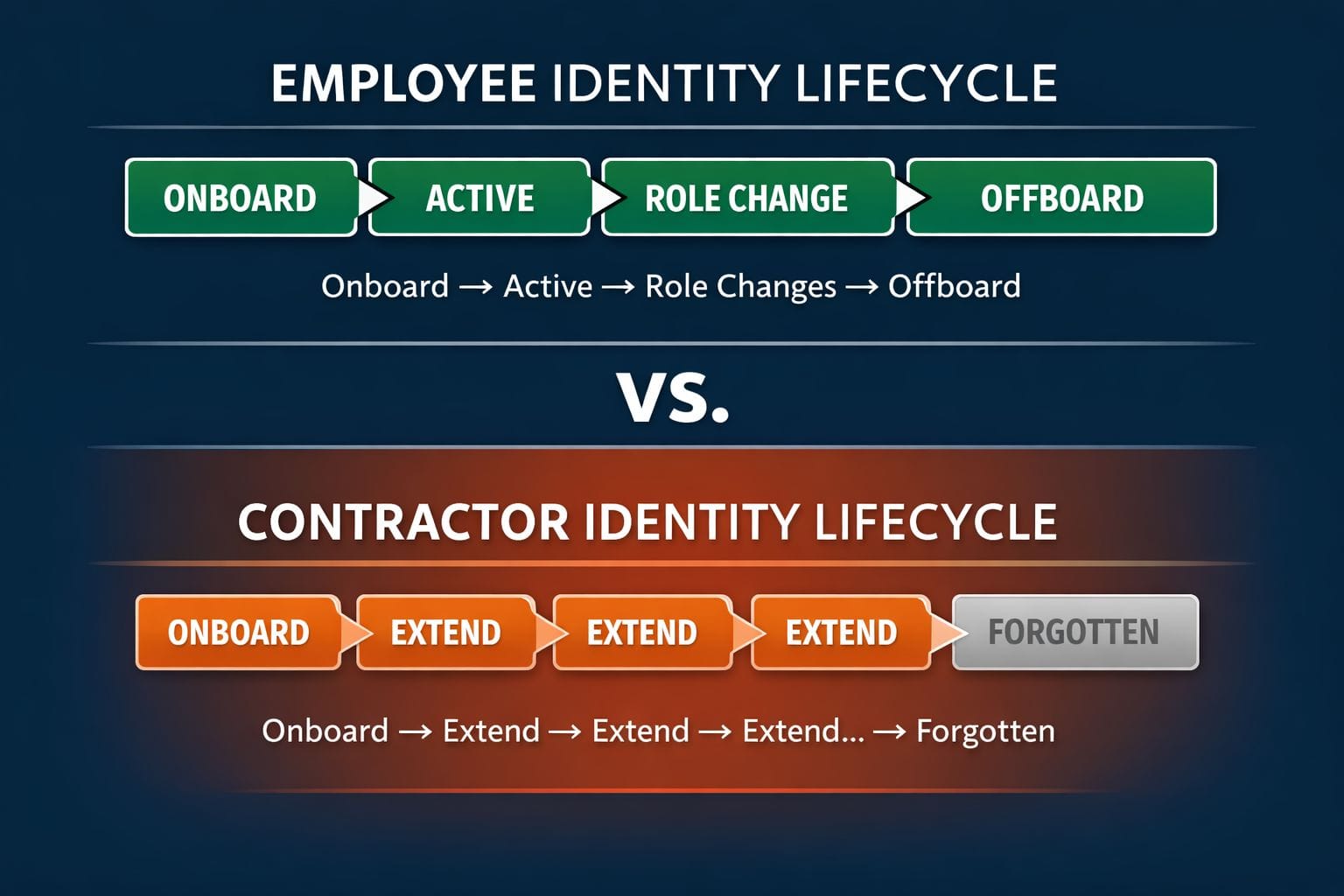
Offboarding may depend on:
- contract expiration
- manual processes
- manager awareness
- vendor communication
Which introduces risk at every step.
If an identity isn’t actively managed, it becomes persistently trusted by default.
🧩 When External Becomes Internal
Once access is granted, attackers don’t distinguish between identity types.
A compromised contractor account can:
- access internal systems
- move laterally
- extract sensitive data
- initiate operational disruption
From the attacker’s perspective, a valid login is a valid login. This is why modern threat models increasingly focus on identity compromise rather than perimeter breach.
MITRE ATT&CK frameworks highlight valid account abuse as a primary technique used in real-world intrusions.
The fastest way inside is often through an identity that already belongs there.
🛡️ How Security Leaders Should Respond
Closing the contractor access gap doesn’t mean limiting collaboration. It means managing external identities with the same rigor as internal ones.
1. Apply lifecycle discipline.
Every contractor identity should have a defined start, review cadence, and expiration.
2. Enforce least privilege by default.
Access should align tightly with role and be scoped to specific systems.
3. Continuously validate identity context.
Device posture, location, and behavior should inform access decisions — not just credentials.
4. Unify visibility across identity sources.
Centralized tracking of human and non-human identities is critical in distributed environments.
5. Audit access regularly.
Periodic review of contractor permissions helps prevent silent accumulation of risk.
Zero Trust principles reinforce that trust must be continuously evaluated — regardless of whether the identity is internal or external.
External identities should not be treated as exceptions — they should be treated as first-class security concerns.
💡 Unlocked Tip of the Week
Ask a simple question:
“Which external identities currently have access to our most sensitive systems?”
If the answer isn’t immediate and precise, that’s your starting point.
Because attackers don’t look for the most complex vulnerability, they look for the least governed access.
📊 Poll of the Week
Where do you see the biggest contractor-related risk? |
|
Login or Subscribe to participate in polls. |
🔥 Final Takeaway
Modern organizations are no longer defined by their employees. They are ecosystems.
Vendors, contractors, and partners extend capability — but also expand risk.
Security can no longer stop at the organizational boundary. Because access doesn’t.
The organizations that succeed will not just secure who they employ…
They will secure who they allow in.
Stay ready. Stay resilient.
Until next time,
The EveryKey Team
Check out last week’s edition of Unlocked
🙋 Author Spotlight
Meet Jordan Hale - Software Developer
Jordan Hale works on backend systems, automation, and reliability tooling that support secure access and modern infrastructure. With experience across cloud-native development and security-focused engineering, Jordan helps improve telemetry, strengthen authentication workflows, and support incident response teams with clearer, more trustworthy data.
Jordan is passionate about practical security engineering and enjoys exploring how automation and AI can reduce operational risk and speed up detection. With an engineering-first mindset, Jordan focuses on clean implementation, measurable outcomes, and strong operational discipline.
Our Sponsor
The Future of AI in Marketing. Your Shortcut to Smarter, Faster Marketing.

Unlock a focused set of AI strategies built to streamline your work and maximize impact. This guide delivers the practical tactics and tools marketers need to start seeing results right away:
- 7 high-impact AI strategies to accelerate your marketing performance
- Practical use cases for content creation, lead gen, and personalization
- Expert insights into how top marketers are using AI today
- A framework to evaluate and implement AI tools efficiently
Stay ahead of the curve with these top strategies AI helped develop for marketers, built for real-world results.