

The Ultimate Guide to Cybersecurity Awareness Month Campaigns

The Ultimate Guide to Cybersecurity Awareness Month 2026 Campaigns
Introduction
Cybersecurity Awareness Month is the annual October campaign that helps organizations turn security awareness into measurable defensive action. For 2026, the key objectives are practical: train employees to recognize and report phishing, enforce strong unique passwords and password managers, deploy phishing-resistant MFA, keep software patched, and rehearse incident reporting and recovery workflows. For security leaders, the month is also an opportunity to audit identity controls, validate backup and patching processes, improve executive readiness, and connect everyday user behavior to enterprise risk management.
Every October, public agencies, security teams, and business leaders unite under a single banner to address one of the greatest operational challenges of our era: human digital vulnerability. The digital ecosystem is no longer confined to isolated data centers. It spans distributed cloud workloads, mobile workforces, third-party software-as-a-service (SaaS) dependencies, and thousands of interconnected endpoints. As technological architectures become more sophisticated, malicious actors increasingly focus their efforts on manipulating the human element rather than attempting to break through cryptographic algorithms directly.
Building operational cyber resilience requires an understanding that awareness is not a one-time corporate compliance check. Threat actors adapt continuously, using automated reconnaissance, credential stuffing against exposed application programming interfaces (APIs), and generative AI lures. Managing risk across a modern organization requires translating high-level cybersecurity concepts into observable, day-to-day behavioral defenses across all business units.
The History and Leadership of Cybersecurity Awareness Month
The campaign's history reflects the broader evolution of the global threat landscape. What began as a modest public service initiative has expanded into an internationally recognized operational movement.
Federal governance and public-private cooperation remain central to the campaign's success. As demonstrated when DHS and CISA Announce Cybersecurity Awareness Month 2025 | Homeland Security, governmental agencies coordinate closely with industry leaders to publish standardized defensive resources, establish actionable benchmarks, and mobilize technical leaders across critical sectors. For 2026 programs, those materials remain a baseline for building measurable campaigns around phishing defense, identity security, patch management, incident reporting, and recovery readiness. Concurrently, the National Cybersecurity Alliance leads private-sector engagement, providing vendor-neutral materials designed to empower organizations of all sizes.
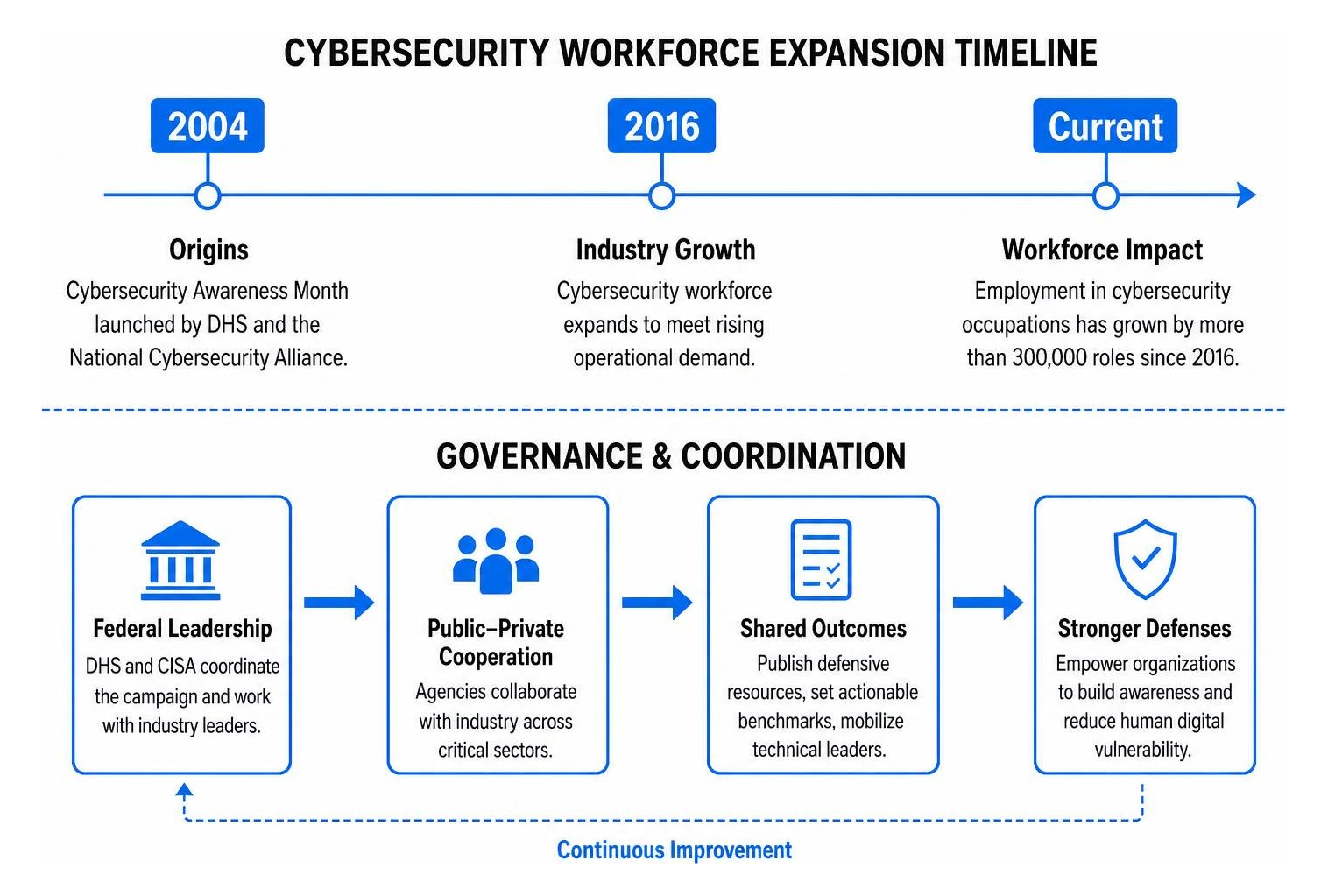
This broad institutional backing has coincided with a dramatic professionalization of the industry. Employment in cybersecurity occupations has grown by more than 300,000 roles since 2016, highlighting the urgent operational need for skilled personnel capable of defending enterprise assets against sophisticated threat actors.
Origins, Evolution, and Governance Across Global Coalitions
When the U.S. Department of Homeland Security (DHS) and the National Cybersecurity Alliance launched the first campaign in October 2004, digital security primarily focused on basic desktop antivirus installation, updating operating system patches over dial-up or early broadband connections, and advising users not to share passwords on sticky notes.
Over the past two decades, the focus has shifted dramatically alongside enterprise computing models:
- 2004-2009: Early focus centered on consumer awareness, safe web browsing, basic anti-malware signatures, and spam filtering.
- 2010-2017: Enterprise cloud adoption, mobile device management (MDM), distributed network perimeters, and standardized frameworks such as the National Institute of Standards and Technology (NIST) Cybersecurity Framework (CSF) took center stage.
- 2018-2023: Threat intelligence tracked the emergence of widespread IoT botnets, specialized darknet ransomware-as-a-service (RaaS) operations, and enterprise supply chain compromise.
- 2024-2026: Identity security, phishing-resistant Multi-Factor Authentication (MFA), AI-assisted social engineering, software supply chain assurance, and the Zero Trust security model have become foundational.
Internationally, the European Union Agency for Cybersecurity (ENISA) and the European Commission coordinate European Cybersecurity Month (ECSM) alongside US efforts. In parallel, presidential actions, including the National Cybersecurity Awareness Month, 2025 - The White House proclamation, continue to elevate cyber defense from an internal IT concern to a pillar of national security, sovereignty, and critical infrastructure protection.
The Current Cybersecurity Awareness Month Theme: Securing the Future
CISA's overarching "Secure Our World" initiative provides an enduring foundation for 2026 Cybersecurity Awareness Month planning, while the forward-looking theme "Securing the Next 250" ties the defense of digital assets directly to national and organizational endurance.
Recent public guidance and threat reporting continue to point to identity abuse, phishing, business email compromise (BEC), and software exploitation as campaign priorities. These patterns map directly to common MITRE ATT&CK techniques such as Phishing (T1566), Valid Accounts (T1078), Exploit Public-Facing Application (T1190), and Account Manipulation (T1098). Mitigating these vectors requires established cybersecurity policies and procedures building a strong foundation for organizational security that treat continuous verification and identity validation as standard operating procedure.
Core Defensive Strategies: From Foundational Hygiene to Identity Security
Defending modern enterprises requires establishing structured defensive layers. While user education provides the frontline barrier, it must be reinforced with modern architectural controls, strict policy enforcement, and resilient authentication protocols that align with the essential pillars of cybersecurity every organization should know.
Essential Personal Practices: Phishing Defense, Strong Passwords, and MFA
Enterprise defense begins with actionable individual habits. A large share of successful cyber-attacks still begins with phishing, credential theft, or social engineering that exploits human psychology to circumvent technical filters. Adversary-in-the-middle (AiTM) phishing frameworks, including Evilginx-style reverse proxy tooling, can capture live session cookies and bypass weaker SMS or push-notification MFA flows. Understanding why phishing is still the 1 threat and why passwords make it worse clarifies why basic credential hygiene remains one of the most critical defensive measures:
- Phishing Identification and Reporting: Employees must evaluate unsolicited messages critically, looking beyond visual branding to verify sender domains, inspect header routing, avoid urgent call-to-action triggers, and report suspicious payloads immediately to internal Security Operations Centers (SOCs).
- Credential Complexity and Generation: Passwords must be lengthy, cryptographically random, and unique across every internal and external service. Understanding what is a password manager a complete guide to password security in 2026 helps teams deploy enterprise password managers that eliminate credential reuse and insecure local storage.
- Multifactor Authentication Deployment: Passwords alone are insufficient to protect corporate access. Implementing multi-factor authentication your complete guide to enhanced security ensures that compromised credentials cannot grant unilateral access to internal databases, email servers, or code repositories.
- Automated Software Patching: Known vulnerabilities in operating systems, browsers, and endpoint dependencies represent easy targets for automated exploit kits. Organizations must enforce rapid patch cycles and centralized vulnerability management against flaws cataloged in MITRE ATT&CK techniques like T1190 (Exploit Public-Facing Application).
Why Modern Resilience Demands Identity-First Security Architecture
Traditional network perimeters have dissolved. With data distributed across multi-cloud environments and remote endpoints, identity has become the true enterprise perimeter.
A substantial portion of modern breaches involves the misuse of identities, whether through credential theft, AiTM phishing, OAuth consent abuse, token replay, or the abuse of over-privileged service accounts. Attackers do not always need to break into modern networks; they can log in using valid credentials if identity controls are weak. For 2026 campaign planning, identity reviews should include directory hygiene, stale account removal, session lifetime policies, privileged access management (PAM), and conditional access policies tied to device posture and risk signals.
To counter this, security leaders are transitioning toward Zero Trust Architecture (NIST SP 800-207) and passwordless sign-in. Deploying FIDO2/WebAuthn phishing-resistant hardware tokens or passkeys with Yubico or Microsoft Entra ID can reduce the risk of session hijacking and credential harvesting. EveryKey is a small wireless key that locks your computer when you walk away and unlocks it when you return, and it works alongside those tools.
Securing non-human identities (NHIs) is equally vital. Machine-to-machine tokens, service principals, automated deployment pipeline keys, and API secrets must be monitored continuously with behavioral analytics, granted least-privilege permissions, and managed through automated lifecycle protocols.
Enterprise Resilience, Critical Infrastructure, and Campaign Toolkits
While individuals must maintain defensive habits, enterprise IT teams, systems administrators, and critical infrastructure operators bear the responsibility of engineering resilient systems.

Small businesses are frequently targeted by cybercriminals because they may have smaller security teams, fewer monitoring resources, and trusted supply chain relationships with larger enterprise networks. Internet-facing edge systems remain a recurring risk area. CISA's Known Exploited Vulnerabilities (KEV) catalog has repeatedly included exploited vulnerabilities in VPNs, firewalls, secure gateways, and remote access platforms. Recent additions underscore the urgency: in January 2025, CISA added CVE-2025-0282, a critical stack-based buffer overflow in Ivanti Connect Secure exploited in the wild since December 2024, to the KEV catalog, reinforcing the need for rapid patching of internet-facing appliances. In December 2024, the Cl0p ransomware group's mass exploitation of CVE-2024-50623 in Cleo file-transfer products (disclosed in late 2024) led to confirmed data breaches across dozens of organizations, demonstrating how supply chain software vulnerabilities continue to cascade through enterprise environments. For Cybersecurity Awareness Month 2026, organizations should connect awareness messaging to vulnerability management workflows that use KEV prioritization, CVSS, EPSS, authenticated scanning, and asset ownership data.
| Security Dimension | Personal Digital Hygiene | Enterprise & Infrastructure Control |
|---|---|---|
| Authentication | Password manager, consumer MFA apps | Phishing-resistant FIDO2, SSO, Conditional Access, PAM |
| Phishing Defense | Visual inspection, reporting suspicious mail | DMARC/DKIM/SPF enforcement, AiTM email filters, SIEM logging |
| Data Protection | Local encrypted drive, personal cloud backup | Immutable multi-region backups, automated data classification |
| Vulnerability Mgmt | Auto-update OS and consumer apps | Automated patch cycles (CISA KEV catalog), vulnerability scanning |
| Incident Response | Resetting accounts, contacting bank | Formal IR playbooks, live tabletop drills, forensic logging |
Organizational Protection and the 3Rs for Critical Infrastructure
For operators of industrial control systems (ICS), supervisory control and data acquisition (SCADA) systems, utilities, healthcare systems, and state, local, tribal, and territorial (SLTT) governments, CISA emphasizes the 3Rs of Cybersecurity:
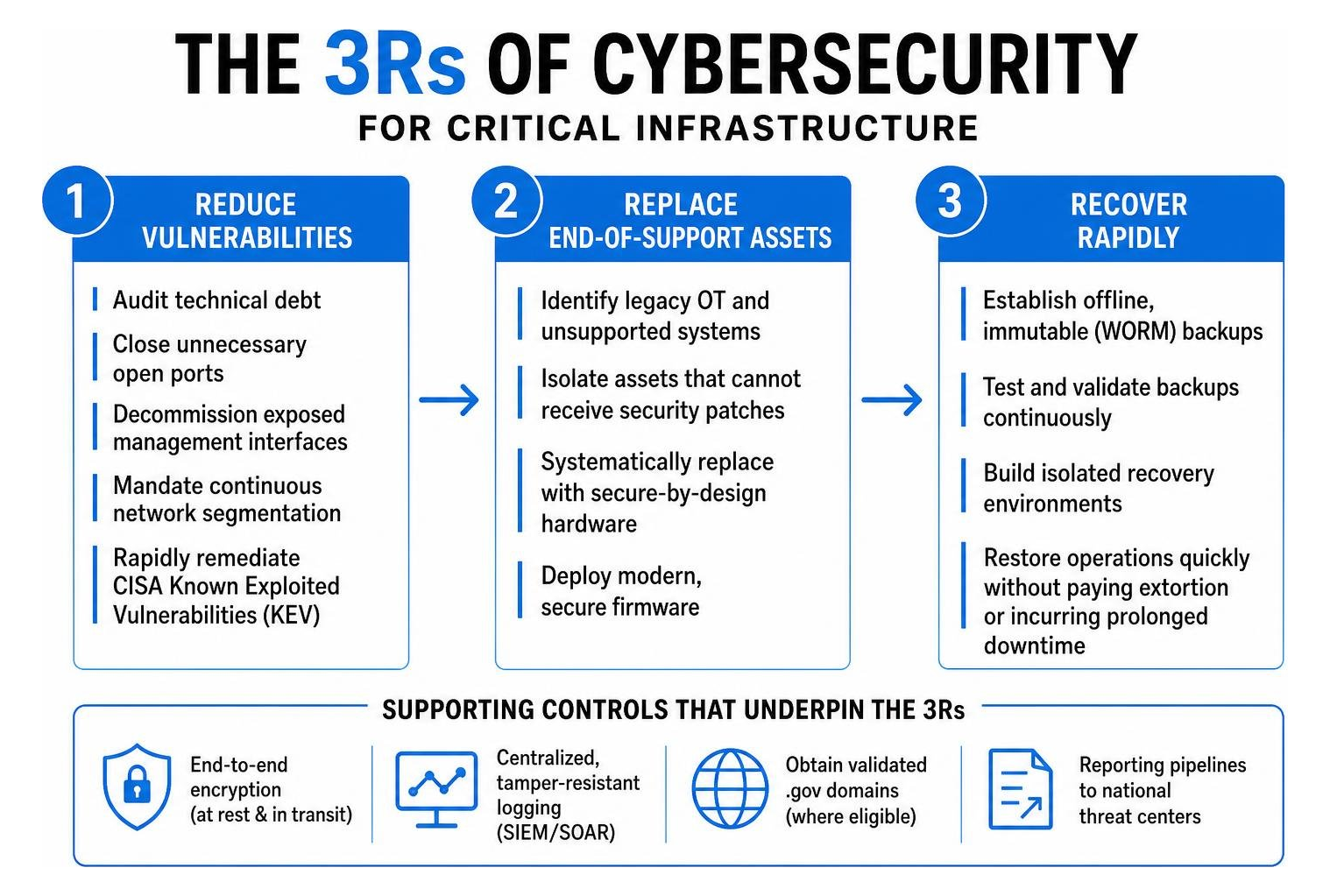
- Reduce Vulnerabilities: Proactively audit technical debt, close unnecessary open ports, decommission exposed management interfaces, mandate continuous network segmentation, and rapidly remediate vulnerabilities listed in CISA's Known Exploited Vulnerabilities (KEV) catalog.
- Replace End-of-Support Assets: Legacy operational technology (OT) and unsupported operating systems that cannot receive security patches must be isolated or systematically replaced with secure-by-design hardware and modern firmware.
- Recover Rapidly: Establish, test, and continuously validate offline, immutable, write-once-read-many (WORM) backups. Build isolated recovery environments to restore operational capacity quickly without paying extortion demands or suffering prolonged downtime.
Organizations must also ensure end-to-end encryption for data at rest and in transit, implement centralized, tamper-resistant system logging (SIEM/SOAR), obtain validated .gov domains where eligible to minimize brand spoofing, and establish formal reporting pipelines to national threat centers.
Deploying Actionable Cybersecurity Awareness Month Toolkits and Weekly Drills
Organizations do not need to build campaign strategies from scratch. Security leaders can download the standardized Cybersecurity Awareness Month Toolkit | CISA or leverage community resource suites such as the [FREE RESOURCE KIT] Cybersecurity Awareness Month Kit 2026 Now Available | #hacking | #cybersecurity | #infosec | #comptia | #pentest | #ransomware - National Cyber Security Consulting to structure weekly engagement.
A standard October implementation cadence follows a four-week operational model:
- Week 1: Phishing and Social Engineering Tactics: Focus on practical detection exercises, AI voice clone identification, and automated reporting buttons within corporate email clients.
- Week 2: Identity, Passwords, and Authentication: Run workshops transitioning departments to enterprise password managers, configure hardware tokens, and audit inactive directory accounts.
- Week 3: Device Security, Patching, and AI Safety: Educate staff on the risks of unauthorized generative AI tool usage, insecure public Wi-Fi access, and unpatched endpoint dependencies.
- Week 4: Incident Response and Threat Reporting: Execute a live cyber drill how organizations prepare for real world cyber attacks using structured tabletop scenarios to evaluate cross-functional communication between IT, executive leadership, legal counsel, and public relations.
Frequently Asked Questions About Online Safety Campaigns
Who leads Cybersecurity Awareness Month and when did it start?
The initiative was officially launched in October 2004 by the National Cybersecurity Alliance and the U.S. Department of Homeland Security (DHS). Today, the campaign is co-led in the United States by the Cybersecurity and Infrastructure Security Agency (CISA) and the National Cybersecurity Alliance, with international coordination from organizations such as the European Union Agency for Cybersecurity (ENISA).
What are the 3Rs of cybersecurity for critical infrastructure?
Developed for critical infrastructure operators and enterprise environments, the 3Rs framework includes:
- Reduce: Mitigate known vulnerabilities and minimize public-facing attack surfaces.
- Replace: Decommission and upgrade legacy, unsupported hardware and software assets.
- Recover: Build immutable backup architectures and verified incident response procedures to sustain and rapidly restore critical operations during a disruption.
What are the four core habits recommended for all digital users?
CISA and the National Cybersecurity Alliance recommend four primary behaviors:
- Using strong, complex, and unique passwords combined with a secure password manager.
- Enabling phishing-resistant multi-factor authentication (MFA) across all personal and business accounts.
- Recognizing and reporting suspicious communications, phishing emails, and social engineering attempts.
- Keeping all operating systems, applications, and firmware updated through automated patching.
Conclusion
A successful 2026 security program cannot rely on annual awareness initiatives alone. Threat actors operate around the clock, continuously refining automated attacks against corporate identities, network perimeters, and critical supply chains. While October provides a valuable structured opportunity to focus team attention, true resilience requires sustaining these practices throughout the entire operational year.
Transitioning from passive compliance to active defense requires establishing measurable security controls, deploying identity-first authentication architectures, and cybersecurity awareness month building a culture of online safety that empowers employees to act as an active defensive line.
Security leaders, IT administrators, and technical decision-makers can explore technical playbooks, architectural guides, and threat intelligence reports on the Unlocked knowledge platform or register directly through the Unlocked community portal to stay ahead of emerging threats.