
Step-by-Step Guide to Cyber Safety Awareness Month 2026
Turn Cybersecurity Awareness Month into a structured four-week program covering identity hygiene, phishing simulations, vulnerability remediation, incident drills, and free Champion toolkits.

Step-by-Step Guide to Cyber Safety Awareness Month 2026
The Evolution and Importance of Cyber Safety Awareness Month
Executing an effective cyber safety awareness month campaign requires a structured, four-step operational roadmap: auditing identity hygiene to mandate phishing-resistant MFA, deploying targeted social engineering simulations, remediating unpatched edge vulnerabilities, and conducting cross-functional incident tabletop exercises. Establishing these baseline habits eliminates up to 99% of opportunistic attacks across enterprise networks.
Recent intelligence highlights the necessity of structured hygiene programs. In January 2026, CISA and the FBI issued a joint cybersecurity advisory highlighting automated credential-stuffing campaigns exploiting legacy single-factor logins across critical infrastructure supply chains. Coordinated workforce education and continuous technical controls serve as primary defenses against these widespread access threats.
Origins and Mission of Cyber Safety Awareness Month
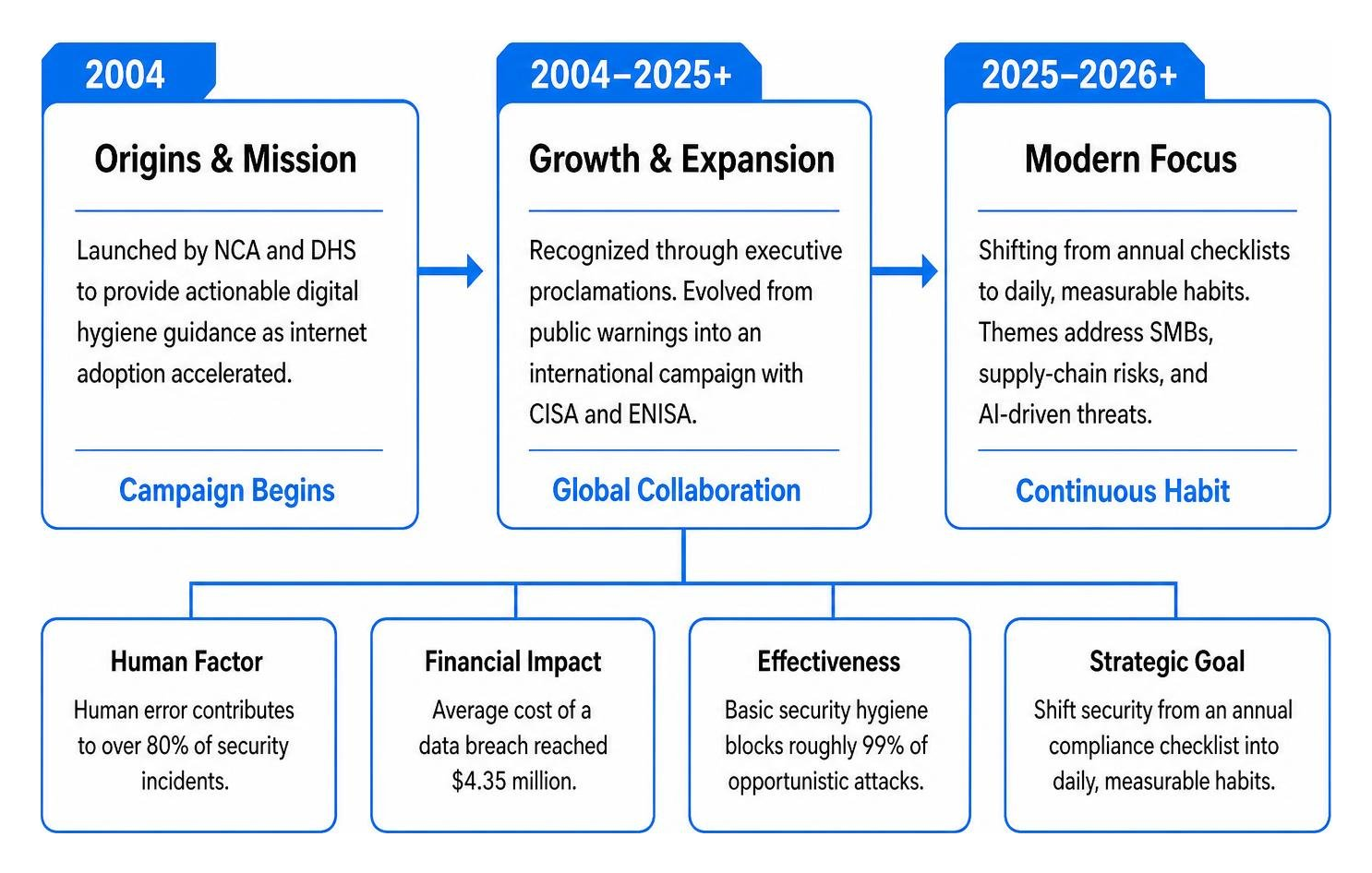
The campaign began in October 2004, launched through a joint effort between the National Cybersecurity Alliance (NCA) and the U.S. Department of Homeland Security (DHS). It was designed to provide actionable digital hygiene guidance as internet adoption accelerated across enterprise and consumer environments.
The effort is formally recognized each year through executive proclamations, as highlighted in the National Cybersecurity Awareness Month, 2025 – The White House release. Over the past two decades, the initiative has transitioned from broad public service warnings into an international campaign supported by agencies like the Cybersecurity and Infrastructure Security Agency (CISA) and the European Union Agency for Cybersecurity (ENISA).
The goal is to shift security from an annual compliance checklist into daily, measurable habits. Research shows that human error contributes to over 80% of security incidents, and the average cost of a data breach reached $4.35 million. Because basic security hygiene blocks roughly 99% of opportunistic attacks, consistent personal habits remain one of the most cost-effective defensive controls available.
Annual Themes and National Cyber Strategy
The campaign's themes mirror the shifting tactics used by modern threat actors:
- "Secure Our World": Introduced by CISA as an enduring 365-day program emphasizing four fundamental behaviors: strong passwords, phishing reporting, multi-factor authentication, and regular patching.
- "Building a Cyber Strong America": The 2025 theme prioritized the security of small and medium-sized businesses (SMBs) and state, local, tribal, and territorial (SLTT) governments, recognizing that smaller suppliers are prime targets for supply-chain attacks.
- "Securing the Next 250": Framed around America's 250th anniversary, the 2026 campaign addresses systemic risks accelerated by generative AI and automation.
Supply-chain risks remain widespread. An adversary compromising a single regional managed service provider (MSP) or utility vendor can pivot into municipal water systems, healthcare records, or critical operational networks. This reality has driven national defense initiatives to focus on frontline organizations.
Foundational Pillars of Modern Security Hygiene
Defending modern networks requires mastering core hygiene controls. When implemented consistently, these practices dramatically reduce an organization's exploitable attack surface.
Identity Security, Password Management, and Phishing Defense
Compromised credentials remain the primary initial access vector across enterprise networks. Threat actors frequently deploy credential stuffing toolkits to test stolen username-and-password combinations against hundreds of online services.
Once a user falls for a phishing lure, attackers need an average of just 1 hour and 12 minutes to access private data. Modern social engineering exploits cognitive blind spots—such as artificial urgency and authority cues—as detailed in The Psychology of Phishing: Why We Still Fall for It.
To counter these attacks, organizations are adopting The New NIST Password Guidelines: Building a Smarter, Stronger Digital Identity, formalized in the updated NIST SP 800-63-4 Digital Identity Guidelines. These standards recommend:
- Prioritizing passphrase length (15+ characters) over arbitrary character complexity rules.
- Eliminating arbitrary 90-day password expiration policies, which often prompt users to create predictable variations.
- Screening credentials against known compromised password databases.
- Deploying a dedicated enterprise credential tool. Using What Is a Password Manager? A Complete Guide to Password Security in 2026 helps staff maintain unique credentials for every service while preventing credential harvesting on spoofed domains.
Multi-Factor Authentication and Vulnerability Management
Enabling Multi-Factor Authentication: Your Complete Guide to Enhanced Security prevents approximately 99.2% of automated account takeover attempts.
While legacy SMS verification codes and voice calls offer basic protection, they remain vulnerable to SIM-swapping and adversary-in-the-middle (AiTM) proxy phishing toolkits (such as Evilginx). Organizations should transition toward phishing-resistant authentication methods:
- FIDO2 / WebAuthn Passkeys: Use public-key cryptography bound to a specific origin domain, eliminating credential theft from spoofed phishing pages.
- Hardware Security Keys and Biometric Tokens: Require cryptographic proof of possession and physical user presence.
- App-Based Push Notification Hardening: Require number matching to mitigate push bombing (MFA fatigue) attacks.
Alongside identity controls, systematic patch management remains critical. Unpatched public-facing assets remain a primary access point for ransomware operations. Organizations should track vulnerability catalogs—such as CISA’s Known Exploited Vulnerabilities (KEV)—and deploy automated vulnerability scanners to identify end-of-support operating systems, outdated libraries, and unpatched network edge devices.
Enterprise Execution: Building a 4-Week Action Plan
Running an effective cyber safety awareness month program requires practical, engaging training rather than dry annual compliance presentations. Breaking October into four weekly modules allows security teams to deliver bite-sized lessons that build on each other.
| Week | Focus Area | Core Topics Covered | Key Deliverables & Activities |
|---|---|---|---|
| Week 1 | Social Engineering & Phishing | AI deepfakes, spear phishing, SMS scams (smishing) | Phishing simulation baseline; microlearning videos |
| Week 2 | Identity & Access Defense | Passphrases, enterprise password vaults, MFA/passkeys | MFA enrollment audit; passkey transition guides |
| Week 3 | Data Security & Device Hygiene | System patching, logging, shadow IT, secure backup | Endpoint compliance checks; asset inventory review |
| Week 4 | Incident Response & Culture | No-blame incident reporting, threat escalation, cyber careers | Live tabletop exercises; community trivia sessions |
Structuring Your Campaign Cadence
Organizations should structure their training around digestible, 90-second microlearning modules. This format fits into daily workflows without disrupting productivity, as highlighted in Cybersecurity 101 Training: The Foundation of Modern Security Awareness.
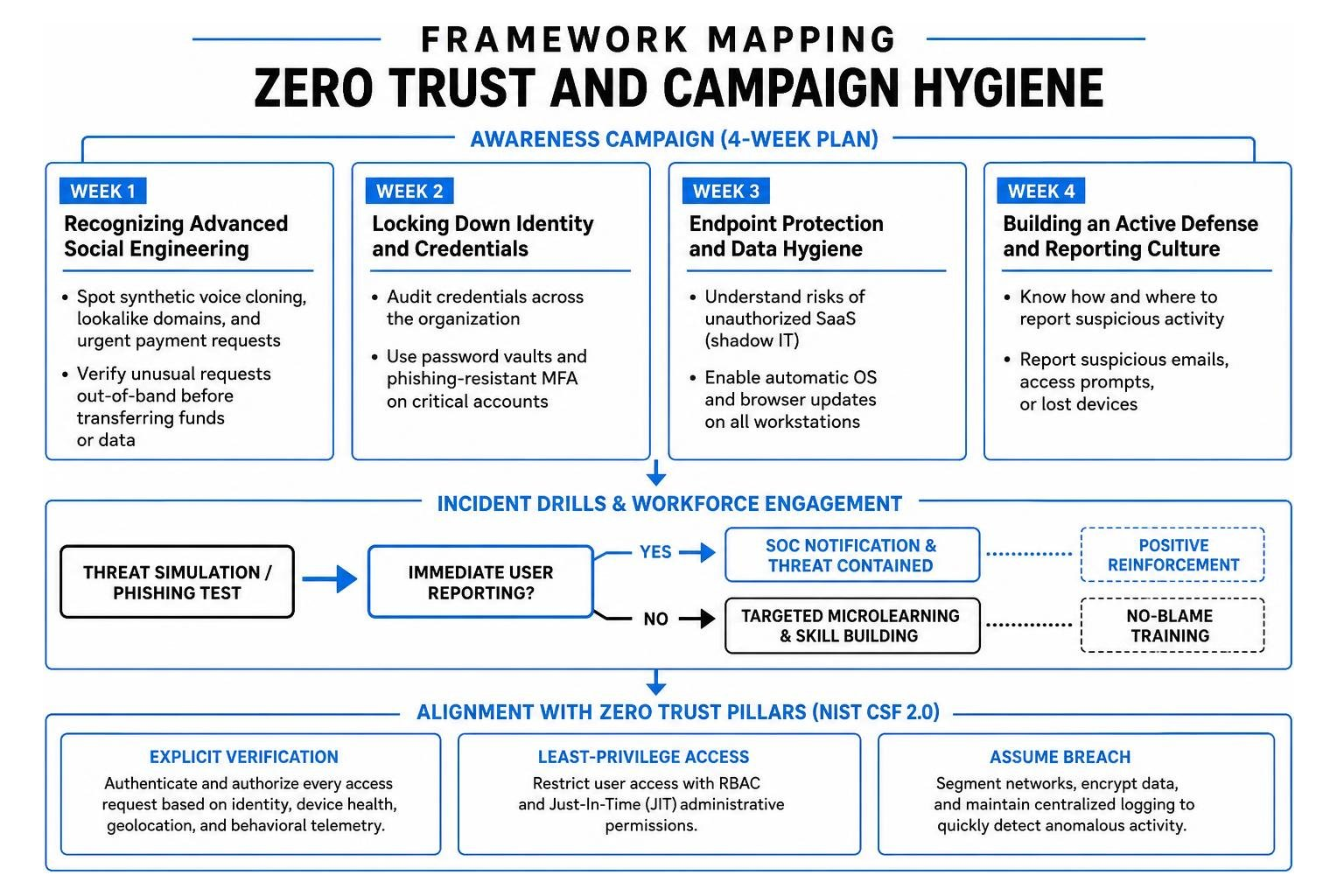
- Week 1: Recognizing Advanced Social Engineering: Train employees to spot synthetic voice cloning, lookalike domains, and urgent payment requests. Establish out-of-band verification procedures—such as confirming unusual requests through a separate, pre-arranged channel—before transferring funds or sensitive data.
- Week 2: Locking Down Identity and Credentials: Audit account credentials across the organization. Guide employees through setting up password vaults and registering phishing-resistant MFA tokens on critical business accounts.
- Week 3: Endpoint Protection and Data Hygiene: Educate staff on the risks of unauthorized SaaS applications (shadow IT) and verify that automatic operating system and browser updates are enabled across all workstations.
- Week 4: Building an Active Defense and Reporting Culture: Demystify the incident escalation process. Ensure every employee knows exactly how and where to report suspicious emails, unauthorized access prompts, or lost devices.
Operationalizing Incident Drills and Workforce Engagement
Theoretical awareness must be reinforced through practical exercises. Running realistic incident simulations gives staff hands-on experience identifying and reporting threats.
- Interactive Competitions: Run organization-wide trivia challenges to test threat-recognition skills in a collaborative setting.
- Tabletop Exercises: Conduct scenario-based walk-throughs using resources from Cyber Drill: How Organizations Prepare for Real-World Cyber Attacks to evaluate how cross-functional teams handle simulated data breaches.
- No-Blame Reporting Frameworks: Avoid punitive measures when employees make mistakes during simulations. A supportive environment encourages staff to flag suspicious activity quickly, turning every user into an active security sensor.
- Standards-Based Frameworks: Align organizational training metrics with federal and academic benchmarks outlined by the Cybersecurity Awareness Month | NIST resource hub.
Aligning Campaign Strategies with Modern Architecture and Standards
Security awareness programs are most effective when paired with defensive architecture. To evaluate overall maturity, security leaders map their operations against established frameworks like the NIST Cybersecurity Framework (CSF 2.0).
Understanding the Essential Pillars of Cybersecurity Every Organization Should Know helps teams integrate user education directly into a Zero Trust Security: Building a Stronger Future with Zero Trust Architecture framework. Zero Trust assumes the perimeter is compromised and enforces continuous verification across all users, devices, and network sessions:
- Explicit Verification: Authenticate and authorize every access request based on user identity, device health, geolocation, and behavioral telemetry.
- Least-Privilege Access: Restrict user access rights with role-based access control (RBAC) and Just-In-Time (JIT) administrative permissions.
- Assume Breach: Segment corporate networks, encrypt data at rest and in transit, and maintain centralized system logging to quickly detect anomalous activity.
- The Critical Infrastructure "3Rs": Apply the 3Rs model—Reduce vulnerabilities through continuous scanning, Replace legacy end-of-support hardware and software, and Recover quickly using isolated, immutable backups.
When evaluating access management solutions, organizations can consider several enterprise tools based on their infrastructure needs:
- Hardware Security Modules (HSMs) and FIDO2 Keys (e.g., YubiKey): Provide physical, phishing-resistant multi-factor authentication tokens.
- Identity and Access Management Platforms (e.g., Microsoft Entra ID, Okta): Centralize identity governance, conditional access policies, and single sign-on (SSO).
- Enterprise Password and Access Managers (e.g., 1Password, Bitwarden, EveryKey): Provide cross-platform credential storage, secure sharing, and automated password generation to eliminate credential reuse across enterprise teams.
Campaign Champion Toolkits and Community Participation
Organizations of any size can run structured security awareness programs by taking advantage of freely available campaign resources.
The National Cybersecurity Alliance and CISA offer free Champion toolkits through the Cybersecurity Awareness Month 2026 portal. Registering as an organizational Champion gives security teams access to:
- Actionable cybersecurity tipsheets for remote and on-site staff.
- Printable high-resolution security posters for office environments.
- Ready-to-use social media graphics, video assets, and internal email templates.
- Discussion guides designed for executive leadership and IT teams.
October also features Cybersecurity Career Week, addressing the global cybersecurity workforce gap of 3.4 million professionals. Organizations can participate by hosting student open houses, mentoring aspiring security analysts, and highlighting career pathways for non-technical professionals—such as risk analysts, technical communicators, and policy specialists.
Frequently Asked Questions about Cyber Safety Month
What is the primary objective of Cybersecurity Awareness Month?
Held every October, the campaign is an international initiative that provides individuals and organizations with practical knowledge to defend against cyber threats. It focuses on turning fundamental security behaviors—such as recognizing phishing, using strong passphrases, enabling MFA, and updating software—into routine digital habits.
What are the four essential cyber hygiene steps recommended for individuals?
Security agencies worldwide emphasize four foundational practices:
- Use Strong Passwords and Passphrases: Create long, unique credentials for every account and store them in an enterprise password manager.
- Enable Multi-Factor Authentication (MFA): Require a secondary verification step, prioritizing phishing-resistant passkeys or hardware tokens.
- Recognize and Report Phishing: Verify unexpected communications and avoid clicking unverified links or opening unexpected attachments.
- Update Software Regularly: Turn on automatic updates across all operating systems, browsers, and applications to patch known security vulnerabilities.
How can organizations with limited budgets participate effectively?
Organizations do not need large budgets to build a strong security culture. Teams can register as campaign Champions to access free training toolkits, printable posters, and pre-built communication templates. Combining these materials with 90-second microlearning videos, internal phishing quizzes, and clear incident reporting procedures delivers effective security training at minimal cost.
Turning October Into a Year-Round Habit
Cybersecurity Awareness Month provides a focused opportunity to evaluate defenses, update access policies, and reinforce digital hygiene. However, effective security cannot be confined to a single month—it requires continuous, year-round vigilance across every layer of the organization.
Threat actors constantly refine their tactics, using automated credential attacks, AI-generated phishing lures, and rapid vulnerability exploitation. Protecting modern enterprise environments requires pairing human awareness with technical controls: phishing-resistant multi-factor authentication, enterprise password managers, centralized logging, and Zero Trust architectures.
To explore deeper technical guides, framework walk-throughs, and security strategies, visit Cybersecurity Awareness Month: Building a Culture of Online Safety and browse the resources available at Unlocked. To stay updated on emerging threat intelligence and security best practices, join our community.


